21.02.2026 by Viktor Siebert
Repair of a Yaskawa SGDB-15VD Servopack with Sporadic Alarm A.10 and Humming Motor
Initial Situation and Fault Description.
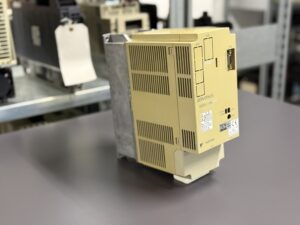
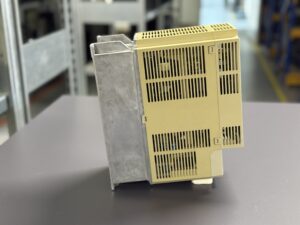
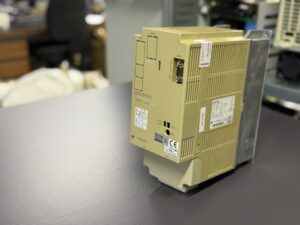
The submitted servo controller from Yaskawa Electric, model SGDB-15VD Servopack, showed sporadic alarm A.10 according to the customer. At the same time, it was reported that the connected motor merely hummed when the axis was enabled, but did not start properly. The fault occurred irregularly, frequently during power-up or immediately after the Servo ON signal.
A humming motor usually indicates that the power stage is being driven, but no stable current control or proper feedback is present. In combination with alarm A.10, which according to the manufacturer documentation indicates an overcurrent condition, this behavior is technically plausible. The drive detects a current rise outside the permissible range and blocks the power stage.
Technically noteworthy was that the fault was not permanently reproducible. This often points to thermally or age-related unstable assemblies within the current control circuit.
Incoming Inspection and Initial Diagnosis
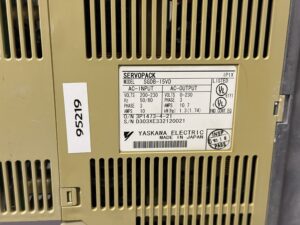
After receipt, a visual inspection was carried out. The device showed no mechanical damage. The nameplate confirmed:
Model: SGDB-15VD
Input: 200–230 V AC, 3 phases
Output: 0–230 V AC, 3 phases
Rated current: approx. 10 A
On the test bench, the Servopack was operated with a compatible motor. Alarm A.10 could be reproduced. When activating the Servo ON signal, the motor began to hum audibly without building torque. Shortly afterwards, the alarm appeared.
Measurements in the DC link showed stable supply voltage. The encoder feedback signals were correct. This allowed the peripheral components to be excluded as the cause.
The initial narrowing down indicated the internal current measurement circuit or the gate control of the power stage.
Technical Analysis
Alarm A.10 corresponds to an overcurrent message according to the manufacturer documentation. In the service description of this series, this alarm is associated with exceeding the permissible output current.
A humming motor without rotation typically occurs when one phase is incorrectly driven or current control operates unstably. During analysis of the current feedback, a drifting signal was detected in the current measurement path. The measured values fluctuated even without load.
The cause was aged signal conditioning in the current feedback section. Due to years of thermal stress, characteristic values had shifted. As a result, the controller interpreted even moderate inrush currents as an overcurrent condition.
Typical for devices of this series are age-related changes in the DC link and in the gate drive circuitry. These can cause sporadic fault messages, especially during power-up.
Repair Measures and Refurbishment
As part of the repair, the following work was carried out:
- Renewal of critical components in the current feedback and driver section
- Refurbishment of the DC link
- Replacement of thermally stressed components
- Cleaning of the PCB and heat sinks
- Renewal of the thermal interface
- Re-soldering of highly stressed power connections
The goal was the complete restoration of stability in the current control circuit. Additionally, preventive measures were implemented to minimize future drift and thermal stress.
Final Functional Test
The Servopack was then tested on the test bench under the following conditions:
- Multiple power cycles
- No-load operation
- Load operation with simulated inertia
- Rapid acceleration and deceleration
- Continuous operation under thermal load
Alarm A.10 no longer occurred. The motor started smoothly without humming or vibration. Current consumption remained within specification. Power-up and power-down behavior was stable.
Conclusion
The sporadic alarm A.10 was caused by unstable current feedback. Through targeted refurbishment of the power and measurement sections, operational reliability was fully restored.
Professional repair significantly extends the service life of the Servopack and prevents costly machine downtime.
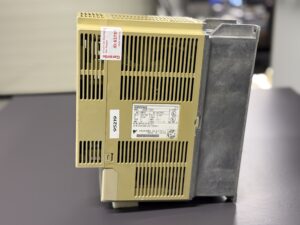
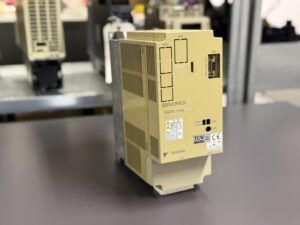
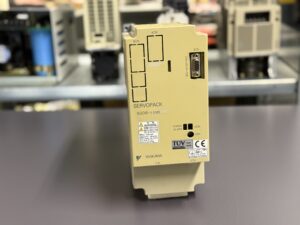
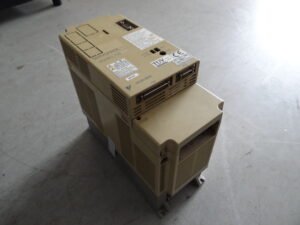
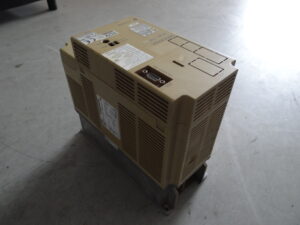
Information about the mentioned Servopack: Yaskawa Servopack SGDB-15VD
Further details on our Yaskawa repairs can be found here: Yaskawa Sigma 1 Repair
📞 Feel free to contact us if you have any questions regarding your Yaskawa drive technology. Our team will be happy to assist you.
Technical Specifications
| Parameter | Value |
|---|
| Manufacturer | Yaskawa Electric |
| Device type | AC Servo Drive |
| Model designation | SGDB-15VD |
| Series | SGDB |
| Power | approx. 1.5 kW |
| Input voltage | 200–230 V AC |
| Output voltage | 0–230 V AC |
| Rated current | approx. 10 A |
| Control type | PWM servo control |
| Feedback | Incremental encoder |
| Cooling | Convection cooling |
| Protection class | IP10 |
| Ambient temperature | 0–55 °C |
| Mounting | Control cabinet |
| Origin | Japan |
| Product status | Discontinued |
Alarm Messages and Troubleshooting
| Alarm Code | Description | Possible Cause | Recommended Action |
|---|
| A.10 | Overcurrent | Unstable current feedback | Check power stage |
| A.20 | Fuse triggered | Short circuit | Check load |
| A.30 | Regeneration fault | DC link problem | Check resistor |
| A.40 | Overvoltage | Supply voltage too high | Check mains |
| A.51 | Overspeed | Encoder fault | Check feedback |
| A.70 | Overload | Mechanical blockage | Reduce load |
| A.81 | Encoder error | Signal interruption | Check cable |
| A.83 | Battery warning | Encoder battery empty | Replace battery |
| A.C1 | Phase detection | Phase failure | Check mains |
| CPF00 | Operator error | Communication issue | Check operator panel |