27.04.2026 by Viktor Siebert
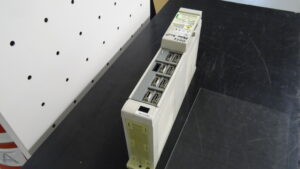
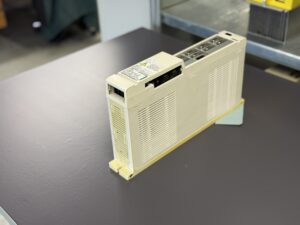
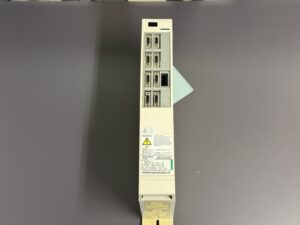
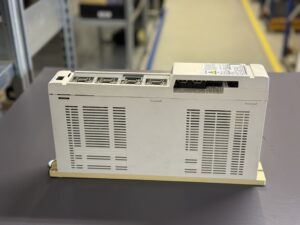
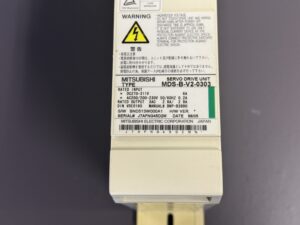
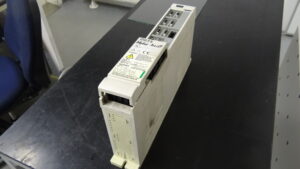
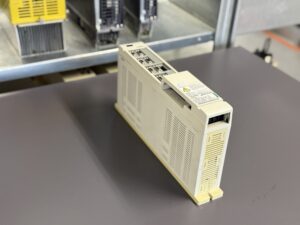
Mitsubishi MDS-B-V2-0303 Servo Drive Unit with Alarm 32 in warm condition
Repair story.
The customer sent us a Mitsubishi servo drive type MDS-B-V2-0303 with a typical but difficult fault description: Alarm 32, but not immediately, only after about 30 to 40 minutes of machining time. After cooling down, the machine would run again until the fault appeared once more.
We were able to confirm this behavior in the workshop. The unit initially ran cleanly, but as operating time increased, the temperature rose significantly. The heatsink in particular stood out. Despite a working fan, it reached around 80°C. That is clearly too high for this assembly. At the same time, the motor also became unusually warm.
Alarm 32 on these units indicates a fault in the power module, usually related to overcurrent or a faulty output stage.
That made the direction clear. The problem was not external, but inside the drive itself.
Troubleshooting from practice
The customer had already checked typical things. Wiring, peripherals and basic conditions were fine. The fan was also running, so it was not a classic cooling issue.
The key point was the behavior in warm condition. When cold, the unit ran stable. As the temperature increased, the behavior became more noticeable. The fault only appeared under load and heat.
This is a classic sign of components that still function electrically, but are already at their thermal limit.
What we found inside the unit
After opening and analyzing the power section, it quickly became clear that this was not a single defect.
The power stage showed several critical issues. Some components had clear signs of aging, others were already heavily thermally stressed. The control of the power modules was also no longer stable.
This combination causes system losses to increase. The unit gets hotter and hotter, control becomes unstable and eventually the protection reacts. In this case, Alarm 32.
This also explains why the motor heated up. If the output stage is no longer working cleanly, the motor does not receive stable power.
Repair
In such a case, replacing a single component is not enough. That might work temporarily, but the next failure would already be waiting.
That is why we completely overhauled the unit.
The power stage was fully checked and critical components were replaced. The driver stage, meaning the actual control of the power modules, was also revised. Additionally, the unit was thoroughly cleaned to improve heat dissipation. All thermally stressed components were specifically renewed.
In short: not patched, but properly repaired.
Testing in warm condition
After the repair came the crucial part: testing.
The unit was operated under load for an extended period. We specifically monitored the temperature curve, ran different operating states and checked start and stop behavior.
The most important point was the warm condition. That was exactly where the fault originally occurred.
The result was clear. The temperature remained within normal range, running behavior was clean and no alarm returned.
That confirmed the root cause was eliminated.
Conclusion from the workshop
This case clearly shows why thermal faults are often difficult. Everything works normally when cold. Only under load does the real problem appear.
Typical for such failures are aged power electronics, increasing power losses and unstable control in warm condition.
Replacing individual components alone would not have been enough. Only the complete overhaul solved the problem sustainably.
In practice, this means: If a fault occurs only after longer runtime, always consider temperature and power electronics and not just wiring or peripherals.
More details about our Mitsubishi repair services can be found here:
Mitsubishi drive Repair by Industrypart
📞 Feel free to contact us with any questions about your Mitsubishi drive technology.
Our expert team is happy to help!
Technical Data
| Parameter | Value |
|---|
| Manufacturer | Mitsubishi Electric |
| Device type | Servo Drive Unit |
| Model | MDS-B-V2-0303 |
| Series | MDS B |
| Input voltage | DC 270 to 311 V / AC 200 to 230 V |
| Frequency | 50/60 Hz |
| Current | approx. 6 A |
| Output | 3AC, approx. 2.9 A |
| Cooling | forced cooling with fan |
| Feedback | encoder, incremental / serial |
| Year | approx. 1996 |
| Origin | Japan |
| Product status | discontinued / legacy |
Key Repair Steps
| Area | Measure | Why important |
|---|
| Power stage | critical components replaced | prevents thermal failure |
| Driver stage | control revised | stable signal for power modules |
| Heatsink | cleaned and checked | improves heat dissipation |
| Electronics overall | preventive overhaul | avoids follow up failures |
| Unit interior | fully cleaned | reduces temperature and leakage |
Typical Cause
In this case, the fault is very likely a thermal defect in the power stage.
Typical triggers are aged power semiconductors, a drifting driver stage, increasing power losses, long term thermal stress and uneven phase control.
This leads to stable operation in cold condition, but instability in warm condition until shutdown occurs.
Alarm Assignment
| Code | Description | Cause | Solution |
|---|
| 32 | Power Module Error / Overcurrent | power module overloaded or defective | check power stage, replace components |
| 30 | Over regeneration | braking resistor overloaded | reduce load or check resistor |
| 31 | Overspeed | speed too high | check control |
| 3A | Overcurrent | excessive motor current | check load or output stage |
| 3B | Power module overheat | overheating | check cooling |
| 46 | Motor overheat | motor thermally overloaded | reduce load |
| 23 | Excessive speed error | control deviation too high | check feedback |
| 2F | Communication error Encoder | feedback signal issue | check cable / encoder |
| 24 | Grounding error | ground fault | check insulation |
| 50 | Overload | continuous overload | check machine / parameters |
Components
The Mitsubishi MDS B V2 0303 is a typical servo drive with a clearly structured internal layout. The main assemblies can be divided into control and power sections.
Overview of main assemblies
| Assembly | Designation | Function | Inspection notes |
|---|
| Control board | RK111B 12 or BN634A815G51 D | Drive control, signal processing, closed loop regulation | Check for thermal stress, cold solder joints and stable signal behavior |
| Power board | RK155 V2 0303 BN634A810G51A B | Power stage for motor drive | Critical under thermal load, check components for heat damage |
| Heatsink with fan | integrated | Dissipation of heat from power components | Check for contamination and proper airflow |
| Power modules | integrated on power board | Convert control signals into motor power | Typical failure point for Alarm 32 |
| Driver stage | part of power board | Controls switching of power semiconductors | Instability leads to thermal issues |
| Power supply section | internal | Supplies control and power electronics | Check voltage levels and ripple |
Testing Notes from Practice
The unit should not be tested only in cold condition. Especially with this fault pattern, a longer run under load is important. At least 30 to 60 minutes of runtime is useful while heatsink temperature, current consumption and motor behavior are monitored.
Start and stop should be checked several times. If available, a thermal camera also helps to identify thermally abnormal areas more quickly.
Typical Fault Characteristics
Typical is that the fault occurs with a delay. After cooling down, the unit works again. The temperature rises despite a working fan, the motor also heats up and the shutdown occurs under load, either sporadically or reproducibly.
Safety note
Before opening or disconnecting connectors, always isolate from power, secure against reconnection, wait for discharge time and verify absence of voltage. Measurements on live parts only by qualified personnel.