03.01.2026 by Viktor Siebert
Repair of a YASNAC POWER SUPPLY CPS-18FB a intermittent start-up failure after cold power-off
Initial Situation and Customer Complaint,
The YASNAC CPS-18FB power supply was sent to our workshop with an unusual and at first glance difficult to interpret fault description. The customer reported that the CNC system showed no reaction when switched on. Only after approximately one hour of being powered did the machine suddenly start and then operate without any further issues. Once the system had been shut down completely and left without power, for example overnight, the same behavior occurred again at the next start-up.
Such symptoms are often underestimated in practice. Because the unit eventually starts and then runs reliably, the problem is frequently attributed to external influences or ignored until the failure becomes permanent. In reality, this type of behavior is a clear indicator of age-related electronic drift inside the power supply.
Incoming Inspection and First Tests
Upon arrival at our facility, the CPS-18FB was subjected to a standard incoming inspection. The housing showed no signs of mechanical damage. There were no obvious burn marks, no blown fuses, and no visible defects that would immediately explain a total start-up failure.
When mains voltage was applied under controlled conditions, the power supply behaved exactly as described by the customer. There were no output voltages present, no activity on the backplane, and no response from the connected CNC control. At this stage, short functional tests and quick measurements did not reveal any clear fault. The unit appeared electrically inactive, yet not shorted or damaged in a catastrophic way.
Reproducing the Fault Under Controlled Conditions
Because sporadic and time-dependent faults are among the most challenging cases in industrial electronics repair, the CPS-18FB was connected to our dedicated test equipment for CNC power supplies. These test setups allow us to simulate realistic operating conditions, including controlled cold starts, defined load scenarios, and long-term operation.
After approximately one hour of continuous power being applied, the power supply suddenly started up. The +5 V and +24 V output rails came up cleanly and remained stable. From that point on, the unit behaved completely normally. The CNC control initialized correctly, and the system could be operated without any interruptions.
To verify reproducibility, the power supply was switched off completely and left without voltage for an extended period. After cooling down to ambient temperature, the test was repeated. The same delayed start-up behavior occurred again, confirming that the fault was both reproducible and temperature dependent.
Detailed Analysis and Root Cause Identification
With the fault reliably reproduced, a deeper analysis was carried out. Special attention was paid to the feedback and reference circuits responsible for monitoring the output voltages and enabling the power supply during the start-up sequence.
The investigation revealed that several components within these circuits had drifted out of their original tolerance range due to aging. While they were not completely defective, their electrical characteristics had changed enough to affect the timing and thresholds of the internal control logic. As a result, the power supply did not reach the required enable conditions immediately after power-on.
Only after prolonged thermal stabilization did the affected components reach values that allowed the internal reference voltages to rise above the enable threshold. Until this point, the power supply remained locked in a non-operational state, even though no classic fault such as a short circuit or overload was present.
Repair Process and Preventive Measures
Once the root cause had been clearly identified, the affected sections of the power supply were repaired. Components responsible for voltage reference stability and feedback accuracy were replaced with new, carefully selected parts.
Based on our long-term experience with similar YASNAC power supplies, we decided to go one step further. Additional components known to be critical in aging systems were replaced as a preventive measure. This approach significantly reduces the risk of similar drift-related issues occurring again in the near future.
After the repair, the CPS-18FB was thoroughly cleaned and reassembled. All connections were checked, and the unit was prepared for extended testing.
Testing on Dedicated CNC Power Supply Test Equipment
Following the repair, the power supply underwent an extensive testing procedure using our in-house test facilities. Multiple cold-start cycles were performed to ensure immediate start-up under all conditions. The unit was also operated under continuous load for extended periods to verify long-term stability.
Throughout these tests, the output voltages remained within specification. The power supply started instantly after power was applied, regardless of previous downtime or ambient temperature. No irregularities were observed during load changes or prolonged operation.
Result and Customer Benefit
After completion of all tests, the YASNAC CPS-18FB was cleared for return to the customer. The repaired unit now starts immediately, provides stable +5 V and +24 V supplies, and allows the CNC control system to initialize reliably every time.
This repair case clearly demonstrates that delayed start-up behavior is not a random phenomenon. It is often a warning sign of aging electronics that can be addressed successfully with the right diagnostic approach, proper test equipment, and a preventive repair strategy.
Conclusion
The YASNAC CPS-18FB is a robust power supply designed for long service life in industrial CNC systems. However, like all electronic equipment, it is subject to aging effects. Time-dependent start-up failures are a typical symptom of component drift and should not be ignored.
Professional repair combined with preventive component replacement and realistic testing restores full functionality and extends the operational life of the CNC system. This approach helps avoid unplanned downtime and preserves valuable machine installations that would otherwise be at risk.
If you want, I can next prepare a matching technical data section, alarm overview, or additional blog elements exactly aligned with your standard structure.
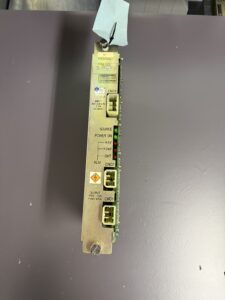
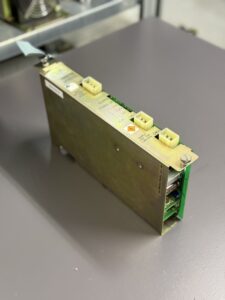

Information about the mentioned power sipply: Supply: YASNAC POWER SUPPLY CPS-18FB
For more details about our Yaskawa repair services, visit: Yaskawa Repairs
📞 Feel free to contact us if you have any questions about your Yaskawa drive technology!
Technical Information
English Version
Technical Specifications
Manufacturer: Yaskawa / YASNAC
Model: CPS-18FB
Device type: Switching power supply for CNC control systems
Input voltage: 200–230 V AC
Input frequency: 50 / 60 Hz
Input current: approx. 2.9 A
Output voltages: +5 V DC, +24 V DC
Output currents: +5 V DC 1.5 A, +24 V DC 4.5 A
Mounting: Rack module, backplane powered
Weight: approx. 1.5–2.0 kg
Typical controls: YASNAC J50, J300
Application and Function within the CNC System
The CPS-18FB is a central power supply unit for older YASNAC CNC controls. It supplies control boards, I/O modules and logic electronics via the rack backplane. Stable voltage build-up is mandatory for the CNC to start. Even small deviations prevent system release.
Function Description
The CPS-18FB converts mains voltage into regulated +5 V and +24 V DC. Internal monitoring compares these values with reference thresholds. Only when all limits are met the outputs are enabled. Aging effects in the feedback circuit directly affect this process.
Alarms and Troubleshooting Related to the CNC Control
Power Supply Error: CNC does not start due to missing stable voltages
Control Voltage Abnormal: Voltage drift during power-on sequence
Initial Power On Failure: No control initialization
Intermittent Power Loss: Temperature-dependent instability