26.01.2026 by Viktor Siebert
Repair of a Yaskawa SGMP-04A2HA11 AC Servo Motor from a Haas HA5C Rotary Table
Initial situation at the customer site.
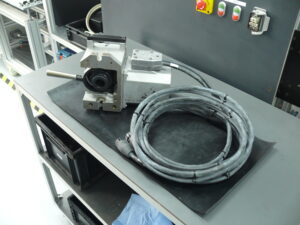
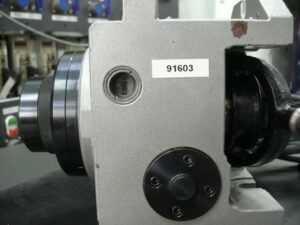
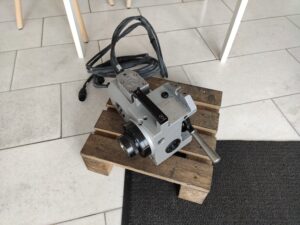
The Haas HA5C rotary table was delivered fully assembled by the customer. The installed Yaskawa AC servo motor SGMP-04A2HA11 was still mounted and mechanically connected. According to the fault description, repeated encoder alarms occurred on the servo drive SGDH-04AE-OY. The reported fault code was A.84, a typical encoder-related alarm from the Sigma-II series.
The customer explained that the error initially appeared sporadically. Over time, however, the frequency increased. The machine could sometimes still be started but stopped unpredictably during operation. As is often the case, troubleshooting did not begin with the motor itself but with the peripheral components. First, the servo drive was replaced, followed by the encoder and motor cables. Despite these measures, the fault persisted.
For a long time, the motor itself was not suspected as the root cause. From the outside, it appeared to be in good condition. There were no visible damages, no obvious oil traces, and no corrosion on connectors or housing. Only after all other options had been exhausted did the customer decide to send in the complete rotary table including the motor.
Motor removal and initial inspection
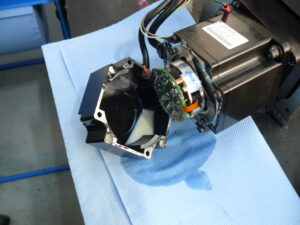
After removing the motor from the Haas HA5C, a completely different picture emerged as soon as the encoder cover was opened. When the encoder cap was removed, a significant amount of liquid flowed out of the encoder chamber. In total, around 100 milliliters of a mixture consisting of emulsion, oil, and fine contamination were collected.
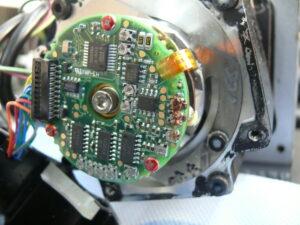
This mixture had accumulated in the encoder area over a long period of time. It was not a sudden failure but a gradual process. The encoder electronics were fully contaminated. Circuit boards, connector pins, and sensor areas were visibly soaked. In retrospect, it is almost surprising that the motor was still operational at all.
The cause became clear very quickly. The shaft seal of the motor had lost its sealing function. Through this leakage, coolant from the machining environment was able to slowly penetrate into the motor interior. From the outside, this damage was not visible.
Damage pattern at the encoder
The motor was equipped with an encoder of type UTOPH-20AWF. This encoder provides high-resolution feedback and is designed for precise positioning tasks, which are essential for applications such as the Haas HA5C. Due to the ingress of liquid, however, unstable feedback signals occurred.
The observed symptoms matched exactly the reported alarm A.84 on the SGDH servo drive. Sporadic communication errors, signal interruptions, and inconsistent position data caused the servo amplifier to stop operation for safety reasons.
This is a well-known pattern in practical field service. Encoder faults are often not purely electronic defects but the result of environmental influences. Coolants, emulsions, and fine debris represent one of the greatest risks for encoders, especially when seals age or are exposed to mechanical stress.
Repair process according to industrypart standards
The encoder was completely replaced. Repairing the existing encoder would not have been a sustainable solution due to the extensive moisture contamination. At the same time, the entire motor was overhauled according to our preventive repair standard.
All ball bearings were replaced, as it could not be ruled out that they had already been exposed to liquid as well. All seals were renewed, with particular attention to the shaft-side sealing elements to reliably prevent future ingress.
The motor housing was thoroughly cleaned, degreased, and subsequently repainted. This step is not only cosmetic but also serves corrosion protection and long-term value preservation.
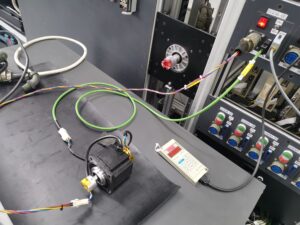
After mechanical reassembly, extensive testing was carried out. The motor was electrically tested, the encoder was adjusted, and the unit was operated on a suitable Yaskawa test bench. Torque behavior, current consumption, temperature characteristics, and feedback signals were monitored over multiple test cycles.
Special characteristics of the Haas HA5C rotary table
The Haas HA5C is a highly precise 5C collet rotary table and at the same time a historically significant product. It was the first product introduced by Haas Automation in 1983 and marked the introduction of the fourth axis into CNC manufacturing.
The rotary table enables precise indexing as well as 4-axis simultaneous machining. It is commonly used for small tools, bar material from 1/8 to 1 inch, as well as drilling and milling operations at various angles. Integration is performed directly via the Haas control, which places high demands on the positioning accuracy of the drive system.
In such applications, a stable and reliable encoder signal is essential. Even minor disturbances in feedback can lead to axis errors, machine stops, or dimensional deviations.
Information about the mentioned Servopack and Servomotor:
More information about our Yaskawa repairs can be found here.
📞 Feel free to contact us if you have any questions regarding your Okuma drive technology. Our experienced team is always ready to provide you with expert advice and support.
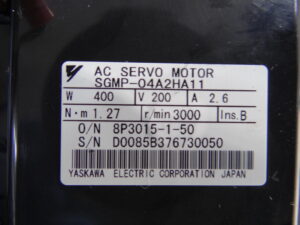
Technical specifications of the Yaskawa SGMP-04A2HA11
| Feature | Value |
|---|
| Motor type | AC servo motor |
| Series | Yaskawa Sigma |
| Model | SGMP-04A2HA11 |
| Rated power | approx. 400 W |
| Rated voltage | 200 V |
| Rated current | approx. 2.6 A |
| Rated torque | approx. 1.27 Nm |
| Rated speed | 3000 rpm |
| Insulation class | B |
| Encoder | UTOPH-20AWF |
| Cooling | Convection |
| Manufacturer | Yaskawa Electric Corporation |
Typical SGDH alarm messages related to encoder problems
| Alarm code | Description | Cause | Corrective action |
|---|
| A.84 | Encoder communication error | Signal interruption or moisture | Check encoder and cable |
| A.81 | Encoder initialization error | Faulty feedback signal | Replace encoder |
| A.82 | Encoder data error | Interference or short circuit | Check cable and encoder |
| A.83 | Encoder power supply error | Unstable supply | Check drive and encoder |
| A.90 | Servo anomaly | Unstable feedback | Repair encoder circuit |
| A.91 | Feedback error | Position deviation | Check mechanics and encoder |
| A.94 | Encoder monitoring error | Implausible position data | Replace encoder |
| A.97 | Internal feedback error | Electronic damage | Replace encoder |
| A.C0 | Feedback communication error | Communication interruption | Check cables and connectors |
| A.C2 | Feedback timeout | Signal loss | Repair encoder circuit |
Preventive measures for operation
This case clearly demonstrates the importance of preventive maintenance for drive components. Seals are subject to aging, especially in environments with coolant and emulsion. From the outside, such damage is often not visible.
Regular visual inspections, insulation measurements, and preventive motor overhauls when required can help avoid unplanned downtime. Especially for high-precision rotary tables like the Haas HA5C, a forward-looking maintenance approach is highly beneficial.
Conclusion
After overhaul, the Yaskawa SGMP-04A2HA11 servo motor once again showed stable and smooth operating behavior. The encoder works reliably, and the SGDH servo amplifier no longer reports any alarms. The Haas HA5C rotary table was fully restored and returned to the customer in operational condition.
This repair case once again highlights that not every encoder alarm originates from the servo drive electronics. In many cases, the root cause lies deeper and is the result of gradual environmental influences. This is exactly where experience and a systematic approach make the decisive difference.