24.09.2026 by Viktor Siebert
Yaskawa SGMEV-08DDA6C: Intermittent encoder failure stops a machine in tandem operation
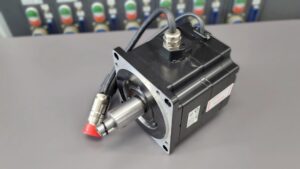
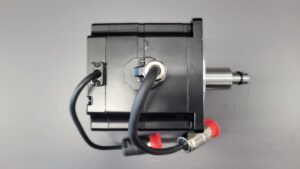
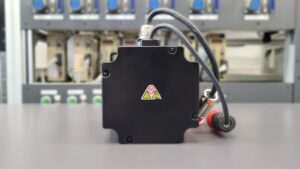
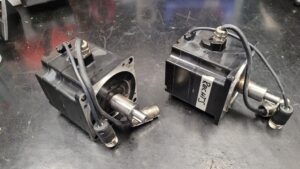
The machine stopped during machining. To the customer, it appeared as though one of the two servo motors was becoming overloaded. At the same time, he already suspected an encoder fault. The machine uses two Yaskawa SGMEV-08DDA6C AC servo motors operating in tandem between centres. Suspicion focused on the left-hand motor. To include the second drive in the investigation, industrypart received both motors for testing, marked left and right.
This repair case shows why the cause of a machine stoppage cannot be determined from the observed behaviour alone. An apparent overload, disrupted position feedback and mechanical resistance can look similar to the operator. For the repair, however, identifying the actual fault is essential.
Two motors working together in one application
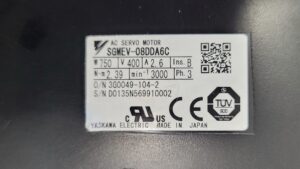
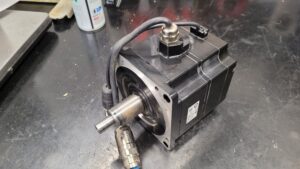
The SGMEV-08DDA6C is a Yaskawa AC servo motor. The nameplate on the motor in this case specifies 750 W, 400 V, 2.6 A and a rated speed of 3,000 rpm. The rated torque is 2.39 Nm. In the customer’s machine, the motors operate with Yaskawa SGDV-3R5D11A SERVOPACKs.
According to the customer, both motors run in tandem between centres. Troubleshooting therefore concerns an application in which two drives work together. A problem with one motor can interrupt the shared machining process. Sending in both motors was therefore sensible, even though only the left-hand motor was initially suspected. However, the term tandem operation alone does not establish the machine’s specific control architecture or parameter settings.
Diagnosis: One encoder was cutting out
A fault was confirmed in one of the motors: the encoder was cutting out intermittently. The installed encoder was a Yaskawa UTTIH-B20DG. This finding provided the basis for replacing the faulty encoder.
The encoder supplies feedback on the rotor position. The servo drive needs this information to control the motor. When the feedback drops out intermittently, the drive loses essential information. Such a fault can interrupt operation even if the motor initially appears mechanically unremarkable.
The customer described the behaviour as a kind of overload. However, no specific alarm code was supplied for this case. We therefore do not retrospectively attribute the machine stoppage to A.710, A.720 or a particular encoder alarm. The available SGDV alarm list distinguishes between overload alarms and encoder communication faults. The alarm that actually appeared would need to be established from the alarm history or a documented display reading.
The cause of the encoder’s internal damage also remains undetermined. Moisture, a cable problem or a temperature-dependent electronics fault must not be presented as the cause of this case without supporting findings. What is confirmed here is the intermittent encoder failure that was identified.
New encoder programmed and adjusted to match the motor
We replaced the defective UTTIH-B20DG with a new encoder. The new encoder was then programmed and adjusted precisely for the motor.
This is an essential part of the repair. Mechanical installation alone does not fully describe the replacement process. The feedback must match the motor and be correctly aligned. Both programming and adjustment were therefore carried out in this case. The specific settings remain motor-dependent and are not a general guide for other versions.
The machine manufacturer’s requirements must also be followed when recommissioning the motor in the machine. Adjusting the encoder for the specific motor does not automatically replace any required homing procedure or alignment of machine-side position references.
Complete motor overhaul
In addition to replacing the defective encoder, the affected motor was completely dismantled. We cleaned the components, renewed the bearings and seals, and repainted the motor. The work therefore also included a mechanical overhaul.
Bearings and seals perform different functions. The bearings support the rotor and allow it to rotate. The seals protect the intended interfaces against the ingress of contaminants. Their condition matters in a motor used in an industrial environment. Replacement of these components is documented in this case. However, this does not establish that bearing or seal damage caused the original machine stoppage.
The built-in brake was also serviced. It is an OGURA-CLUTCH MCNB37Y-05 rated for 24 V DC. It was cleaned and adjusted. Brake replacement was not part of the repair described here. This distinction is important: the encoder, bearings and seals were renewed; the existing brake was retained.
Load testing on the Yaskawa test bench
Following the overhaul, the motor underwent a final test under load. industrypart has a test system equipped with a Yaskawa SGDV SERVOPACK for this purpose. This allows the motor to operate together with suitable drive electronics.
Load testing complements the work on the dismantled motor with an operational check. In a case involving an encoder that previously cut out intermittently, the interaction between the motor, feedback and SERVOPACK is particularly relevant. The supplied video records part of the test setup. Its length does not establish the total test duration.
Specific load values, a complete measurement trace and the duration of the test programme are not available for this report. We therefore do not provide invented test values. Nor do we claim that a combined tandem test was carried out with the customer’s complete control system. What is confirmed is the final load test of the overhauled motor.
Recommendations for continued operation
If further machine stoppages occur, the complete alarm display, affected axis and operating conditions should be recorded. It is particularly useful to know whether the fault occurs during acceleration, during machining or only after an extended period of operation. This information makes it easier to distinguish between feedback faults, mechanical problems and an actual overload.
External cables, connectors and sealing points also deserve attention. Damaged cables or contamination at connections can complicate troubleshooting. Testing and repair work must follow the documentation for the specific motor and SERVOPACK, as well as the machine manufacturer’s instructions. Where two motors work together, their correct assignment to the respective machine axes must also be maintained.
The decisive finding in this case was the intermittent encoder failure. The repair combined encoder replacement and adjustment for the specific motor with a complete mechanical overhaul, servicing of the existing brake and a final load test.
Price, lead time and further information
Pricing and turnaround time for repairing a Yaskawa SGMEV-08DDA6C .
Further information about our Yaskawa Sigma-V servo motor repairs is available here:
https://www.industrypart.com/yaskawa-sigma-v
Our manufacturer section for Yaskawa drive technology:
https://www.industrypart.com/manufacturers/yaskawa
Please contact us if you have questions about your Yaskawa motors or a specific fault.
Technical section: Yaskawa SGMEV-08DDA6C
| Feature | Documented information |
|---|
| Manufacturer | Yaskawa Electric |
| Model | SGMEV-08DDA6C |
| Device type | AC servo motor |
| Rated power | 750 W |
| Voltage stated on the nameplate | 400 V |
| Rated current | 2.6 A |
| Rated torque | 2.39 Nm |
| Rated speed | 3,000 rpm |
| Phases | 3 |
| Insulation class | B |
| O/N stated on the nameplate | 3G0049-104-2 |
| Encoder according to the repair information | Yaskawa UTTIH-B20DG |
| Brake | OGURA-CLUTCH MCNB37Y-05, 24 V DC |
| SERVOPACK in the customer’s machine | SGDV-3R5D11A, according to the customer |
| Application in this case | Two motors operating in tandem between centres |
| Weight, dimensions, ingress protection rating, year of manufacture | Not clearly documented in the available material |
| Manual reference | Supplied extract “Alarm Liste – Deutsch-14.pdf”, section 10.1.1 |
The voltage stated on the motor nameplate does not mean that the motor should be connected directly to the mains. It operates with the designated servo drive. This case does not establish general interchangeability between different SGDV variants.
Functions and components
| Component | Function | Work carried out in this case |
|---|
| Stator and rotor | Convert electrical energy into mechanical torque | Motor completely dismantled and cleaned; no winding replacement specified |
| UTTIH-B20DG encoder | Position feedback to the servo drive | Replaced with a new encoder, programmed and adjusted for the motor |
| MCNB37Y-05 brake | Braking function within the motor | Existing brake cleaned and adjusted |
| Bearings | Support the rotor | Replaced |
| Seals | Seal the designated interfaces | Replaced |
| Housing | Mechanical protection | Cleaned and repainted |
| SGDV SERVOPACK | Supplies and controls the motor | Part of the test setup; no repair work on the SERVOPACK described |
Alarm messages and troubleshooting
The following messages come from the supplied SGDV manual extract, printed pages 10-3 to 10-5. They provide technical guidance and are not a list of alarms that occurred in this case. The suggested checks are general technical guidance, rather than a complete reproduction of the manufacturer’s repair instructions. Alarm names below are English translations of the supplied German extract.
| Code | Alarm name, translated from the manual | Meaning, paraphrased | General checks |
|---|
| A.710 | Overload: High load | Torque substantially above the rated value for a short period | Check the load, mechanics, brake release and operating profile |
| A.720 | Overload: Low load | Torque continuously above the rated value | Investigate continuous loading and mechanical resistance |
| A.810 | Encoder backup error | Encoder power supplies lost; position data lost | Check the power supply and backup system, where applicable; restore according to the manual |
| A.820 | Encoder checksum error | Incorrect encoder memory checksums | Have the encoder and stored data examined by a specialist |
| A.830 | Absolute encoder battery error | Battery voltage below the threshold after power-on | Check the battery and its connection according to the configuration |
| A.840 | Encoder data error | Incorrect data in the encoder | Check encoder diagnostics and correct matching |
| A.850 | Encoder overspeed | Encoder rotating at high speed when power was switched on | Check the movement conditions at power-on |
| A.860 | Encoder overheating | Encoder internal temperature too high | Check temperature conditions and heat sources |
| A.C90 | Encoder communication error | Communication between SERVOPACK and encoder not possible | Check the cable, connectors, power supply and encoder |
| A.C91 | Encoder communication position data error | Error when calculating encoder position data | Investigate feedback and the transmission path |
| A.C92 | Encoder communication timer error | Error in the communication timer between encoder and SERVOPACK | Check the communication path and the components involved |
| A.CA0 | Encoder parameter error | Incorrect encoder parameters | Check motor-specific data and matching |
| A.Cb0 | Encoder feedback error | Incorrect content in encoder communication | Check the encoder, communication and possible interference |
An encoder alarm alone does not prove that the encoder is defective. The transmission path and power supply also form part of troubleshooting. In this repair case, intermittent encoder failure was explicitly confirmed as a separate diagnostic finding.