28.12.2025 by Viktor Siebert
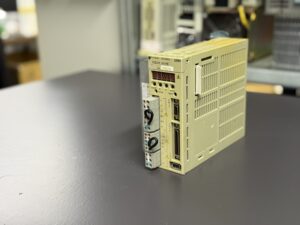
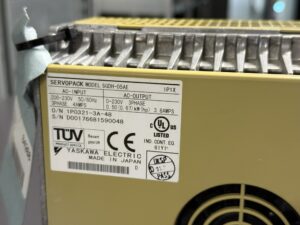
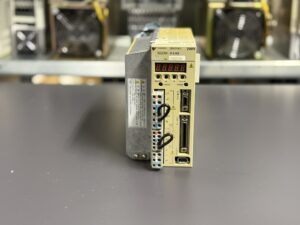
Repair of a Yaskawa SGDH-05AE Servopack with intermittent Alarm 10
Intermittent Alarm A.10 Without Reproducible Fault on External Test Benches
This Yaskawa SGDH-05AE servopack was received from the customer with the report that the axis stopped sporadically with alarm A.10. The issue was particularly critical because the fault did not occur consistently, but only under real machine operating conditions.
The unit had already been examined by two different repair workshops. On both external test benches, the servopack operated for several hours without any fault. No overcurrent, no overheating, and no alarm could be reproduced. As a result, the device was returned to the customer as “no fault found”.
In the actual machine environment, however, the drive continued to trigger intermittent A.10 alarms, causing unexpected machine downtime.
Why Alarm A.10 Is Often Not Immediately Detectable
Based on our experience with several hundred SGDH repairs, alarm A.10 is very often not caused by a hard short circuit, but by a combination of age-related and load-related effects, such as:
- Aging power components
- Thermally stressed IGBT stages
- Drifting current measurement circuits
- Marginal heat dissipation
- High dynamic braking stress
These conditions frequently remain below the detection threshold of basic functional tests. They typically appear only under load, during temperature rise, or during rapid acceleration and braking cycles.
Repair Approach
After incoming inspection, the servopack was completely disassembled and professionally cleaned. A detailed inspection of the power-related assemblies followed.
Because this failure pattern is well known to us, no selective component replacement was performed. Instead, a standardized preventive overhaul specific to the SGDH series was applied.
This overhaul includes:
- Replacement of thermally and electrically critical components
- Reconditioning of current sensing and protection circuits
- Inspection and optimization of the cooling path
- Replacement of the cooling fan
- Verification of the dynamic braking circuit
- Rework of mechanically and thermally stressed solder joints
The focus is intentionally not on one visibly defective part, but on the elimination of all known weak points that can lead to alarm A.10 over time.
Testing Under Realistic Conditions
After repair, the servopack was tested not only at idle, but under:
- Varying load conditions
- Extended thermal stress
- Repeated acceleration and braking cycles
Only after stable operation without overcurrent or temperature-related tendencies was the unit approved for return shipment.
Since reinstallation at the customer site, alarm A.10 has not reoccurred.
Conclusion
Alarm A.10 in the Yaskawa SGDH series is a typical aging and stress-related failure mode. It often cannot be detected by short or simplified bench tests.
Only through:
- Extensive series experience
- Preventive replacement of known weak points
- Thermally realistic testing conditions
can the issue be resolved reliably and permanently.
For this reason, we consistently apply standard overhauls instead of minimal repairs for SGDH servopacks.

Further information such as price and delivery time for:
Yaskawa SGDH-05AE Servopack
More details about our Yaskawa repair expertise can be found here: Yaskawa SIGMA II repairs by Industrypart
Similar models we regularly repair:
SGDH-05AE-OY
Device Data
| Item | Value |
|---|
| Series | Sigma II (SGDH) |
| Device type | AC Servo Drive |
| Rated output power | approx. 0.5 kW |
| AC input | 200–230 V AC, 3-phase, 50/60 Hz |
| AC output | 0–230 V AC, 3-phase |
| Output current | approx. 3.8 A |
| Control method | Digital servo control |
| Cooling | Internal cooling fan |
| Display | 7-segment LED |
| Protection class | IP1X |
| Country of origin | Japan |
Correct Alarm Definition A.10 (SGDH Series)
Alarm code: A.10
Alarm name: Overcurrent or Heat Sink Overheated
Alarm reset: Not available (hard alarm)
Meaning according to Yaskawa:
- An overcurrent flowed through the IGBT power stage
- Or the SERVOPACK heat sink temperature exceeded the allowable limit
This alarm may occur during main power ON or while the servomotor is running.
Alarm Overview (Excerpt SGDH Series)
| Alarm | Description | Meaning |
|---|
| A.10 | Overcurrent / Heat Sink Overheated | IGBT overcurrent or heat sink overtemperature |
| A.30 | Regeneration Error | Regenerative transistor or resistor fault |
| A.32 | Regenerative Overload | Regenerative energy exceeds capacity |
| A.40 | Overvoltage | DC bus voltage too high |
| A.41 | Undervoltage | DC bus voltage too low |
| A.71 | Overload High Load | Short-term overload |
| A.72 | Overload Low Load | Continuous overload |
| A.7A | Heat Sink Overheated | Pure temperature alarm |