19.02.2026 by Viktor Siebert
Repair and Complete Overhaul of a Yaskawa SGDV-260D11A with CPF00 Fault
Technical Case Report Based on Sigma-V Alarm Structure.
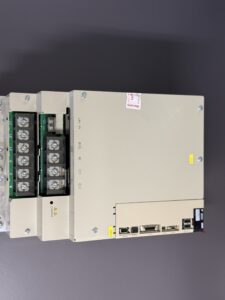
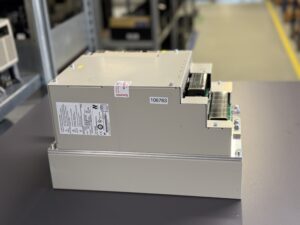
A Yaskawa SGDV-260D11A servo drive from the Sigma-V series was submitted with the customer complaint that the connected motor suddenly stopped rotating and the front display remained completely blank. The drive was operating together with a Yaskawa SGMGH-1ADCA61 AC servo motor in a CNC machining environment.
Upon arrival, the unit powered up electrically and the main circuit charged correctly. However, the integrated 7-segment display showed no indication. When a handheld operator panel was connected, the drive displayed the fault code CPF00.
According to the official Sigma-V alarm documentation, CPF00 indicates:
Transmission error 1 Handheld operator communication fault, typically caused by CPU malfunction or internal communication failure.
This immediately pointed to a defective processor or communication board rather than a power section failure.
Failure Analysis
The CPF00 alarm in Sigma-V drives is typically associated with:
- Internal CPU malfunction
- Communication bus failure
- Logic power supply instability
- Corrupted firmware or parameter memory
- Internal processor board damage
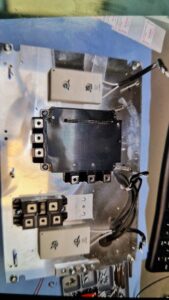
After detailed electrical diagnostics, the communication and processor board was confirmed defective. The power stage, IGBT module, and DC bus section were electrically stable and fully functional.
There were no visible burn marks, but the processor board showed complete loss of communication functionality.
Probable Root Cause
The most likely root cause was a damaged encoder cable.
Possible scenarios include:
- Mechanical crushing of the cable
- Coolant penetration into the cable
- Insulation breakdown causing intermittent short circuits
- Voltage spikes fed back into the logic section
Encoder circuits operate with low-level signal voltages and are highly sensitive to short circuits or electromagnetic disturbances. Even a temporary short circuit or coolant intrusion can permanently damage the communication electronics.
Although rare, this type of failure is technically plausible in coolant-intensive machine tool environments.
Repair Process
1. Complete Disassembly and Inspection
The drive was fully dismantled. All internal modules were separated and visually inspected. Connectors and solder joints were examined carefully.
2. Processor and Communication Board Replacement
A compatible donor unit was used to transplant a fully functional CPU and communication board.
All connectors were cleaned and inspected before reassembly. Strict ESD protection procedures were followed during the entire process.
3. EPROM Reprogramming and Parameter Restoration
After hardware replacement, the EPROM data was reloaded and all device-specific parameters were restored.
This ensured:
- Correct motor configuration
- Proper encoder resolution
- Axis-specific parameters
- Firmware integrity
4. Functional Test Bench Validation
The drive was tested under full load conditions:
- Acceleration and deceleration cycles
- Torque monitoring
- Encoder feedback verification
- Thermal endurance testing
- Continuous operation stability test
After testing, the drive operated fully stable and fault-free.
Preventive Complete Overhaul
Beyond replacing the defective processor board, the unit underwent a full preventive refurbishment to ensure long-term reliability.
The following preventive measures were performed:
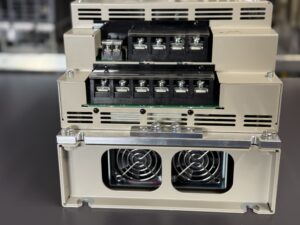
- Replacement of all cooling fans
- Cleaning of all heatsinks and ventilation paths
- Inspection and ESR testing of DC link capacitors
- Inspection of power capacitors for aging
- Re-soldering thermally stressed power areas
- Inspection of IGBT modules
- Connector integrity verification
- Insulation resistance testing
- Thermal stress testing under load
This preventive overhaul significantly reduces the risk of future Sigma-V alarms such as:
- A.100 Overcurrent or heatsink overheating
- A.7A0 Heatsink overtemperature
- A.7AB Cooling fan failure
- A.400 Overvoltage
- A.410 Undervoltage
- A.320 Regenerative overload
- A.C90 Encoder connection fault
By addressing both the root failure and age-related wear components, the drive was restored to a condition comparable to new equipment in terms of reliability and operational safety.
Final Result
The CPF00 fault was caused by a defective processor board, most likely triggered by encoder cable damage.
Through targeted electronic repair and complete preventive refurbishment, the SGDV-260D11A was restored to full operational reliability.
The drive now operates stable, safe, and ready for long-term industrial use. The customer benefits from significantly lower replacement cost while achieving high operational security and machine availability.
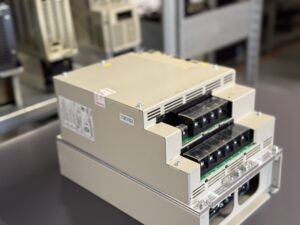
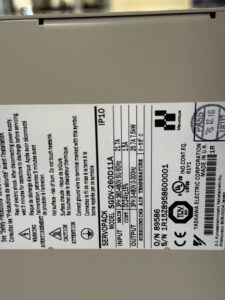
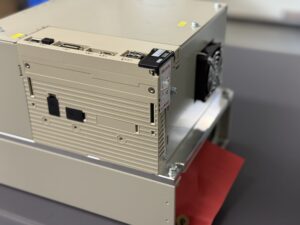
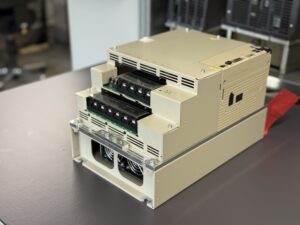
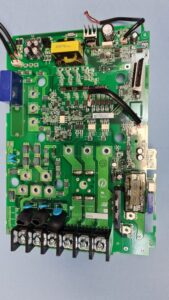
Information about the mentioned Servopack: Yaskawa Servopack SGDV-260D11A
Further details on our Yaskawa repairs can be found here: Yaskawa Sigma V Repair
📞 Feel free to contact us if you have any questions regarding your Yaskawa drive technology. Our team will be happy to assist you.
Technical Specifications
| Parameter | Value |
|---|
| Model | SGDV-260D11A |
| Series | Sigma-V |
| Input | 3PH 380–480 V AC |
| Frequency | 50/60 Hz |
| Rated Current | 21.7 A |
| Output | 3PH 0–480 V |
| Power | approx. 7.5 kW |
| Protection | IP10 |
| Cooling | Forced air |
| Ambient | 0–55 °C |
| Motor | SGMGH-1ADCA61 |
| Feedback | Incremental encoder |
Repair and Complete Refurbishment
Besides replacing the defective CPU board, the entire unit was fully refurbished:
- All cooling fans replaced
- All heatsinks cleaned
- DC link capacitors inspected
- ESR measurement performed
- Power stage solder joints refreshed
- IGBT inspection
- Insulation testing
- Thermal load endurance test
This preventive overhaul reduces the risk of typical Sigma-V alarms such as:
- A.100 Overcurrent
- A.7A0 Heatsink overheat
- A.7AB Fan failure
- A.410 Undervoltage
- A.400 Overvoltage
- A.320 Regenerative overload
All codes according to official Sigma-V alarm documentation Alarm Liste – Deutsch-10.
Typical Sigma-V Alarm Codes
| Alarm | Description | Meaning | Action |
|---|
| A.100 | Overcurrent | IGBT overload | Inspect power stage |
| A.300 | Regeneration error | Brake circuit fault | Check resistor |
| A.320 | Regenerative overload | Excess brake energy | Adjust resistor |
| A.400 | Overvoltage | DC bus high | Check supply |
| A.410 | Undervoltage | DC bus low | Check supply |
| A.510 | Overspeed | Speed exceeded | Check parameters |
| A.710 | Overload high | Short overload | Reduce load |
| A.720 | Overload low | Continuous overload | Inspect mechanics |
| A.7AB | Fan stop | Cooling failure | Replace fan |
| A.810 | Encoder backup error | Position lost | Check encoder |
| A.C90 | Encoder connection error | Communication failure | Check cable |
| CPF00 | Transmission error | CPU communication fault | Check control board |
Source Sigma-V alarm list Alarm Liste – Deutsch-10.
Conclusion
The CPF00 fault was caused by a defective processor board, most likely triggered by a damaged encoder cable.
Through targeted repair and complete preventive refurbishment, the drive was restored to full operational reliability.
The system now operates stable, safe and ready for long term industrial use.