03.03.2026 by Viktor Siebert
Repair of a Yaskawa SGDF-B5CS with thermal shutdown caused by a defective power stage
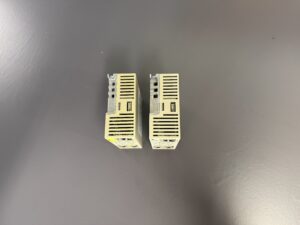
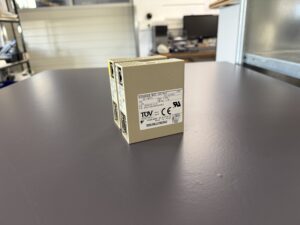
Two Yaskawa servopacks SGDF-B5CS arrived at our workshop almost at the same time. The fault description was strikingly similar. During operation and in some cases also in the real machine, the units suddenly turned off. Not with a clean, reproducible alarm at power on, but only after a certain run time. Exactly these fault patterns are tricky in practice because a short functional test at no load often looks normal and the fault becomes visible only under temperature and load.
We first recorded both units using our standard intake process. External visual inspection, verification of nameplate data, connectors, and housing condition. One key detail of this series was immediately important. These units have no fans. That design can make sense for compact systems because there is no mechanically wearing cooling component. At the same time it shifts the risk. Without a fan there is no active thermal reserve. Everything depends on clean heat transfer through the heatsink and on the ambient air inside the cabinet. If temperature rises there or heat cannot be dissipated properly, the power stage enters a range where internal protection circuits trip.
Next, we reproduced the fault. A SGDF-B5CS can appear stable for several minutes at no load, so we intentionally built a test with a defined load and thermal monitoring. The key was not only electrical function but the temperature rise on the heatsink and near the power components. Both units showed the same pattern. After a warm up phase, temperature increased much faster than expected and shortly after that the unit shut down. The unit turned off completely. Exactly as the customer had described. That made it clear that we were not dealing with a simple communication issue or a sporadic control fault, but with a thermally triggered protective event.
At this point the hypothesis was obvious. Either heat dissipation is mechanically compromised, or power loss in the stage is too high because components no longer switch correctly. A power stage can still operate electrically, but due to aged transistors, weakened drivers, increased switching losses, or partially defective semiconductors, it can generate far more heat than normal. Especially in compact servopacks without fans, this quickly causes a protective shutdown.
We opened the units and performed a detailed inspection. We do not look only for obvious burn marks. Fine indicators matter as well, such as discoloration on certain PCB areas, changes in insulation materials, thermal traces on resistors and solder joints, or micro cracks. In parallel we isolated and tested the power stage. Multiple tests work together here. Short circuit tests, leakage tests, driver plausibility, and, very importantly, a comparison between both units. When two units arrive with almost identical fault patterns, the comparison is extremely valuable.
The result was clear. The power stage was defective. Not as a complete failure, but in a way that under temperature and load it entered a critical operating range. This kind of defect is particularly dangerous in many machines because it is often sporadic at first and then causes a stop at the worst possible moment.
For that reason we deliberately chose not to do a minimal repair and instead performed a preventive overhaul. Why. Because these servopacks may be small, but they do not require less work. In fact it is the opposite. Due to high component density and passive cooling they must be treated like Swiss watches. One weak point can push the whole system into protection. If you only replace one component, you risk the next aged part causing the same chain reaction shortly after.
Our preventive overhaul includes a complete rework of thermally relevant areas. Cleaning heatsink surfaces, checking clamping pressure, replacing or renewing thermal interface materials where it makes sense, and consistent testing of the power components. We also check the supply rails because undervoltage or ripple in the 24 V range can stress the driver stage. After that comes an extended burn in test. Not just a short power on. We apply thermal load, observe the temperature profile, monitor signals, and ensure the shutdown no longer occurs.
Another topic is why such units are repaired at all. The answer is practical. For many machines there are no genuine new units anymore or a modern replacement cannot be integrated without major electrical and mechanical changes. And the so called replacement market, for example on auction platforms, is often a risk for these series. Many offered units are heavily worn, of unclear origin, or simply not what they are claimed to be. In the worst case you exchange one defective unit for another defective unit and lose more time and money.
That is exactly why a proper repair with verification and preventive overhaul is valuable. The customer gains predictable availability, fewer unplanned stops, and a technically traceable solution instead of an unclear swap.
Preventive Measures for the Customer
- Check control cabinet temperature: Passively cooled servopacks react sensitively to high ambient temperature. The goal is a stable, low cabinet temperature.
- Improve airflow inside the cabinet: Provide clearance around the heatsink, avoid heat pockets caused by ducting directly in front of convection surfaces.
- Clean filter mats and heat exchangers: Contamination reduces airflow and raises the base temperature.
- Regularly inspect connectors: Loose contacts create contact resistance and additional heat.
- Keep heatsink surfaces clean: Dust layers act like insulation.
- Review the load profile: Continuous near limit load or frequent hard acceleration increases average losses.
- Take thermal symptoms seriously: If a unit fails only after minutes, it is often an early sign of a thermal defect.
Conclusion
The SGDF-B5CS is small but thermally demanding. If the power stage ages or cabinet heat dissipation is insufficient, the internal protection chain trips and the unit shuts down. A preventive overhaul and a true thermal burn in test are the key so the machine runs reliably again and not only briefly.
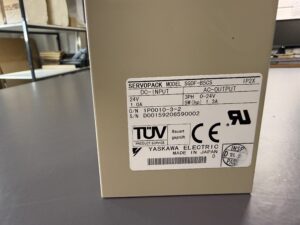
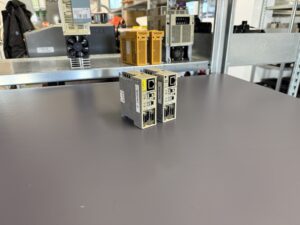
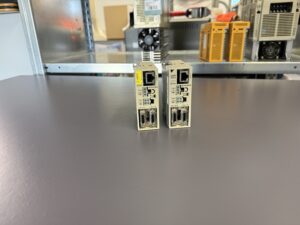
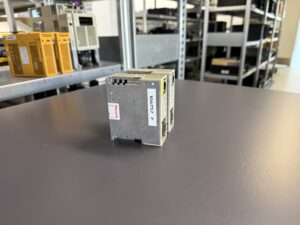
Further information such as price and delivery time for:
Yaskawa Servopack SGDF-B5CS
More details about our Yaskawa repair expertise can be found here: Yaskawa SIGMA II repairs by Industrypart
Similar models we regularly repair:
SGDF-B5CP
SGDF-B3CP
SGDF-B3CS
Technical Specifications
| Field | Value |
|---|
| Type | Servopack Servo Drive |
| Device / Model | Yaskawa SGDF-B5CS |
| Manufacturer | Yaskawa Electric (Made in Japan) |
| Protection rating on device | IP2X (as on nameplate) |
| Supply | DC 24 V, 1.0 A (control supply) |
| Output | 3~ AC, 0 to 24 V, 1.3 A, 5 W (as on nameplate) |
| Cooling | Passive via heatsink, no fans |
| Control / regulation | Servo controller, closed loop control via encoder feedback (typical for servopacks) |
| Weight | approx. 1 to 2 kg (approx., not shown on nameplate) |
| Dimensions | approx. 180 x 160 x 120 mm (approx., estimated from series size) |
| Production year | unknown (not stated, therefore open) |
| Manual reference | Protective functions such as overload and heatsink overtemperature are typically described for Yaskawa servopacks (general). Manual CACR_SR..BB Bulletin wit… |
Operating Environment & Compatible Devices
Typical operating environment
- Control cabinets in machine tools, handling systems, special purpose machines
- Environment with limited convection and often high heat dissipation inside the cabinet
- Especially critical when multiple power components are densely packed or filter mats are clogged
Compatible systems
- Servo motors with encoder feedback from the matching Yaskawa series (exact motor assignment depends on machine builder and parameterization)
- CNC controls and machine controls that provide suitable command interface for this servopack (depending on system analog or digital via machine interface)
- Important: For retrofit or replacement, ensure correct system integration, because wrong parameterization or incompatible encoder signals can lead to protective shutdowns and consequential damage
Functional Description
The Yaskawa SGDF-B5CS is a compact servo controller that, from a 24 V DC control supply, provides a three phase motor drive in the range of 0 to 24 V. Motor dynamics are realized via closed loop control, typically with encoder feedback.
Core tasks
- Drive the servo motor via a three phase power stage
- Process setpoints from the machine control
- Monitor current, temperature, and feedback signals
- Provide protective functions to prevent consequential damage
Protective mechanisms
Servopacks of this class typically include protective functions such as overcurrent, overload, and heatsink overtemperature. In a fault condition, the power stage is blocked, the unit goes into alarm or, depending on the fault pattern, shuts down completely.
Special feature of the SGDF-B5CS
These units operate without fans. This means thermal margin strongly depends on:
- Contact surface and heat transfer to the heatsink
- Airflow inside the control cabinet
- Ambient temperature and contamination
Alarm Messages & Troubleshooting
The following table is based on the available alarm overview on the unit and shows typical error codes, causes, and corrective actions.
| Code | Fault description | Cause | Solution |
|---|
| A.02 | Parameter breakdown | Parameter checksum or memory content faulty | Check parameters, reload if necessary, if recurring check internal memory |
| A.04 | Parameter setting error | Parameter outside allowable range | Correct parameter values, verify plausibility for the application |
| A.10 | Overcurrent | Overcurrent in the power stage | Check motor wiring, check motor for short circuit, check power stage, check mechanics |
| A.31 | Position error pulse overflow | Position error too large, control deviation exceeds limit | Mechanics blocked, check encoder signal, check tuning parameters |
| A.51 | Overspeed | Motor speed above limit | Check commands, check feedback, verify encoder signal quality |
| A.70 | Overload | Continuous load above limit | Mechanics stiff, axis overloaded, check cycle, check cooling |
| A.80 | Encoder error | Encoder feedback signals faulty | Check encoder cable, connector, supply, signal waveform |
| A.b1 | Reference input read error | Reference input not detected | Check command signal, check input circuit, check interface |
| A.C1 | Servo overrun detected | Motor or encoder out of control | Check encoder, check motor wiring, check mechanical coupling |
| A.C2 | Encoder output phase error | Encoder phase relationship A B C faulty | Check cable, shielding, connector, sensor |
| A.C3 | Encoder phase A B disconnection | Wire A or B open | Cable break, connector, crimp points |
| A.C4 | Encoder phase C disconnection | Wire C open | Check cable, connector, sensor |
| CPF00 | Digital Operator transmission error 1 | Operator not communicating | Check operator cable, connector, supply |
| CPF01 | Digital Operator transmission error 2 | Repeated communication errors | Check line quality, noise, connector, operator |
| A.99 | Not an error | Normal state | No action required |
Components
| Assembly | Designation / code | Function | Inspection or repair notes |
|---|
| Power stage | Power transistors / driver stage | Three phase motor drive | Thermal test under load, driver signals, insulation, short circuit test |
| Heatsink | Passive heat sink | Heat dissipation | Check contact surfaces, thermal interface material, screw pressure, contamination |
| Control section | CPU logic, parameter memory | Control, protection, communication | Check voltage rails, reset behavior, parameter integrity |
| Encoder interface | Feedback input | Evaluate encoder signals | Check waveform, levels, shielding, connector, cable breaks |
| 24 V supply | DC input section | Supply for logic | Ripple, undervoltage, connector contact issues |
| Protection circuit | Overtemp, overcurrent, overload | Shutdown at limits | Find root cause instead of repeated resets, observe temperature trend |