29.01.2026 by Viktor Siebert
Repair of a Yaskawa AC Spindle Motor UAASKD-11HHB11 with Encoder UTMSI-10AABAAC
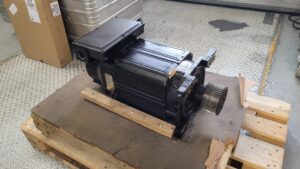
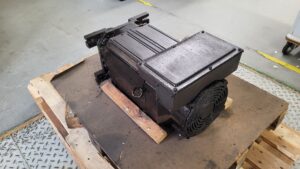
The Yaskawa AC Spindle Motor UAASKD-11HHB11 arrived at our facility in a condition that is rarely seen, even after many years of practical repair experience. The customer described the situation very clearly: during operation, the motor had become so loud that the machine operator could only work for extended periods while wearing hearing protection. At the same time, overload alarms on the spindle drive occurred more and more frequently. At first sporadically, later several times per day.
As is often the case, the motor condition was tolerated for a long period. The machine was heavily utilized, production pressure was high, and the motor continued to run despite clear symptoms of progressive mechanical and electrical damage. An external service provider had already detected insulation problems and increased resistance values. Nevertheless, the overhaul was postponed repeatedly until the alarms could no longer be ignored.
Incoming condition and initial inspection
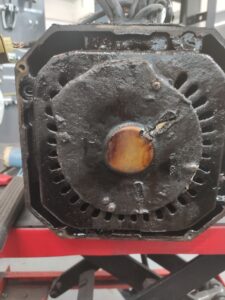
Already during unpacking, it was obvious that this motor had been operated for years under extremely unfavorable conditions. The entire outer surface was covered with a thick layer of oil, grease, dust and abrasion residue. Over time, this layer had hardened into an almost concrete-like mass. All ventilation openings, cooling fins and transitions were completely blocked.
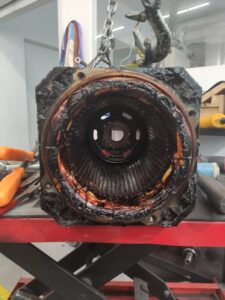
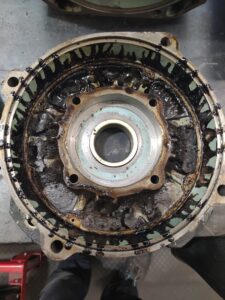
Our technician documented the condition in detail in the incoming inspection checklist. Particularly striking was the fact that a dirt layer of approximately three centimeters had formed throughout the entire interior of the motor. This mass could no longer be removed using standard cleaning methods. In some areas, solid chunks had to be carefully removed with a small chisel in order to access the underlying components.
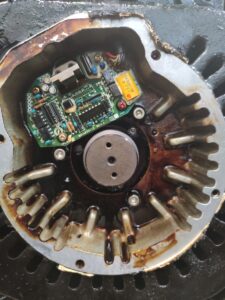
The motor’s cooling channels were completely blocked. Effective heat dissipation had therefore not been possible for a long time. The cooling fan was also fully clogged, contaminated with oil and partially corroded. Under these conditions, thermal overload is unavoidable, regardless of the electrical design of the motor.
Disassembly and mechanical refurbishment
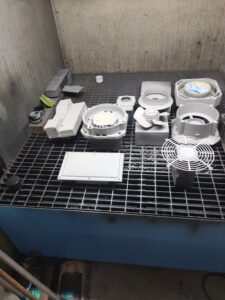
After complete disassembly, all assemblies were treated separately. Rust was removed mechanically and chemically, all components were thoroughly cleaned, washed and then carefully dried over several days under controlled conditions. Particular attention was paid to removing moisture from areas close to the windings and housing to prevent future insulation problems.
Several screws broke during disassembly due to corrosion and the hardened contamination. These screws were drilled out, damaged threads were re-tapped and replaced with new fasteners. The remaining screws were cleaned, inspected and reused where their condition allowed.
The motor bearings showed clear signs of wear and corrosion. Due to the extremely harsh operating environment, all bearings were consistently replaced. The same applied to all seals, which had long since lost their protective function. Preventive replacement is essential for spindle motors, as even minor leakages can lead to severe secondary damage over time.
Cooling fan overhaul as a critical component
The motor fan was treated as a separate unit. After disassembly, complete rust removal, cleaning and washing were carried out. The fan was then dried, re-bearings installed, reassembled and repainted. In spindle motors, the fan is not a secondary component but a safety-critical part of the overall system. Restricted airflow directly leads to thermal overload, insulation aging and premature bearing failure.
Encoder overhaul and electrical restoration
The installed encoder UTMSI-10AABAAC was also heavily contaminated. Oil and fine abrasive particles had penetrated deep into the encoder housing. The encoder was professionally overhauled, cleaned and inspected. Special attention was paid to signal integrity and mechanical coupling, as even the smallest deviations in spindle applications can lead to control instability, speed fluctuations and recurring alarms.
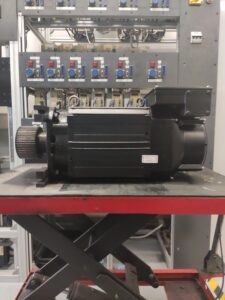
After completing all mechanical work, the motor was completely repainted. This step serves not only aesthetic purposes but also long-term protection against corrosion and renewed contamination.
Testing under realistic operating conditions
The refurbished motor was tested using an original Yaskawa AC Spindle Drive of the type CIMR-VMW20110-XXXD. Testing was not limited to no-load operation but extended up to the maximum permissible speed and performance limits of the motor. During testing, current consumption, running noise, thermal behavior and control stability were continuously monitored.
Particular attention was paid to thermal performance. After previously fully blocked cooling channels, it was essential to verify that the motor could now dissipate heat efficiently again. Temperature development remained stable within the permissible range even under full load. The motor ran smoothly, evenly and without abnormal noise. Overload alarms did not reoccur.
Preventive overhaul as the key to operational reliability
This repair case clearly demonstrates that a spindle motor does not fail abruptly but sends warning signals over a long period of time. Increased noise, rising temperatures, recurring overload alarms and elevated insulation values are clear indicators that intervention is required.
Through consistent preventive overhaul, the motor was not only restored but also secured for long-term operation. Bearings, seals, fan and encoder were deliberately serviced to prevent future failures. In many cases, such an overhaul is more economical and sustainable than waiting for a total failure with consequential damage to the machine and production.
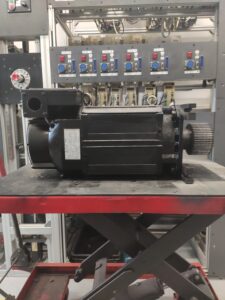
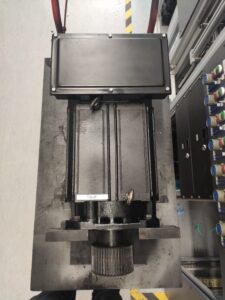
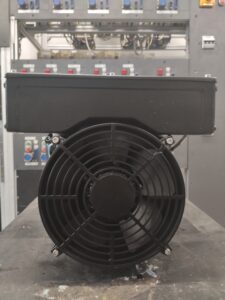
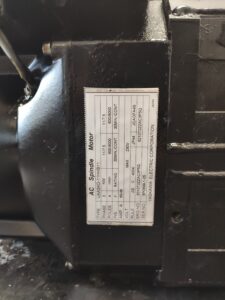
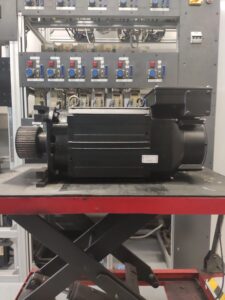
Further information such as price and delivery time for the: Yaskawa AC Spindle Motor UAASKD-11HHB11
mentioned Yaskwa Drive Yaskawa Varispeed CIMR-VMW20110-XXXD AC Spindle Drive
mentioned Yaskawa Encoder UTMSI-10AABAAC
More details about our Yaskawa repair expertise can be found here: Yaskawa Repair at Industrypart
📞 Feel free to contact us if you have any questions regarding your Yaskawa drive technology.
Our team looks forward to your inquiry!
Technical Specifications
Yaskawa AC Spindle Motor UAASKD-11HHB11
| Parameter | Value |
|---|
| Manufacturer | Yaskawa Electric Corporation |
| Motor type | AC Spindle Motor |
| Model designation | UAASKD-11HHB11 |
| Rated power | 11 kW |
| Rated voltage | 230 V AC |
| Phases | 3 |
| Rated current | approx. 65.4 A |
| Speed range | 600 – 8000 rpm |
| Duty cycle | 30 min / Continuous |
| Cooling method | Forced air cooling, external fan |
| Encoder | UTMSI-10AABAAC |
| Insulation class | Class F |
| Protection class | approx. IP54 |
| Mounting type | Flange mount |
| Country of manufacture | Japan |
Operating environment and typical applications
The Yaskawa AC Spindle Motor UAASKD-11HHB11 is primarily used in high-performance CNC machine tools. Due to its power reserve and high rated speed, it is designed for continuous machining processes under high thermal load.
Typical applications include:
- CNC machining centers
- Milling machines with high spindle load
- Production machines operating in multi-shift environments
- Applications with frequent load changes
- Machines with high chip volume and continuous operation
The motor is typically operated in combination with Yaskawa AC Spindle Drives of the CIMR-VMW series and is intended for industrial environments with oil mist, dust and increased mechanical stress, provided that regular maintenance and cleaning are performed.
Alarm messages and troubleshooting
Typical spindle drive alarms associated with this motor (VM3 / VM3C)
| Alarm code | Description | Cause | Recommended action |
|---|
| F-700 | Output overload | Mechanical overload, blocked cooling | Inspect motor and cooling channels |
| F-900 | Motor temperature too high | Insufficient cooling, contaminated fan | Clean fan and cooling paths |
| F-901 | Motor temperature too high | Continuous overload | Inspect bearing condition |
| F-302 | Cooling fan error | Fan defective or blocked | Repair or replace fan |
| F-800 | Excess speed deviation | Mechanical resistance, bearing damage | Inspect bearings |
| F-100 | Inverter output overcurrent | Increased motor current | Electrical inspection of motor |
| F-500 | Motor overspeed | Unstable control | Inspect encoder |
| F-C00 | Encoder signal cable interruption | Cable or encoder defective | Inspect encoder wiring |
| F-d15 | INC signal error | Encoder signal fault | Overhaul encoder |
| F-20 | Motor overheat | Thermal overload | Inspect cooling and load |
Components and assemblies
| Component | Designation | Function | Inspection notes |
|---|
| Stator | Winding assembly | Torque generation | Insulation measurement |
| Rotor | Spindle rotor | Power transmission | Check runout |
| Bearings | Precision bearings | Radial and axial support | Check noise and play |
| Seals | Shaft seals | Protection against oil and contamination | Always replace preventively |
| Fan assembly | External cooling fan | Heat dissipation | Check speed and bearings |
| Encoder | UTMSI-10AABAAC | Speed and position feedback | Check signal stability |
| Housing | Motor housing | Mechanical protection | Inspect for corrosion |
| Fasteners | Steel fasteners | Structural integrity | Inspect for corrosion and breakage |