18.03.2026 by Viktor Siebert
Repair of a Yaskawa UAASKB-11LYA11 Spindle Motor with Bearing Failure and Encoder Damage
Initial situation and fault pattern
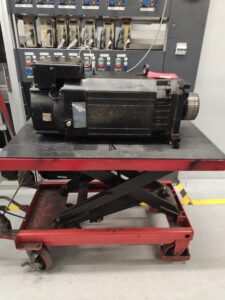
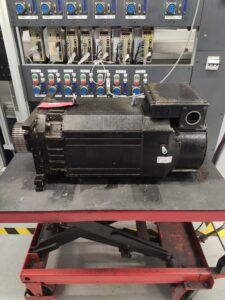
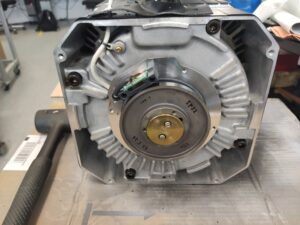
In this repair case, a Yaskawa AC Spindle Motor UAASKB-11LYA11 with encoder UTMSI-10AAGAZA was delivered to our workshop. According to the customer, problems had occurred in the spindle drive. In addition, it was known that the ball bearings were seized. There was contamination inside the motor, which had already led to further mechanical and sensor-related consequential damage. The magnetic pickup of the encoder was already significantly damaged or worn away. In addition, the motor fan unit was defective. A fan unit of type Minebea RT7525-0240W-B30R-S01 was used.
After the repair, the motor was tested together with the Yaskawa CIMR-M5A2022 drive on the test bench. The available Yaskawa documentation for the M5 system shows that alarm messages for encoder faults, overcurrent, overtemperature, motor lock and fan faults are relevant in the environment of this spindle system. These include, for example, AL-30 Encoder signal cable disconnection, AL-40 Motor overheat 1, AL-41 Motor overheat 2 and AL-48 Internal cooling fan fault.
Before starting work: switch the system to a de-energized state, secure it against being switched on again, wait for the discharge time, and verify absence of voltage. Measurements on live parts may only be carried out by qualified electricians.
Incoming inspection and initial diagnosis
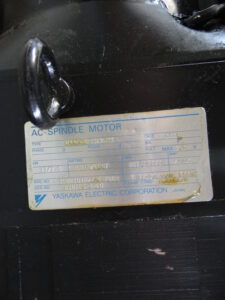
During the incoming inspection, the motor was first visually checked and the nameplate was recorded. The following data, among others, was available from the nameplate: 4 poles, insulation class F, max. 230 V, 500 / 10000 r/min and 54 / 41 A. The operating information on the plate indicates 30MIN / CONT. These values were used as the basis for the technical evaluation.
Already during the initial mechanical inspection, severe bearing damage was evident. The bearings no longer ran freely but were seized. In such cases, there is a high risk that the rotor is no longer guided correctly. This results in runout, increased friction, vibration and additional thermal stress. This chain also matches the model-related fault patterns described in the M5 documentation such as Motor Lock Detection, Overload and Motor Overheat.
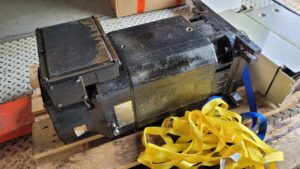
In addition, heavy internal contamination was found. From a workshop perspective, this is a typical indication of an operating environment that was insufficiently sealed or exposed over a longer period. The dirt that had entered not only stressed the bearings, but also damaged the encoder area. The magnetic pickup was mechanically attacked. This means there was not a pure bearing issue, but an overlapping fault pattern of mechanics, feedback and cooling.
Technical analysis
The technical evaluation was deliberately separated into several levels.
The visible damage consisted of seized ball bearings, a damaged encoder with a destroyed magnetic pickup, and a defective fan.
The probable technical main cause was the ingress of dirt into the motor interior. This dirt led to increased bearing stress, lack of lubrication or mechanical destruction of the bearings and, as a consequence, to runout and contact or abrasion damage in the encoder area.
The reported alarm from the overall system must be clearly separated from this. A drive alarm does not automatically mean that the alarm exactly describes the visible mechanical damage. In the tested M5 system, several alarms are conceivable that fit this damage pattern or can occur as consequential faults. According to the documentation, the following relationships are particularly technically plausible:
AL-30 in the case of interrupted encoder wiring or disturbed encoder signal,
AL-32 in the case of significant speed deviation,
AL-34 in the case of motor lock,
AL-40 / AL-41 in the case of thermal overload,
AL-48 in the case of failure of the internal cooling fan.
Important here: a defective fan alone does not explain a destroyed magnetic pickup. Conversely, encoder damage does not automatically explain the bearing damage. In this case, there was very likely a cause-effect chain with several consequential stages. First, dirt entered the motor. Then the condition of the bearings deteriorated. As the mechanical running problem increased, the encoder and cooling were additionally stressed. The fan failure then further aggravated the thermal situation.
From a technical point of view, this must therefore be regarded as a combined damage case:
primary mechanical damage in the motor bearing system, secondary damage in the feedback system, additional failure of the cooling unit.
Repair measures and overhaul
The repair was carried out in several steps.
First, the motor was completely disassembled and cleaned internally. All relevant components were checked for consequential damage. In the case of contaminated spindle motors, cleaning is not merely a cosmetic measure. Deposits affect cooling, insulation, sensor technology and the long-term stability of the bearing system.
The bearing system was then overhauled. The seized ball bearings were removed and replaced. Particular attention was paid to fits, bearing seats and the general mechanical condition of the shaft and bearing shield. In this device class, correct alignment is crucial so that no additional stress or misalignment occurs after assembly.
The encoder UTMSI-10AAGAZA had to be replaced or repaired because the magnetic pickup could no longer work reliably due to contamination and mechanical impact. Such damage typically leads to unstable or implausible feedback signals. In operation, this is not only reflected in encoder alarms, but often also in consequential effects such as speed fluctuations, unstable control or fault shutdown.
In addition, the defective fan unit was replaced. In the present case, the fan component Minebea RT7525-0240W-B30R-S01 was relevant. In spindle motors, the fan is not a secondary accessory, but a central assembly for thermal stability. In the system environment, the Yaskawa M5 manual also explicitly names fan faults and motor overtemperature as relevant fault causes.
After replacing the defective components, the sealing points, connectors and internal cable routing were checked. This step is particularly important in motors with contamination damage, because follow-up faults often result from damaged cable insulation, contaminated connectors or insufficient sealing.
Final function test
After completion of the repair, the motor was tested on the test bench with the Yaskawa CIMR-M5A2022. From a workshop perspective, the test was not just a short trial run, but a technical function test focusing on running behavior, signal stability and thermal plausibility.
The test specifically checked free rotation, clean acceleration, stable feedback signal, plausible behavior at different speeds, and the function of the fan unit. From the M5 documentation it is known that, especially in the interaction between motor, encoder and power section, fault patterns such as overcurrent, speed deviation, encoder line faults and thermal messages are system-relevant.
After the repair, the motor could again be operated cleanly on the test bench. The running behavior was normal, the feedback worked stably and the cooling was available again.
Result and conclusion
The device showed a combined damage case with mechanical bearing damage, damaged feedback system and defective fan unit. The repair included cleaning, bearing replacement, overhaul or replacement of the encoder and replacement of the fan. In the final test bench test with the Yaskawa CIMR-M5A2022, the spindle motor was functional again.
What is particularly important technically in this case is the clear distinction between visible damage and possible alarm cause. A mechanically damaged motor can trigger very different consequential alarms in the drive. For operators, this means: do not only acknowledge the alarm, but always evaluate mechanics, feedback and cooling together. This is exactly how to avoid a supposedly electrical fault actually being an advanced mechanical damage.
More details about our Yaskawa repair expertise can be found here: Yaskawa Repair at Industrypart
📞 Feel free to contact us if you have any questions regarding your Yaskawa drive technology.
Our team looks forward to your inquiry!
Technical specifications
| Field | Value |
|---|
| Manufacturer | Yaskawa Electric Corporation |
| Device type | AC spindle motor |
| Model | UAASKB-11LYA11 |
| Series | UAASKB |
| Optional data | Encoder UTMSI-10AAGAZA, fan Minebea RT7525-0240W-B30R-S01 |
| Power | not available |
| Input voltage | system-side not available |
| Output voltage | nameplate: max. 230 V |
| Rated current | nameplate: 54 / 41 A |
| Control type | speed-controlled spindle drive via Yaskawa CIMR-M5A2022 |
| Feedback | Encoder UTMSI-10AAGAZA |
| Cooling | fan-cooled, fan Minebea RT7525-0240W-B30R-S01 |
| Protection class | not available |
| Mounting | spindle motor, machine mounting details not available |
| Ambient temperature | not available |
| Insulation class | F |
| Number of poles | 4 |
| Rated speed | nameplate: 500 / 10000 r/min |
| Origin | Japan |
| Product status | old, exact availability not available |
| Associated test drive | Yaskawa CIMR-M5A2022 |
Operating environment and possible applications
The Yaskawa AC Spindle Motor UAASKB-11LYA11 is a spindle motor for machine tool applications. Typical operating environments are machining centers, lathes, milling machines and similar CNC machines with a controlled main spindle drive. Due to the high speed and the need for stable feedback, the environment is particularly critical with regard to contamination, cooling, cable routing and bearing condition.
Typical problematic environmental conditions are dust, oil mist, coolant ingress, insufficient sealing, thermal overload and long maintenance intervals. Especially in older spindle systems, dirt ingress and failing fans often lead to consequential damage to bearings and encoders.
Functional description
The spindle motor operates in a system combination with a controlled Yaskawa spindle drive. The power section in the drive generates the motor control. Feedback is provided by the encoder. The system can only control cleanly if speed and position signals are plausible and stable.
The Yaskawa M5 system monitors various protective functions. The documentation lists overcurrent, ground fault, overload, overvoltage, undervoltage, encoder faults, speed deviation, motor lock, motor overtemperature, thermistor faults and fan faults as relevant states, among others.
In practical operation, several levels therefore interact:
power section for motor supply,
control system for speed and behavior,
feedback system for actual value generation,
protective functions for temperature, current and signal quality,
cooling for thermal stability.
If one of these levels fails or delivers implausible values, the overall system can shut down or become unstable.
Cause-effect chain
Cause → Effect → Symptom
Dirt ingress into the motor → wear and seizure of the bearings → rough running, increased friction, heating
Bearing damage → changed rotor running behavior and vibration → encoder damage, unstable feedback, control problems
Damaged magnetic pickup in the encoder → faulty actual-value signals → encoder alarm, speed fluctuations, shutdown
Defective fan unit → insufficient heat dissipation → thermal overload, overtemperature messages
Mechanical primary damage plus disturbed feedback → increased control deviation → speed deviation or motor-lock-like fault pattern
Alarm messages and troubleshooting
| Alarm code | Description | Cause | Measure |
|---|
| AL-01 | Overcurrent | Short circuit, wiring fault or excessive output current | Check motor and output wiring, eliminate short circuit |
| AL-02 | Ground fault | Ground fault on motor side | Check motor insulation and cable between drive and motor |
| AL-05 | Inverter output overload | Output current above 120 % for too long | Check load, review drive sizing |
| AL-06 | Motor overload | Motor overload | Reduce load, check mechanical resistance |
| AL-07 | Motor Overload when motor is locked | Motor blocked or running at low speed against high resistance | Check bearings, rotor running, tool jam and motor shaft |
| AL-10 | Converter fault | Fault in the converter unit | Check fault content at the converter |
| AL-11 | Main circuit overvoltage | DC bus voltage too high | Check mains voltage, load and parameters |
| AL-12 | Main circuit undervoltage | DC bus voltage too low | Check input voltage |
| AL-13 | Control circuit undervoltage | Control voltage too low | Check control supply |
| AL-30 | Encoder signal cable disconnection | Encoder cable interrupted or incorrectly connected | Check encoder wiring and signal quality |
| AL-31 | Motor overspeed | Motor speed above 120 % of set rated speed | Check parameters and encoder cable, ensure separation from power cables |
| AL-32 | Excessive speed deviation | Actual speed drops significantly below reference speed | Check load, tool jam, encoder cable and parameters |
| AL-33 | Load fault | Output U/T1, V/T2, W/T3 interrupted | Check motor cable and connection |
| AL-34 | Motor Lock Detection | Motor remains at very low speed despite torque command | Check bearings, shaft, mechanical blockage and encoder cable |
| AL-40 | Motor overheat 1 | Motor temperature above limit, minor fault | Check cooling and wiring |
| AL-41 | Motor overheat 2 | Motor temperature too high for too long | Check fan, contamination and thermistor signal |
| AL-42 | Motor thermistor disconnection | Thermistor cable interrupted | Check thermistor cable and environment |
| AL-48 | Internal cooling fan fault | Internal cooling fan stopped | Replace fan |
Assembly overview
| Assembly | Function | Notes |
|---|
| Motor bearing system | Guides the rotor mechanically with precision | Always check in case of noise, stiffness or heat |
| Encoder UTMSI-10AAGAZA | Provides feedback signals for control | Contamination and mechanical contact can cause total failure |
| Magnetic pickup | Detects encoder-relevant signals | Mechanically damaged in the present case |
| Fan Minebea RT7525-0240W-B30R-S01 | Cools the motor | Failure leads to thermal overload |
| Winding system | Generates electromagnetic torque | Check insulation condition after contamination and heat |
| Connectors and internal wiring | Transfer power and signals | Always inspect after dirt ingress |
| Sealing system | Prevents ingress of dirt and liquids | Often critical in older motors |
| Drive CIMR-M5A2022 | Supplies and controls the spindle motor | Not necessarily the cause of failure, but important for system test |
Tests
| Test | Result / Goal |
|---|
| Visual inspection outside | Nameplate recorded, external condition checked |
| Disassembly and internal inspection | Contamination and mechanical damage confirmed |
| Bearing inspection | Bearings seized, replacement required |
| Encoder inspection | Magnetic pickup damaged, replacement/repair required |
| Fan inspection | Fan defective |
| Cable and connector inspection | checked for damage and contamination |
| Mechanical running test after assembly | free running restored |
| Test bench test with CIMR-M5A2022 | motor running and feedback checked |
| Cooling function test | fan function restored |
| Final system test | operational condition achieved in test |
Repair measures
| Measure | Carried out |
|---|
| Incoming inspection | Yes |
| Complete disassembly | Yes |
| Internal cleaning | Yes |
| Replacement of seized bearings | Yes |
| Overhaul / replacement of encoder UTMSI-10AAGAZA | Yes |
| Replacement of defective fan unit | Yes |
| Inspection of sealing and connection points | Yes |
| Inspection of internal cable routing | Yes |
| Reassembly and mechanical check | Yes |
| Test bench test with Yaskawa CIMR-M5A2022 | Yes |
Preventive measures
Operators should regularly check spindle motors of this type for running noise, temperature behavior and contamination. Clean cooling paths and a functioning fan unit are especially important. If the fan fails, thermal stress often increases gradually until consequential faults occur.
In addition, connectors, encoder cables and sealing points should be checked during planned maintenance. Even slight dirt ingress can, over the long term, lead to bearing and encoder problems in high-speed spindle motors. If initial symptoms such as rough running, unusual acceleration behavior or sporadic speed fluctuations are detected early, major consequential damage can often be avoided.
Practical measures that make sense are:
regular cleaning of the motor environment,
visual inspection of fans and air routing,
checking for oil mist and coolant ingress,
inspection of signal and power cables for secure routing,
early intervention in the event of bearing noise or rising temperature.
Function test on the test bench
| Test procedure | Result |
|---|
| Connection to Yaskawa CIMR-M5A2022 | successful |
| Start-up test | motor starts |
| Running test across speed range | stable operation in the test |
| Encoder feedback test | signal behavior plausible |
| Fan function test | fan works |
| Observation of running noise and mechanics | normal after repair |
| Final function test | passed |
Result
The Yaskawa AC Spindle Motor UAASKB-11LYA11 could be technically restored after replacement of the damaged bearings, overhaul or replacement of the encoder UTMSI-10AAGAZA and renewal of the defective fan unit, and was successfully tested on the test bench with the Yaskawa CIMR-M5A2022.