24.05.2026 by Viktor Siebert
CNC Production Downtime Caused by Encoder Failure on Omron R7M-A75030-S1-D Servomotor with Omron R7D-AP08H Servo Driver
Introduction as a Real Service Case.
An industrial customer from the metalworking sector reported recurring production interruptions on a CNC machine equipped with an Omron R7M-A75030-S1-D AC servomotor and an Omron R7D-AP08H servo driver.
The most critical aspect was the sporadic nature of the faults during active machining cycles. The machine occasionally stopped directly during production. Encoder and communication errors appeared intermittently on the servo drive display. In some cases, the fault disappeared temporarily after a restart.
As is common in industrial troubleshooting, the customer first performed the standard escalation procedure:
- replacement of the servo drive
- inspection of encoder wiring
- inspection of connectors
- verification of power supply stability
Only after all external causes had been excluded was the motor sent to our workshop for technical analysis.
Initial Diagnosis
During incoming inspection, typical symptoms of an unstable encoder feedback system were immediately identified:
- sporadic encoder communication faults
- unstable speed feedback
- axis dropouts during load changes
- unstable regulation under thermal stress
- intermittent Servo Ready faults
- inconsistent feedback signals
Visual inspection additionally revealed:
- thermal aging around the encoder section
- increased bearing noise
- mechanical stress marks on encoder cabling
- contamination in the feedback area
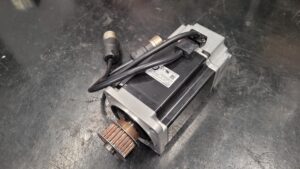
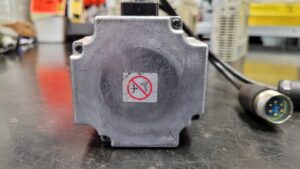
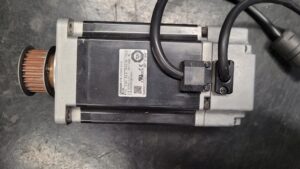
The installed encoder was a Yaskawa TRD-FY2000.
Actual Root Cause
Technical analysis revealed several combined causes:
- internal encoder failure
- unstable phase feedback
- intermittent interruption of encoder channels
- thermally induced signal dropouts
- beginning bearing wear
- unstable feedback signals between encoder and servo driver
The most relevant Omron alarm was:
| Alarm | Meaning |
|---|
| A.C3 | Encoder disconnection detected |
According to the Omron documentation, this alarm indicates:
- encoder phase A/B/S interruption
- short circuit in encoder signals
- contact faults
- defective encoder wiring
Additional typical secondary alarms:
- A.C2 Phase error detected
- A.C1 Runaway detected
- A.51 Overspeed
- A.d0 Deviation counter overflow
Source from Omron alarm manual.
Repair Measures
The servomotor was completely overhauled and professionally repaired.
Performed work:
- complete disassembly
- replacement of the defective encoder
- bearing replacement
- cleaning of all assemblies
- winding insulation test
- inspection of feedback wiring
- encoder system realignment
- encoder phase verification
- thermal load testing
- extended endurance test
- operation test with compatible Omron R7D-AP08H servo driver
Special focus was placed on:
- stable encoder communication
- reliable phase feedback
- smooth speed regulation
- thermal signal stability
Final Testing and Return Shipment
After repair completion, the motor was tested on our test bench under realistic load conditions.
The following tests were performed:
- encoder feedback stability
- signal quality
- thermal behavior
- load changes
- regulation stability
- continuous operation
- communication stability
After successful final testing, the system operated stably without encoder or communication faults.
The motor was returned to the customer shortly afterward so that production could resume quickly.
Customer Feedback
“After the repair, the axis runs stable again. The sporadic encoder faults are completely gone and the machine is producing reliably again.”
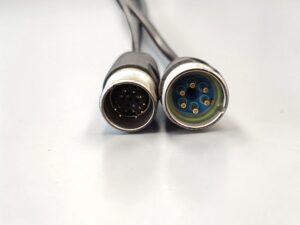
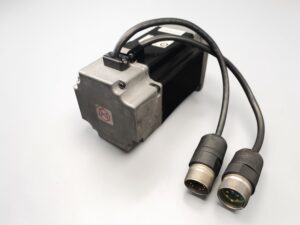
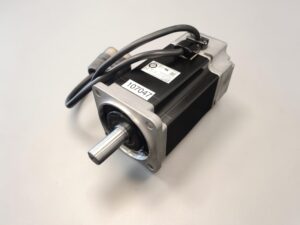
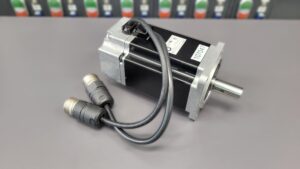
Information about the mentioned Servopack and Servomotor:
More information about our Omron repairs can be found here.
📞 Feel free to contact us if you have any questions regarding your Omron drive technology. Our experienced team is always ready to assist you.
Technical Specifications
| Parameter | Value |
|---|
| Manufacturer | Omron |
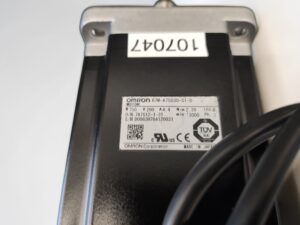
| Model | R7M-A75030-S1-D |
| Motor Type | AC Servo Motor |
| Power | 750 W |
| Voltage | 200 V |
| Current | 4.4 A |
| Speed | 3000 min⁻¹ |
| Torque | 2.39 Nm |
| Phases | 3 |
| Insulation Class | B |
| Encoder | Yaskawa TRD-FY2000 |
| Servo Driver | Omron R7D-AP08H |
| Origin | Made in Japan |
Nameplate information based on uploaded images.
Operating Conditions
| Condition | Value |
|---|
| Ambient Temperature | up to 40 °C |
| Humidity | 20 to 80 % |
| Mounting | Flange mounting |
| Cooling | Self-cooled |
| Vibration Limit | 15 µm |
| Environment | Industrial environment |
| Protection | IP65 except shaft opening |
Technical data based on servo documentation.
Cooperation with Other Equipment
The system is typically used with:
- Omron R7D series servo drives
- CNC controls
- machine tools
- positioning systems
- motion control systems
- industrial automation systems
Supported feedback systems:
- encoder feedback
- position signals
- speed feedback
- pulse generators
- deviation counters
Functional Description
The Omron R7M-A75030-S1-D operates as a highly dynamic AC servomotor for precise positioning and speed control applications.
The system uses:
- PWM power regulation
- encoder feedback
- closed-loop control
- speed control
- position control
- current regulation
- overcurrent protection
- regeneration monitoring
- thermal protection
The encoder provides the essential feedback for:
- position
- speed
- regulation stability
- synchronization
- axis movement
Even small disturbances in the feedback system frequently result in:
- encoder alarms
- positioning deviations
- axis dropouts
- communication faults
- production downtime
Alarm and Error Codes
| Alarm | Error Name | Meaning | Reset | Action |
|---|
| A.04 | Parameter setting error | Incorrect motor or parameter setup | Power Cycle | Check parameters |
| A.10 | Overcurrent | Overcurrent detected | Power Cycle | Check motor and power stage |
| A.30 | Regeneration error | Braking circuit fault | Reset | Check braking resistor |
| A.32 | Regeneration overload | Excessive regenerative energy | Reset | Increase braking capacity |
| A.40 | Overvoltage/undervoltage | DC bus voltage fault | Reset | Check supply voltage |
| A.51 | Overspeed | Excessive motor speed | Reset | Check encoder and tuning |
| A.70 | Overload | Motor overloaded | Reset | Reduce load |
| A.73 | Dynamic brake overload | Brake resistor overloaded | Reset | Check braking cycles |
| A.74 | Inrush resistance overload | Excessive inrush current | Reset | Check power supply |
| A.7A | Overheat | Overtemperature detected | Reset | Check cooling |
| A.bF | System error | Control system fault | Power Cycle | Check servo driver |
| A.C1 | Runaway detected | Motor runs uncontrolled | Power Cycle | Check phases and encoder |
| A.C2 | Phase error detected | Incorrect electrical angle | Power Cycle | Check encoder phases |
| A.C3 | Encoder disconnection detected | Encoder signal interrupted | Power Cycle | Check encoder and cable |
| A.d0 | Deviation counter overflow | Excessive position deviation | Reset | Check encoder and tuning |
| A.91 | Overload warning | Overload warning | Auto | Monitor load |
| A.92 | Regeneration overload warning | Regeneration warning | Auto | Check braking capacity |
Omron alarm table from uploaded PDF.
Typical Causes of Such Faults
In practice, encoder and communication faults are often caused by:
- thermal aging
- damaged encoder cables
- EMC interference
- defective connectors
- bearing wear
- vibration
- oil or coolant ingress
- improper grounding
- mechanical stress on encoder shafts
- insufficient shielding
Preventive Measures for Customers
Recommended preventive maintenance:
- regular inspection of encoder cables
- checking connectors
- cleaning cooling areas
- bearing inspection
- temperature monitoring in the cabinet
- vibration monitoring
- insulation testing
- replacement of aging encoders
- grounding inspection
- regular visual inspection for oil or coolant ingress
Especially on difficult-to-access axes, preventive maintenance often prevents expensive production downtime.
Conclusion
This case once again demonstrated that encoder-related faults frequently originate not in the servo driver itself but directly in the motor feedback system.
Especially thermally unstable encoders cause sporadic communication faults that often only appear under load conditions.
By completely overhauling the motor including encoder replacement and bearing replacement, the system was permanently stabilized and production reliability restored.