07.02.2026 by Viktor Siebert
Repair of a Mitsubishi Spindle Drive Unit MDS-D-SP-40 after liquid ingress
Initial situation and failure description.
The Mitsubishi Spindle Drive Unit MDS-D-SP-40 was sent to us with no function. According to the customer, the machine suddenly shut down during an active machining process. There was no long-term warning, no gradually increasing faults and no previously known alarm history. The shutdown occurred abruptly, which was particularly critical for the operator since the workpiece was still being machined.
After removal of the spindle drive and delivery to our workshop, the total failure was confirmed. The unit could no longer be initialized and communication with the control system was not possible. Externally, the module showed no mechanical damage, which initially made the fault difficult to identify.
Initial inspection and findings
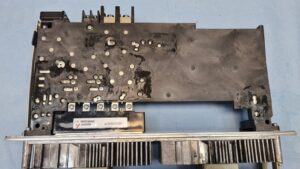
As soon as the unit was opened, an unusual condition became apparent. Inside the device, clearly visible residues of liquid were found, spread across several areas of the electronics. Based on our experience and the smell, consistency and deposits, it was very likely coolant fluid.
The ingress did not occur suddenly but over a long period of time. The traces indicated that the liquid had slowly accumulated over years. In such cases, the damage does not appear immediately but develops gradually until it ultimately leads to a sudden total failure.
We immediately informed the customer and asked them to investigate the cause in the control cabinet environment. It was likely that this was not an isolated risk limited to a single component.
Root cause analysis in the machine environment
Following our feedback, the customer was indeed able to identify a leakage in the machine environment. Over a long period of time, coolant accumulated at an unfavorable point and then entered the control cabinet through cable channels and structural openings.
Such cases are rare and not typical, but they clearly demonstrate how important regular inspection is, even in areas that are assumed to be protected. In this case, it was fortunate that only one device was affected and no other modules were damaged.
Extent of damage to the spindle drive
A detailed analysis of the MDS-D-SP-40 showed that the power stage was fundamentally salvageable. There was no widespread thermal destruction or catastrophic failure across the entire output stage.
However, central components in the power switching section and the associated control circuitry were damaged. The combination of moisture and electrical load caused internal defects that made safe operation impossible.
At this point, it is important to note that we deliberately do not name individual components. What matters is not a single part, but the interaction of environmental influence, aging and electrical stress.
Repair process in the workshop
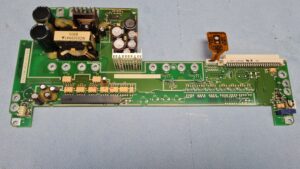
After complete disassembly, the unit was thoroughly cleaned. Residues of coolant, oxidation and contamination were removed to establish a clean and reliable basis for further diagnostics.
Subsequently, all assemblies were inspected in a structured manner. The power stage, control electronics and associated supply sections were tested individually. Defective components were repaired or replaced, always ensuring that the original functionality and characteristics of the unit were maintained.
In parallel, preventive measures were implemented. Components that were still functional but showed age-related risk were also addressed as part of the repair. The goal was not only to restore operation but to stabilize the unit sustainably.
Testing procedures and quality assurance
After completion of the repair, the MDS-D-SP-40 was extensively tested on our test bench. The test was carried out under realistic conditions using appropriate power supply, load simulation and continuous monitoring of all relevant signals.
Special attention was paid to thermal behavior, control stability and clean regulation across the entire operating range. The unit operated stably over an extended period without abnormalities or limit violations. Only after successful completion of all tests was the module approved for return shipment.
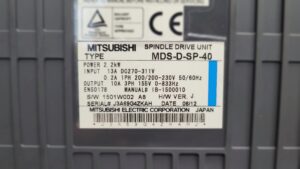
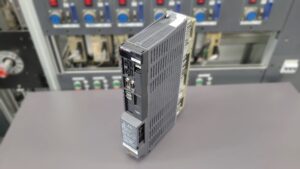
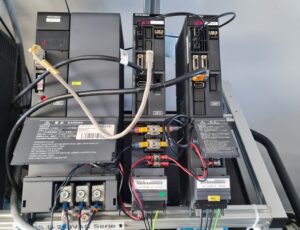
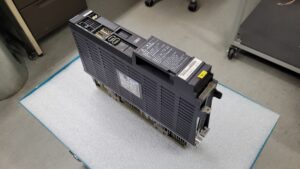
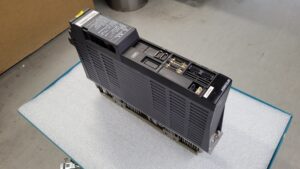
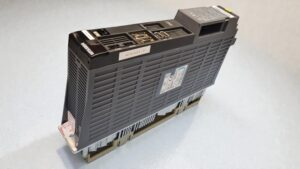
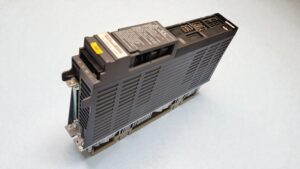
To mentioned Mitsubishi Drive: Mitsubishi Spindle Drive Unit MDS-D-SP-40
More details about our Mitsubishi repair services can be found here:
Mitsubishi drive Repair by Industrypart
📞 Feel free to contact us with any questions about your Mitsubishi drive technology.
Our expert team is happy to help!
Mitsubishi Spindle Drive Unit MDS-D-SP-40
Technical specifications
| Parameter | Value |
|---|
| Manufacturer | Mitsubishi Electric |
| Type | Spindle Drive Unit |
| Model | MDS-D-SP-40 |
| Rated power | 2.2 kW |
| DC link voltage | DC 270–311 V |
| Control circuit input | Single-phase 200–230 V AC |
| Output | Three-phase 155 V AC |
| Output current | approx. 10 A |
| Frequency range | 0–833 Hz |
| Cooling | Forced cooling |
| Application | CNC spindle drive |
| Production date | 06/2012 |
Main assemblies
| Assembly | Designation | Function | Notes |
|---|
| Control board | RM111C-21 or BN638A503G51 | Control and communication | Sensitive to moisture |
| Power board | RM162A-SP or BN638A394G51C | Power switching | High thermal load |
| Power unit | BK0-NC1212 H87 or MP04-D-SP-40 | Energy conversion | Critical in case of liquid ingress |
Typical alarms and fault messages
| Code | Description | Cause | Action |
|---|
| 10 | Undervoltage | Unstable supply | Check mains |
| 17 | A/D error | Signal processing fault | Check electronics |
| 30 | Over regeneration | Excess braking energy | Check brake resistor |
| 32 | Power module overcurrent | Defect or short circuit | Inspect power stage |
| 33 | Overvoltage | Regenerative feedback | Check mains and brake circuit |
| 45 | Fan fault | Insufficient cooling | Check fan |
| 50 | Overload 1 | Mechanical load | Check spindle |
| 51 | Overload 2 | Excessive continuous load | Check process |
| 71 | Power interruption | Supply issue | Check power source |
Preventive recommendations for the customer
Regular visual inspections inside the control cabinet are essential, especially in environments with coolant exposure. Even small leaks can cause serious damage over time. In addition, we recommend periodic inspection of spindle drives, even if no faults have yet occurred. Preventive maintenance is often significantly more economical than unplanned production downtime.
Conclusion
The case of the Mitsubishi MDS-D-SP-40 clearly demonstrates how external influences can disable even robust drive technology. Through structured analysis, targeted repair and preventive measures, the unit was successfully restored and stabilized for long-term operation. At the same time, the customer was able to eliminate the root cause in the machine environment and prevent further damage.