01.01.2026 by Viktor Siebert
Repair of a Mitsubishi Servo Drive Unit MDS-C1-V2-3520 with Speed-Dependent Axis Vibrations
Initial Situation and Customer Symptoms.
On the customer’s machine, axis 20 exhibited noticeable vibrations that occurred only at specific speeds.
Outside these speed ranges, the axis appeared to run smoothly. No typical servo alarms were generated.
The customer initially suspected a mechanical issue and took several corrective actions:
- Replacement of the servo motor
- Replacement of motor and feedback cables
- Multiple adjustments of control parameters
Despite these efforts, the vibration behavior remained unchanged.
Following a recommendation, the customer decided to have the servo drive itself inspected.
Reproduction of the Fault on Our Test System
Upon arrival, the MDS-C1-V2-3520 underwent an initial visual inspection. No external damage was visible.
The drive was then operated on our CNC-like servo test system.
This step is essential: only realistic load simulation and authentic motion profiles allow speed-dependent effects to be reliably reproduced.
After a short time, the fault could be reproduced.
At defined speeds, reproducible vibrations occurred that could not be explained by mechanical influences or parameter settings.
Diagnosis and Root Cause
The analysis confirmed that the issue was not related to the motor, mechanics, or parameterization.
The actual cause was located within the internal signal processing of the drive:
- Age-related drift in control electronics
- Impaired signal processing on the control and power boards
- Instabilities that became apparent only at specific frequencies
Such issues do not necessarily trigger alarms but have a direct impact on axis smoothness.
Repair Measures
The following repair steps were carried out:
- Professional disassembly and cleaning of all assemblies
- Electrical inspection of control and power boards
- Replacement of wear-prone components in the control circuitry
- Load testing of the power electronics
- Recalibration of internal signal paths
All work was performed without modifying the customer’s software or parameters.
Main Components of the Device
| Assembly | Designation | Function |
|---|
| Control board | RK112A-22 or BN634A980G51 | Control logic and communication |
| Power board | RL122B-V2 or BN638A153G51 | Power output stage |
| Power module | BKO-NC1207 H94 A2-V2-3520S | Power supply and energy handling |
Final Testing and Result
After repair, the drive was retested on the test system.
The previously observed vibrations were completely eliminated across the entire speed range.
The unit operated stably and smoothly without abnormalities.
Only after successful extended testing was the servo drive released for return shipment.
Preventive Recommendations for the Customer
- Not every vibration originates from the motor
- Speed-dependent effects often indicate electronic causes
- Parameter tuning cannot replace hardware diagnostics
- A realistic test system is essential for reliable fault analysis
Conclusion
This repair case clearly demonstrates the importance of professional test systems and experience in drive technology.
Replacing motors and cables does not always resolve issues when the root cause lies within the servo drive itself.
Targeted repair saves time, costs, and prevents unnecessary machine downtime.
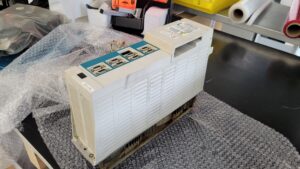
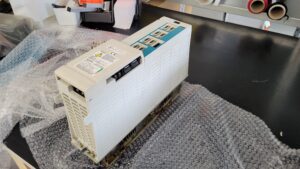
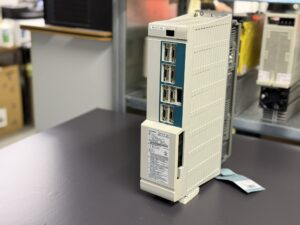
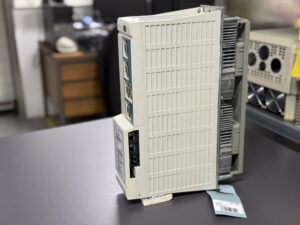
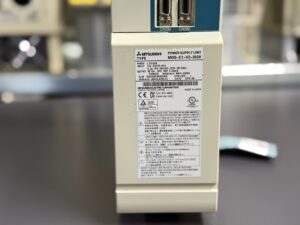
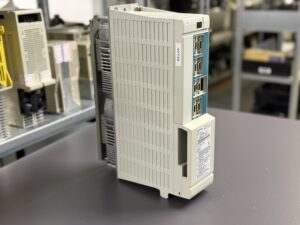
To mentioned Mitsubishi Drive: Mitsubishi Servo Drive Unit MDS-C1-V2-3520
More details about our Mitsubishi repair services can be found here:
Mitsubishi drive Repair by Industrypart
📞 Feel free to contact us with any questions about your Mitsubishi drive technology.
Our expert team is happy to help!
Technical Specifications – Mitsubishi Servo Drive Unit MDS-C1-V2-3520
| Parameter | Value |
|---|
| Manufacturer | Mitsubishi Electric |
| Device type | Power Supply Unit / Servo Drive Unit |
| Model designation | MDS-C1-V2-3520 |
| Rated power | 3.5 kW / 2.0 kW |
| DC bus voltage | DC 270–311 V |
| DC input current | 31 A |
| Control input voltage | Single-phase 200–230 V AC |
| Control input current | 0.2 A |
| Mains frequency | 50 / 60 Hz |
| Output voltage | Three-phase 155–240 V AC |
| Output current | 16 A / 13 A |
| Standards / approvals | EN50178 |
| Documentation | Manual BNP-C3000 |
| Software version | BND582W000AD |
| Hardware version | J |
| Serial number | JBAJCLG28U2L |
| Date of manufacture | 2015-09 |
| Country of origin | Made in Japan |
Alarm Messages and Troubleshooting
| Alarm code | Description | Explanation | Possible cause | Corrective action |
|---|
| 23 | Excessive Speed Error | Deviation between commanded and actual speed exceeds limit | Unstable control loop, feedback issues, electronic drift | Inspect servo drive, evaluate control electronics |
| 28 | Excessive Position Error | Position deviation exceeds allowable range | Control instability, signal distortion, mechanical resonance | Test drive under load, inspect drive electronics |
| 3A | Overcurrent | Excessive current in motor circuit | Vibrations, unstable control behavior, power stage issues | Inspect drive and power electronics |
| 32 | Power Module Overcurrent | Overcurrent detected in power module | Aging power stage, internal signal errors | Inspect and repair power unit |
| 50 | Overload 1 | Overload protection activated | Vibrations increase current demand | Evaluate control behavior and drive condition |
| 51 | Overload 2 | Continuous high current demand | Unstable axis control | Inspect electronics and control loop |
| 52 | Excessive Error 1 | Position error during Servo ON | Control loop instability | Test and repair servo drive |
| 53 | Excessive Error 2 | Position error during Servo OFF | Internal signal deviation | Inspect internal drive electronics |
| 58 | Collision Detection G0 | Disturbance torque exceeds limit during rapid traverse | Electronically induced oscillations | Check control stability |
| 59 | Collision Detection G1 | Disturbance torque exceeds limit during feed movement | Control deviation under load | Test drive under realistic load |
Operating Environment and Compatible Equipment
The Mitsubishi MDS-C1-V2-3520 is typically used in CNC machines equipped with Mitsubishi control systems. Common applications include feed axes in machining centers, lathes, and special-purpose machines.
The drive operates in combination with Mitsubishi AC servo motors from the HF and HA series, together with matching encoder systems. Axis control is handled entirely by the drive and parameterized via the CNC.
Functional Description
The MDS-C1-V2-3520 performs complete current, torque, and position control of a CNC axis.
It processes command values from the CNC, compares them with feedback signals from the motor, and controls output power through its integrated power electronics.
Clean feedback signal processing and stable control loops are critical. Even minor deviations can result in vibrations or resonances without triggering an immediate alarm.