19.01.2026 by Viktor Siebert
Repair of a Mitsubishi Power Supply Unit MDS-D-CV-185 with Alarm 77
Initial Situation and Fault Description.
The Mitsubishi Power Supply Unit MDS-D-CV-185 was delivered by the customer with a recurring Alarm 77. In addition, a small “n” was shown on the unit display. According to Mitsubishi documentation, this alarm indicates an overheating of the power module.
The time history of the fault was particularly noticeable. The first occurrences appeared during the hot summer months. Initially, the customer assumed that the issue was purely temperature-related due to high ambient temperatures inside the control cabinet. After a short cooling phase, the machine could be restarted, and the cooling fan of the power supply unit appeared to be operating normally.
Progressive Deterioration During Operation
Over time, however, a clear pattern emerged. The alarm no longer occurred exclusively during high ambient temperatures but increasingly under high machine load. Especially when machining heavy workpieces or during longer machining cycles, the system shut down.
As the condition continued to deteriorate, the fault began to occur even during the winter months, despite significantly lower ambient temperatures. At this point, it was evident that the issue could no longer be attributed solely to external thermal influences.
Initial Assessment and Typical Root Causes
Such fault patterns are well known from practical experience. In power supply units of the MDS-D series, the root cause is often not the power module itself, but rather components in the surrounding power stage circuitry.
Aging processes play a central role in this context. Over the years, electrical characteristics of certain assemblies change. In addition, harsh industrial environments with dust, fluctuating temperatures, high humidity, and cyclic load peaks accelerate these effects. The result is often an incorrect thermal evaluation within the system, ultimately leading to protective shutdown.
Incoming Inspection and Technical Evaluation
After the unit arrived at our workshop, a structured incoming inspection was carried out. This included a visual inspection, thermal evaluation in idle condition, and basic electrical measurements.
At this stage, the first indications of reduced thermal stability within the power section became apparent. The power module itself was mechanically and electrically intact. There were no signs of internal short circuits or structural damage.
Analysis of the Power Stage
In the next step, the power stage was examined in detail. This confirmed our initial assumption: several critical components in the vicinity of the power section had drifted from their nominal values.
These deviations resulted in insufficient compensation of power losses under load. Consequently, gradual overheating occurred, initially only under extreme operating conditions and later even during normal operation, ultimately triggering Alarm 77.
Repair and Preventive Overhaul
As part of the repair process, not only was the immediate fault corrected, but a targeted preventive overhaul was also performed. The objective was to restore long-term thermal stability and prevent future failures.
After completion of the work, the power supply unit was subjected to comprehensive functional testing under controlled conditions.
Testing on Our Mitsubishi MDS-D/DH Test Bench
The unit was tested on our dedicated test bench for Mitsubishi MDS-D and MDS-DH series. This setup allows simulation of real operating conditions, including load variations, continuous operation, and thermal stress.
The power supply unit operated stably over several hours without any renewed temperature anomalies or fault messages. All protective functions remained within the specified tolerances.
Conclusion from Practical Repair Experience
This case clearly demonstrates that thermal problems cannot be reduced to cooling fans or ambient temperatures alone. Especially in older drive systems, many faults develop gradually due to aging and parameter drift.
Early preventive refurbishment is significantly more economical than unplanned downtime or a complete failure of the power supply unit.
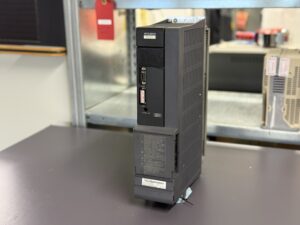
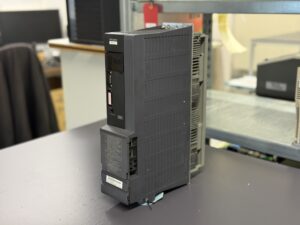
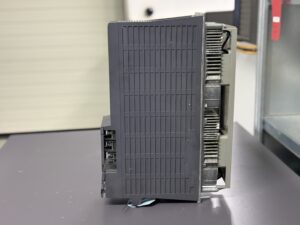
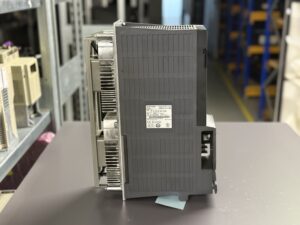
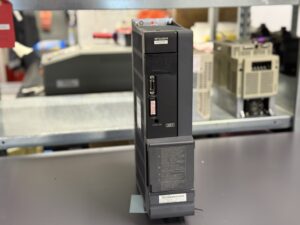
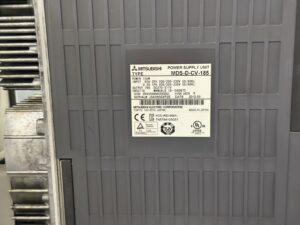
To mentioned Mitsubishi Drive: Mitsubishi Power Supply Unit MDS-D-CV-185
More details about our Mitsubishi repair services can be found here:
Mitsubishi drive Repair by Industrypart
📞 Feel free to contact us with any questions about your Mitsubishi drive technology.
Our expert team is happy to help!
Technical Specifications
| Parameter | Value |
|---|
| Manufacturer | Mitsubishi Electric |
| Type | MDS-D-CV-185 |
| Device category | Power Supply Unit |
| Rated power | approx. 15 kW |
| Input voltage | Three-phase 200–230 V AC |
| Output voltage | DC link approx. 270–311 V |
| Cooling | Forced air cooling |
| Design | Control cabinet module |
| Year of manufacture | 2012 |
| Series | MDS-D |
Typical Application Environment
This power supply unit is used in CNC machines, commonly in machining centers, lathes, and special-purpose machines with multiple servo and spindle axes. Typical characteristics include high load fluctuations, long operating times, and thermally demanding conditions.
Relevant Alarm Messages and Meaning
| Alarm | Description | Typical cause | Action |
|---|
| 77 | Power module overheat | Thermal overload | Check power section |
| 72 | Fan stop | Cooling failure | Check cooling system |
| 73 | Over regeneration | Regenerative overload | Check braking resistor |
| 75 | Overvoltage | DC bus too high | Check power supply conditions |
Main Assemblies
| Assembly | Function |
|---|
| Power section | Supply of DC link energy |
| Heat sink | Dissipation of power losses |
| Fan unit | Active cooling |
| Control logic | Monitoring and protection |
| Sensor system | Temperature and voltage monitoring |
Preventive Measures for the Customer
Regular maintenance is crucial for the service life of such power supply units. This includes cleaning of cooling surfaces, verification of fan operation, thermal measurements under load, and preventive refurbishment after several years of operation.
These measures significantly reduce unplanned downtime and ensure consistent machine availability.