09.05.2026 by Viktor Siebert
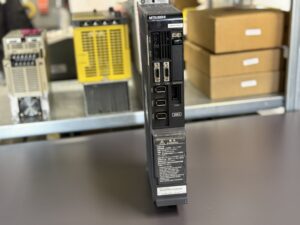
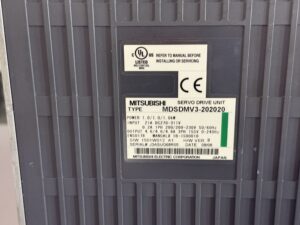
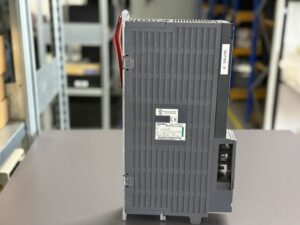
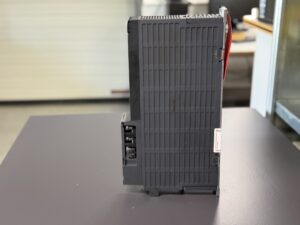
Repair of a Mitsubishi MDSDMV3-202020 REM MDS-DM-V3-202020 Servo Drive Unit with Alarm 32 Power Stage Failure
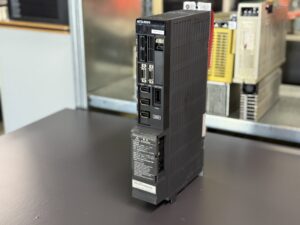
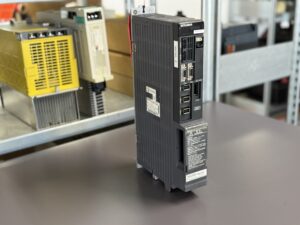
The unit in question, a Mitsubishi MDS-DM-V3-202020 servo drive unit, was received with Alarm 32. According to the fault description, the alarm occurred during machine operation and caused an immediate stop of the axis. Alarm 32 in this series indicates a power module error or overcurrent in the power stage.
In operation, the behavior was typical for this type of failure. The machine initially ran stable, but failed suddenly under load or during acceleration. What stood out was that the fault was not immediately reproducible. This intermittent behavior significantly complicates diagnosis, as thermal effects or semiconductor damage often only appear under load.
During incoming inspection, a visual check was performed first. Slight thermal discoloration was visible in the power stage area, along with aged power components. Initial measurements did not show direct short circuits, but there were noticeable irregularities in the switching behavior of the IGBT stage.
Technically, the MDS-DM-V3 operates as a multi-axis servo amplifier with an integrated power stage. The power stage converts the DC link voltage into a controlled three-phase output voltage for the motor. At the same time, the control section processes feedback signals from the encoder and regulates current, speed, and position within a closed-loop system.
The root cause in this case was a damaged power stage. Due to thermal stress and aging, individual power semiconductors exhibited unstable switching behavior. Under load, this caused short-term current peaks, which were detected by the protection system and triggered Alarm 32.
A key characteristic of such failures is that the unit may still function under no-load or light-load conditions. The fault only appears during dynamic motion or higher current demand. This is why the issue is often perceived as sporadic or difficult to reproduce.
During the repair process, the entire power stage was overhauled. Defective power semiconductors were replaced, thermally stressed components were renewed, and critical solder joints were reworked. Additionally, the heatsinks were cleaned and the driver circuitry was checked.
Prevention is a critical factor. These failures are often caused by insufficient cooling, contaminated fans, or high ambient temperatures. According to the manufacturer, clean cooling paths and functional fans are essential for the longevity of the power electronics.
After the repair, the unit was tested on a test bench. Various load cycles were executed, including both partial and full load conditions. Particular attention was given to monitoring current consumption, DC link voltage, and thermal behavior. The unit showed stable operation with no further fault triggering.
From a practical standpoint, clear diagnostic indicators can be derived. Early signs include sporadic shutdowns under load, unstable motor behavior, or rising cabinet temperatures. Field technicians should closely check cooling, wiring, and mechanical load conditions.
It is important to distinguish this fault from similar ones. While Alarm 32 clearly indicates a power stage issue, faults such as overload or overheating may present similar symptoms but have different root causes.
Conclusion: Power stage failure is a classic but often difficult-to-diagnose issue in servo drives. With proper repair and preventive maintenance, service life can be significantly extended and unplanned downtime reduced.
More details about our Mitsubishi repair services can be found here:
Mitsubishi drive Repair by Industrypart
📞 Feel free to contact us with any questions about your Mitsubishi drive technology.
Our expert team is happy to help!
Technical Specifications
| Parameter | Value |
|---|
| Type | MDS-DM-V3-202020 |
| Manufacturer | Mitsubishi Electric |
| Supply | 200–230 V AC / DC 270–311 V |
| Power | approx. 1 kW per axis |
| Output | 3-phase approx. 155 V |
| Current | up to approx. 6 A |
| Cooling | Fan-cooled |
| Control | CNC servo system |
| Year | approx. 2008 |
| Manual reference | |
Operating Environment and Applications
Typical applications:
- CNC machining centers
- Lathes
- Automated production systems
Typical loads:
- High dynamics due to acceleration
- Continuous operation
- Thermal cycling
Critical environmental factors:
- Oil mist
- Dust
- Poor cabinet ventilation
Functional Description
The servo drive performs the following functions:
- Conversion of supply voltage into DC link
- Generation of controlled motor currents
- Position control via encoder feedback
- Protection functions such as overcurrent and overtemperature
The control loop consists of:
- Current control loop (inner loop)
- Speed control loop
- Position control loop
Protection functions immediately stop the system in case of faults, usually via dynamic braking or shutdown.
Typical Failure Causes and Prevention
| Cause | Effect | Symptom | Preventive measure |
|---|
| Cooling issue | Overheating | sporadic shutdown | check fans |
| Aging power semiconductors | Overcurrent | Alarm 32 | regular maintenance |
| Contamination | poor heat transfer | rising temperature | cleaning |
| Incorrect load | Overload | shutdown | verify sizing |
Alarms and Troubleshooting
| Code | Description | Cause | Solution |
|---|
| 32 | Power module overcurrent | defective power stage | check power section |
| 33 | Overvoltage | DC link too high | check supply |
| 30 | Over regeneration | braking energy too high | check resistor |
| 50 | Overload | excessive load | reduce load |
| 46 | Motor overheat | high temperature | improve cooling |
| 24 | Ground fault | insulation fault | check cables |
| 23 | Speed error | control deviation | check parameters |
| 21 | Communication error | cable or control issue | check connections |
| 17 | A/D error | measurement fault | check electronics |
| 10 | Undervoltage | unstable supply | check mains |
Assembly Overview
| Assembly | Function | Notes |
|---|
| Power module | motor drive | critical for alarm 32 |
| Control board | regulation | rarely defective |
| Heatsink | heat dissipation | often contaminated |
| Fan | cooling | wear component |
| DC link | energy supply | check capacitors |