02.02.2026 by Viktor Siebert
Repair of a Mitsubishi MDS-DH-V2-4020 AC Servo Drive Unit
Initial situation and fault description.
The Mitsubishi MDS-DH-V2-4020 was delivered to our workshop with a clear and critical symptom: the display remained completely dark. No initialization, no status indication, no error code. For the machine operator this meant a total axis failure. From a service perspective, this type of fault usually indicates a problem within the internal power supply or the power stage.
Already at first sight it was obvious that the drive had been operating in a heavily contaminated environment. Dust, fine particles and deposits were clearly visible. Such conditions directly affect the thermal balance of electronic components, especially in servo drives that are operated continuously under load.
Initial diagnosis and visual inspection
During our standardized incoming inspection, it quickly became apparent that the cooling fans were no longer operating properly. They were blocked by dirt and deposits and could no longer ensure sufficient airflow. This is a typical starting point for a gradual failure process in MDS-DH series drives.
When cooling performance is reduced over a long period, the temperature inside the power stage rises steadily. The electronics continue to operate, but outside their specified thermal limits. Semiconductor aging accelerates, solder joints are mechanically stressed, and insulation margins decrease. The final failure then appears sudden, although the root cause has been developing for a long time.
Findings on the power stage
After opening the unit, the diagnosis was confirmed. The power stage showed clear signs of thermal damage. In such a condition, a partial repair is no longer technically reasonable. The power stage had to be completely replaced, as long-term electrical reliability could no longer be guaranteed.
At the same time, the control board was also inspected. Even though it was not directly affected, this step is always part of our procedure. Thermal stress often leads to delayed failures, which is why we never focus on only one assembly.
Cleaning and preparation
Before any repair work is carried out, the unit undergoes a thorough technical cleaning. This is not done for cosmetic reasons, but for functional reliability. Heat sinks, airflow paths and fan areas are completely cleaned from deposits. Only after this step does a repair make technical sense.
All relevant connectors, contact points and mechanical fixations were then inspected. After thermal damage, special attention is paid to mechanical tension and electrical contact quality.
Testing on the servo drive test bench
The decisive step is testing under realistic conditions. The MDS-DH-V2-4020 was operated on our servo drive test bench, not in no-load mode, but under defined load conditions. All relevant voltages, currents and temperature developments were continuously monitored.
The test includes multiple start-stop cycles as well as extended continuous operation. Especially after thermal damage, it is essential to ensure that no hidden instabilities remain. Only after the drive operates stably over an extended period is the repair considered complete.
Checklists and quality assurance
All work steps are documented and controlled using defined checklists. These include incoming inspection, repair steps, cleaning, test protocol and final inspection. This structured approach ensures that no detail is overlooked and that every repair is fully traceable.
For complex servo drives like the MDS-DH series, this systematic process is essential for long-term operational reliability at the customer’s site.
Preventive considerations and conclusion
In this case, the root cause was not an electronic defect itself, but insufficient maintenance of the cooling system. Blocked fans are one of the most common causes of failure in this drive series. With timely cleaning or preventive fan replacement, the damage to the power stage could most likely have been avoided.
This repair clearly shows that preventive measures are not an additional effort, but a core element of reliable maintenance. Our goal is not only to restore functionality, but also to eliminate the underlying causes permanently.
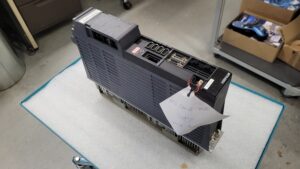
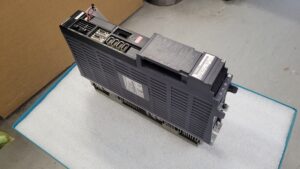
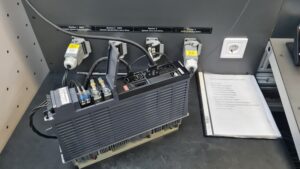
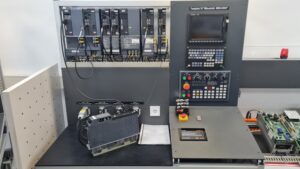
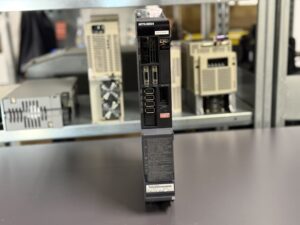
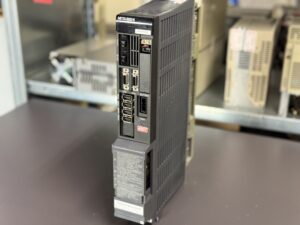
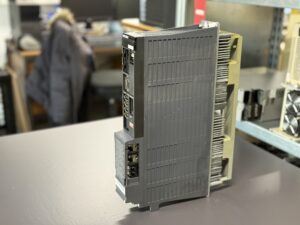
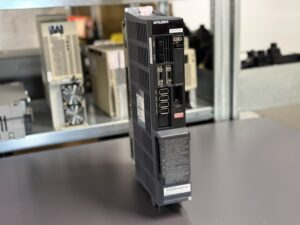
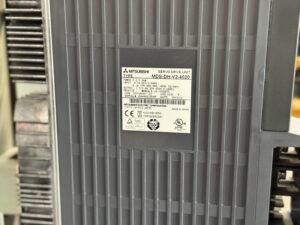
To mentioned Mitsubishi Drive: Mitsubishi Servo Drive Unit MDS-DH-V2-4020
More details about our Mitsubishi repair services can be found here:
Mitsubishi drive Repair by Industrypart
📞 Feel free to contact us with any questions about your Mitsubishi drive technology.
Our expert team is happy to help!
Mitsubishi MDS-DH-V2-4020
Device overview
| Item | Description |
|---|
| Device type | AC Servo Drive Unit |
| Series | MDS-DH |
| Manufacturer | Mitsubishi Electric Corporation |
| Application | CNC axis drives |
| Year of manufacture | 2013 |
| Country of origin | Japan |
Technical specifications
| Parameter | Value |
|---|
| Input voltage | 3-phase approx. 380–480 V AC |
| Output voltage | approx. 0–240 V AC |
| Output current | approx. 7.3 / 3.9 A |
| Rated power | approx. 2.0 / 1.0 kW |
| Frequency range | 0–240 Hz |
| Cooling method | Forced air cooling via internal fans |
Assembly overview
| Assembly | Board designation | Function |
|---|
| Control board | RM115A-22 or BC886A028G51 | Control logic and communication |
| Power board | RM162C-V2 or BC886A010G52B | Power electronics control |
| Power unit | BKO-NC1207 H84 or A2-DH-V2-4020 | Energy conversion for motor drive |
Typical fault patterns
| Symptom | Possible cause |
|---|
| Display remains dark | Power stage failure |
| Sporadic shutdowns | Overheating due to fan blockage |
| Complete failure | Long-term thermal overload |
| Recurrent disturbances | Contaminated cooling channels |
Alarm and Troubleshooting Table (English)
| Alarm | Description | Cause | Solution |
|---|
| 10 | Insufficient Voltage | DC bus voltage too low | Check mains supply, contactors and wiring |
| 24 | Ground Fault | Motor or power cable connected to ground | Perform insulation test on motor and cable |
| 32 | Power Module Overcurrent | Short circuit, motor fault or power stage failure | Check motor, power cable and drive |
| 3A | Overcurrent | Excessive motor current detected | Check mechanical load, parameters and motor condition |
| 3B | Power Module Overheat | Insufficient cooling or fan failure | Clean or replace fan and heatsink |
| 45 | Fan Stop | Cooling fan failure | Inspect and replace fan |
| 46 | Motor Overheat | Motor overload or insufficient cooling | Reduce load and inspect motor cooling |
| 50 | Overload 1 | Continuous overload of motor or drive | Analyze mechanics and load conditions |
| 51 | Overload 2 | High current demand over an extended period | Check motor, load and tuning parameters |
| 60-77 | Power Supply Alarm | Fault detected in connected power supply unit | Diagnose power supply unit |
| 87 | Drive Communication Error | Communication between drive units interrupted | Check fiber optic links and connections |
| 88 | Watchdog Error | Internal control system malfunction | Inspect electronics or repair drive |
Test procedures
| Test step | Description |
|---|
| Visual inspection | Mechanical and thermal condition |
| Voltage measurement | Internal supply verification |
| Load test | Operation under realistic axis load |
| Continuous operation | Thermal stability verification |
| Final inspection | Multiple start-stop cycles |
Preventive measures
| Measure | Benefit |
|---|
| Regular fan inspection | Prevention of thermal damage |
| Cleaning of cooling channels | Stable heat dissipation |
| Preventive fan replacement | Extended service life |
| Defined maintenance intervals | Reduced unplanned downtime |