04.02.2026 by Viktor Siebert
Repair of a Mitsubishi MDS-C1-V2-0303 Servo Drive Unit with consequential damage caused by a mechanically overloaded Mitsubishi HA33NC-TS AC Servo Motor
Initial situation and fault symptoms.
The Mitsubishi MDS-C1-V2-0303 Servo Drive Unit was sent to us together with a Mitsubishi HA33NC-TS AC Servo Motor. The customer was unsure whether the fault originated from the drive or from the motor and therefore decided to send both components in for evaluation. In hindsight, this decision proved to be absolutely correct.
During operation, the servo drive initially showed sporadic overload and overtemperature warnings. The machine continued to run intermittently, but with increasing instability. Eventually, Alarm 32 (Power Module Overcurrent) occurred. From that moment on, operation was no longer possible. The axis could no longer be enabled and the servo drive immediately went into fault state.
This type of fault pattern is particularly critical, as it can indicate both electrical defects and mechanical root causes. Without clearly distinguishing between cause and effect, there is a significant risk of only addressing symptoms instead of the underlying problem.
Technical analysis of the servo drive
After incoming inspection, the MDS-C1-V2-0303 was first examined visually and electrically. Even during the initial inspection, clear damage to the power stage became evident. Several channels showed thermal abnormalities, and a short circuit was detected in one of the power transistor modules.
The gate drive circuitry for the power transistors also showed damage, clearly indicating that the drive had been operated under excessive electrical load for an extended period of time. This type of damage does not usually occur suddenly, but is the result of prolonged overload conditions.
Analysis of the servo motor as the actual root cause
In parallel with the drive analysis, the Mitsubishi HA33NC-TS servo motor was examined. Already during the mechanical inspection, it became apparent that the motor no longer rotated freely. The movement was stiff and uneven, which is a clear warning sign for a servo drive system.
Insulation measurements revealed a critical result: the insulation values were approximately 50 percent below the nominal level. After complete disassembly, the root cause became obvious. The ball bearings were severely worn. Due to advanced bearing wear, a significant amount of fine metallic abrasion had accumulated inside the motor.
This conductive debris settled on windings and insulation surfaces, gradually reducing the electrical insulation. As a result, the motor current increased over time without immediately triggering a clear fault. The servo drive compensated for this increased load over an extended period until the power stage finally became thermally and electrically overloaded.
The actual cause of the servo drive failure was therefore clearly identified as the mechanically damaged motor.
Repair measures on drive and motor
The Mitsubishi MDS-C1-V2-0303 was completely overhauled. The damaged power transistors were replaced, the gate drive circuitry for the power modules was repaired, and all relevant assemblies were thoroughly inspected. In addition, the unit was carefully cleaned to remove any residues caused by thermal stress.
The servo motor was fully disassembled, cleaned, and mechanically overhauled. All ball bearings were replaced, the motor was realigned, and electrical measurements were repeated. After completion of the work, the insulation values were well within specification again, and the motor ran smoothly and evenly.
Testing, commissioning and result
Both components were then operated together on the test bench. The drive ran stably under load, showed no thermal abnormalities, and no longer triggered any overcurrent or overload alarms. The motor exhibited smooth and consistent running behavior across the entire speed range.
After reassembly, both the drive and the motor were returned to the customer. Since then, the machine has been operating reliably and without further alarms. This case clearly demonstrates how important a holistic view of the entire drive system is.
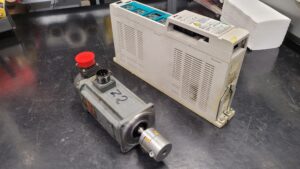
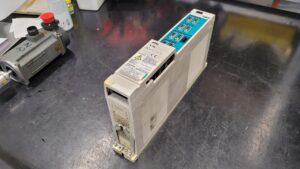
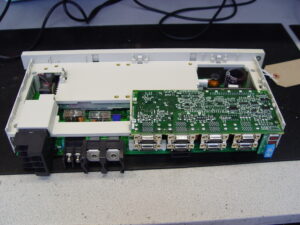
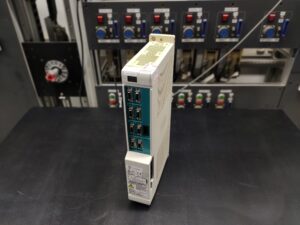
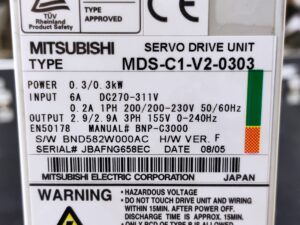
To mentioned Mitsubishi Drive: Mitsubishi Servo Drive Unit MDS-C1-V2-0303
More details about our Mitsubishi repair services can be found here:
Mitsubishi drive Repair by Industrypart
📞 Feel free to contact us with any questions about your Mitsubishi drive technology.
Our expert team is happy to help!
Mitsubishi MDS-C1-V2-0303 Servo Drive Unit
Device overview
Nameplate overview
| Parameter | Value |
|---|
| Manufacturer | Mitsubishi Electric Corporation |
| Device type | Servo Drive Unit |
| Type | MDS-C1-V2-0303 |
| Power rating | 0.3 / 0.3 kW |
| Main circuit input | DC 270–311 V |
| Main circuit input current | 6 A |
| Control circuit input | 0.2 A, 1 phase |
| Control circuit input voltage | 200 / 200–230 V AC |
| Mains frequency | 50 / 60 Hz |
| Output current | 2.9 / 2.9 A, 3 phase |
| Output voltage | 155 V |
| Output frequency range | 0–240 Hz |
| Standard | EN50178 |
| Manual No. | BNP-C3000 |
| Software | BND582W000AC |
| Hardware version | Ver. F |
| Serial No. | JBAFNG658EC |
| Date | 08/05 |
Assemblies according to the parts list
| Type | Board designation | Qty |
|---|
| Control board | RK112A-12 or BN634A980G51 | 1 |
| Power board | RK155B-V24-0303 or BN634AB10G51A A | 1 |
| Power section | Power section | 1 |
Typical operating environment
| Area | Description |
|---|
| Machines | CNC machine tools |
| Axis applications | Feed axes |
| Environment | Electrical cabinet, industrial environment |
| Load profile | Continuous operation with varying loads |
Important alarms and their meaning
| Alarm | Description | Typical cause |
|---|
| Alarm 32 | Power module overcurrent | Motor overload, insulation fault, short circuit |
| Alarm 50 | Overload | Mechanical overload, stiff axis |
| Alarm 46 | Motor overheat | Bearing damage, insufficient cooling |
| Alarm 3B | Power module overheat | Prolonged overload |
| Alarm 45 | Fan stop | Cooling failure |
Conclusion
This repair case clearly demonstrates that a servo drive rarely fails without an underlying cause. Mechanical defects in the motor have a direct and severe impact on the power electronics. Only by analyzing both the motor and the drive together was it possible to identify the true fault chain and implement a sustainable repair. Preventive maintenance of the motor bearings would very likely have prevented the failure of the power stage.