07.05.2026 by Viktor Siebert
Mitsubishi MDS-B-CVE-110 Power Supply Unit Fault 9 / 69 caused by defective power stage
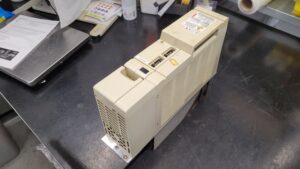
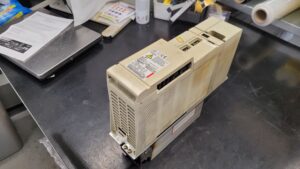
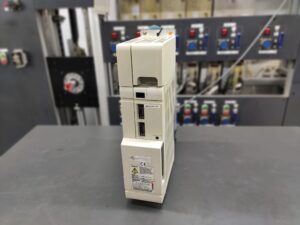
The Mitsubishi MDS-B-CVE-110 unit was received together with a spindle amplifier MDS-B-SP-220 from a Traub TNC42 machine. The fault pattern was clearly reproducible, but not immediately obvious from a technical standpoint.
At machine level, alarm 69 was active. At the same time, the power supply itself reported fault 9 and the connected spindle drive also showed alarm 69. According to the alarm table, alarm 69 indicates a ground fault or leakage to frame ground in the power section .
The key detail in this case:
The spindle motor and its cabling were electrically tested and confirmed to be in proper condition. No insulation fault, no short to ground. This shifted the focus directly to the power supply unit.
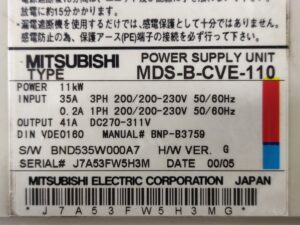
The nameplate already indicates the scale of the system. The unit supplies approx. 270 to 311 V DC at up to 41 A and feeds the DC bus of the connected drives. Any issue in this section immediately affects all downstream modules.
Incoming inspection and initial diagnosis
The standard workshop procedure was applied:
Visual inspection
No obvious burn marks, but typical aging signs in the power electronics and cooling area.
Insulation measurement
Slightly unstable insulation values between DC bus and ground. No hard short circuit, but noticeable leakage currents.
Test bench
The fault was reproducible under load conditions. The unit shut down consistently with fault 9 and 69.
This was the decisive indication: no external fault, but an internal issue within the power supply.
Technical analysis
The MDS-B-CVE is a classic DC bus power supply. Its main functions are:
Rectification of the AC input voltage
Charging of the DC bus
Supplying multiple servo and spindle drives
Monitoring voltage, current and insulation
The protection system detects abnormalities such as ground faults or leakage currents and shuts the system down. This is exactly what happened in this case.
Typical cause-effect chain:
Aging of power semiconductors
Leakage currents in IGBT module or rectifier
Asymmetrical current flow
Detection as ground fault by monitoring circuit
System shutdown
This type of fault develops gradually. The unit still operates partially but fails under load. That is why diagnosis is often difficult.
Why the fault was difficult to detect
No hard short circuit
Insulation values within borderline range
Fault appears only under load
Motor and cabling fully functional
This often leads to misdiagnosis on site, as motor or wiring are typically suspected first.
Repair measures and refurbishment
The analysis confirmed a defect in the power stage of the power supply.
Work performed:
Complete disassembly and cleaning
Inspection of power section
Replacement of critical power components
Refurbishment of thermally stressed assemblies
Preventive replacement of aging components
Important: The repair was not limited to the fault but included preventive measures to avoid future failures.
Final function test
Test conditions:
Operation under realistic load conditions
Monitoring DC bus voltage
Simulation of different load scenarios
Thermal observation
Result:
Stable DC bus voltage
No recurrence of faults 9 or 69
Stable behavior during load changes
Thermally stable operation
Practical benefits and diagnostic hints
Typical symptoms:
Intermittent shutdowns under load
Alarm 69 without clear ground fault
Unstable insulation readings
Fault appears after warm-up
Early detection:
Measure leakage currents
Monitor thermal behavior
Check DC bus stability
Differentiation:
If motor and cables are confirmed to be in good condition, the root cause is often inside the power supply unit.
Preventive measures
Regular cleaning of cooling elements
Inspection of cooling fans
Insulation measurements
Monitoring DC bus voltage
Replacement of aging power components
These measures significantly extend service life and prevent unexpected downtime.
Conclusion
This case shows a typical failure pattern in older CNC systems. The root cause is not always where the alarm suggests.
An aging power stage in the power supply can generate the same symptoms as a real ground fault in the motor.
The repair was sustainable because preventive actions were included in addition to fault correction.
More details about our Mitsubishi repair services can be found here:
Mitsubishi drive Repair by Industrypart
📞 Feel free to contact us with any questions about your Mitsubishi drive technology.
Our expert team is happy to help!
Technical specifications
| Parameter | Value |
|---|
| Type | MDS-B-CVE-110 |
| Power | approx. 11 kW |
| Input | 3x 200–230 V AC |
| Current | approx. 35 A |
| Output | 270–311 V DC |
| Output current | approx. 41 A |
| Function | DC bus supply |
| Manufacturer | Mitsubishi Electric |
| Year | approx. 2000 |
Functional description
The unit generates the DC bus voltage for all connected servo drives.
The control continuously monitors:
DC bus voltage
Current consumption
Insulation condition
Thermal load
If deviations occur, protection mechanisms immediately shut down the system.
Typical failure causes and prevention
| Cause | Effect | Symptom | Prevention |
|---|
| Aging semiconductors | Leakage current | Alarm 69 | Preventive replacement |
| Contamination | Cooling issues | Overheating | Regular cleaning |
| Poor cooling | Thermal drift | Intermittent faults | Check fans |
| Voltage fluctuations | Overload | Shutdown | Check power quality |
Alarm messages and troubleshooting
| Code | Description | Cause | Solution |
|---|
| 9 | Internal PSU fault | Power stage | Repair |
| 69 | Ground fault | Leakage current | Check PSU |
| 67 | Phase loss | Supply issue | Check input |
| 6C | DC bus charging fault | Capacitors | Replace |
| 75 | Overvoltage | Regeneration | Check braking resistor |
Assembly overview
| Assembly | Function | Notes |
|---|
| Rectifier | AC to DC conversion | Thermally stressed |
| DC bus | Energy storage | Capacitors critical |
| Power stage | Energy distribution | Common failure point |
| Control board | Monitoring | Rarely defective |
| Cooling system | Heat dissipation | Regular inspection |