24.12.2025 by Viktor Siebert
Repair of a Mitsubishi HG-H104S-D48 AC Servo Motor with OSA105SA Encoder under Express Conditions
Initial Situation and Customer Background.
The Mitsubishi HG-H104S-D48 AC servo motor arrived at our facility shortly before Christmas as an urgent express repair. The customer’s machine had failed unexpectedly at a very critical moment. A special production order was scheduled to run continuously, and any downtime would have caused serious delays.
For long periods, the machine had only been used moderately. Toward the end of the year, however, it was put into intensive operation and ran continuously in multi-shift mode. It was precisely during this phase of increased utilization that the axis failure occurred and brought the entire machine to a standstill.
A replacement motor was not available at short notice. The manufacturer was able to offer a unit only together with on-site technician support. Due to the holiday period, however, sufficient service personnel were not available. This situation reflects a general challenge currently faced by many companies across Europe. As a result, the customer chose the fastest possible solution and sent the motor to us by express courier.
Initial Diagnosis after Incoming Inspection
Based on the fault description alone, the suspicion quickly focused on an encoder-related issue. After opening the motor, this assumption was confirmed. The encoder was heavily contaminated with emulsion and oil. These media had migrated along the motor shaft and entered the encoder area, making reliable position feedback impossible.
In addition, clear signs of wear were found on the motor bearings themselves. Given the increased operating time and the contamination, a partial repair was ruled out from the beginning.
Coordination with the Customer and Repair Strategy
After discussing the findings with the customer, a clear repair strategy was defined. The priority was maximum operational reliability within the shortest possible turnaround time. An external repainting was deliberately omitted, as it would have required additional time and had no impact on the immediate functionality of the motor. The focus was placed entirely on a thorough technical overhaul.
Repair Process and Restoration
The motor was completely disassembled and thoroughly cleaned. All seals inside and on the motor were replaced as a preventive measure to ensure long-term protection against renewed ingress of oil or emulsion. All motor bearings were renewed due to the detected wear and the increased mechanical stress they had already experienced.
The OSA105SA encoder was not repaired but completely replaced. Due to the severe contamination, a refurbishment was neither technically reliable nor economically reasonable. The replacement encoder was precisely aligned to the motor. This adjustment is critical, as even minimal deviations can later lead to control instability, vibration, or overload alarms.
Testing and Verification
After reassembly, the motor underwent comprehensive electrical testing. It was operated on a suitable test bench under realistic conditions. Current consumption, rotational behavior, feedback signals, and thermal performance were closely monitored. Only after stable operation, clean encoder signals, and normal thermal behavior were confirmed was the motor approved for return.
Reinstallation and Result
The entire repair was completed within a single working day. The motor was reinstalled in the machine immediately afterward. The axis ran smoothly from the first startup, no further alarms occurred, and the machine was able to resume production without additional delays.
Importance of Spare Parts and Know-how
This repair clearly demonstrates how critical spare part availability, experience, and structured processes are. Such a short turnaround time is only possible when encoders, bearings, and seals are in stock and when proper testing and adjustment equipment is available. Especially in times of supply chain constraints and skilled labor shortages, professional repair often represents the most reliable and economical solution.
Conclusion
This case involving a Mitsubishi HG-H104S-D48 AC servo motor highlights how quickly a contaminated or defective encoder can lead to a complete machine shutdown. Through a consistent repair strategy, preventive replacement of critical components, and thorough final testing, the customer was able to continue production during a highly sensitive period. Targeted repair work not only saves time in such situations but also ensures machine availability when it matters most.
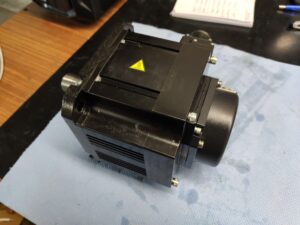
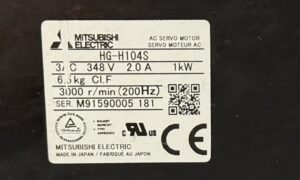


To mentioned Mitsubishi Motor: Mitsubishi HG-H104S AC Servo Motor
Link zum erwähnten: Mitsubishi MDS-DH-V2-1010 AC Servo Drive Unit
Link zum erwähnten: Mitsubishi Encoder OSA105SA
More details about our Mitsubishi repair services can be found here:
Mitsubishi motor Repair by Industrypart
📞 Feel free to contact us with any questions about your Mitsubishi drive technology.
Our expert team is happy to help!
Technical Specifications
| Parameter | Value |
|---|
| Manufacturer | Mitsubishi Electric |
| Motor type | AC Servo Motor |
| Model | HG-H104S |
| Rated output | 1.0 kW |
| Rated voltage | approx. 348 V |
| Rated current | approx. 2.0 A |
| Rated speed | 3000 rpm |
| Encoder | OSA105SA |
| Insulation class | Class F |
| Cooling method | Self-cooled |
| Weight | approx. 6.5 kg |
| Compatible drive | MDS-DH-V2-1010 |
| Mounting | Flange mounted |
| Country of origin | Japan |
Operating Environment and Compatible Equipment
The Mitsubishi HG-H104S is typically used in CNC machine tools, special-purpose machines, and automated production lines. In this case, it operates together with a Mitsubishi MDS-DH-V2-1010 servo drive. This combination is commonly found in machines with medium axis loads, high positioning accuracy, and continuous multi-shift operation. The typical operating environment is characterized by emulsions, coolants, oil mist, and temperature fluctuations, particularly in the metalworking industry.
Functional Description
The HG-H104S is a brushless AC servo motor equipped with a high-resolution encoder. The OSA105SA encoder provides position feedback to the servo drive, which uses this information to control current, torque, and speed. The interaction between motor, encoder, and drive enables precise motion, fast acceleration, and stable control even under varying load conditions. Seals, bearings, and the encoder sealing system are critical for service life, as even small amounts of emulsion or oil entering the encoder area can lead to malfunctions.
Alarm Messages and Troubleshooting (typical for MDS-DH systems)
| Code | Fault description | Cause | Remedy |
|---|
| 18 | Initial communication error | Disturbed encoder communication | Check encoder and cable |
| 22 | Detector data error | Contaminated or damaged encoder | Replace encoder |
| 24 | Grounding error | Oil or emulsion inside the motor | Clean motor, inspect seals |
| 31 | Overspeed | Missing or unstable feedback | Check encoder adjustment |
| 32 | Power module overcurrent | Control error due to incorrect feedback | Eliminate root cause in motor |
| 42 | Feedback error | Encoder signal disturbance | Check cable and encoder |
| 46 | Motor overheat | Worn bearings, increased friction | Replace bearings |
| 50 | Overload 1 | Mechanical stiffness | Inspect motor mechanics |
| 51 | Overload 2 | Continuous overload | Remove root cause |
| 9F | Battery voltage drop | Weak encoder battery | Replace battery |
Components
| Assembly | Designation | Function | Notes |
|---|
| Encoder | OSA105SA | Position feedback | Sensitive to emulsion |
| Ball bearings | Motor bearings | Mechanical guidance | Wear part |
| Seals | Shaft seals | Protection against oil and emulsion | Preventive replacement recommended |
| Encoder bearing | Precision bearing | Accurate encoder positioning | High precision required |
| Motor housing | Aluminum | Heat dissipation | Cleanliness important |