24.02.2026 by Viktor Siebert
Repair of a Mitsubishi AC Servo Motor HF-H154BS after emulsion damage with insulation failure and encoder defect
Initial Situation and Fault Pattern.
The Mitsubishi HF-H154BS AC servo motor was operated together with an MDS-DH-V2-2020 servo drive unit. According to the customer, increasing operational faults occurred. The motor could no longer be referenced reliably, the holding brake no longer opened and closed correctly and insulation problems appeared.
Upon arrival, the overall condition was clearly damaged. The insulation values of the stator were far below the nominal range. In addition, the holding brake showed electrical abnormalities and had no defined mechanical function. The encoder was contaminated with emulsion. The bearings showed increased play and running noise.
Technically noticeable was the combination of poor insulation, encoder failure and mechanical stiffness. The relationship between operating action and fault was clear: after switching on, unstable control behavior occurred, especially at low speed and during positioning movements.
Incoming Inspection and Initial Diagnosis
The first step was visual inspection. Emulsion residue was visible in the area of the encoder, brake and winding head. The seals were hardened and no longer sealing.
Insulation measurement between winding and housing showed values clearly below 1 MOhm at 500 VDC. Safe operation was therefore impossible.
The encoder no longer delivered a plausible signal. The brake did not energize reliably. Mechanically the shaft could only be rotated stiffly, indicating worn bearings.
Technical Analysis
The cause effect chain was clear. Due to damaged seals, emulsion entered the motor housing. This conductive liquid led to leakage currents in the winding area. As a result, insulation values dropped drastically.
In the encoder area, moisture caused corrosion and signal disturbances. The feedback signal became implausible. The control system could no longer position stably, especially at low speed.
In the holding brake area, the emulsion caused corrosion and mechanical sticking. As a result, mechanical functionality was no longer ensured.
The bearings showed grease loss and corrosion marks due to fluid ingress. The increased play additionally affected control behavior negatively.
Such damage patterns are typical for aging seals combined with aggressive coolant environments.
Repair Measures and Overhaul
Due to the moisture damage, partial repair was not reasonable. The encoder was mechanically and electrically damaged. Stable repair of individual components would not have been sustainable.
Performed actions:
- Complete replacement of feedback unit
- Replacement of holding brake
- Replacement of all bearings
- Renewal of all seals
- Cleaning and drying of stator area
- Insulation test after cleaning
- Signal quality test after encoder replacement
All connection cables and connectors were checked. Thermal monitoring was simulated on the test bench.
As a preventive measure, the sealing concept was improved and regular inspection of sealing areas was recommended to the customer.
Final Functional Test
The functional test was performed on a test bench with an MDS-DH-V2-2020 drive unit.
Tested:
- On off behavior
- Referencing
- Positioning at low speed
- Speed ramp up to nominal speed
- Thermal stability
- Overcurrent and signal monitoring
The motor ran vibration free, reproducible and without fault messages. Insulation values were again above 100 MOhm at 500 VDC.
The brake opened and closed within specification.
Conclusion
The damage was clearly caused by emulsion ingress. By completely replacing all affected assemblies, operational safety was restored.
Partial repair would not have delivered a stable long term result. The performed overhaul represents a sustainable solution and significantly increases machine availability.
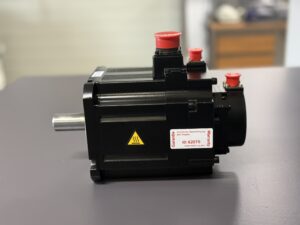
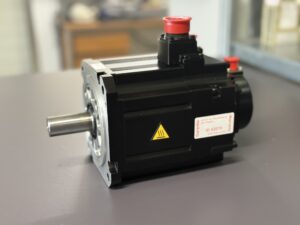
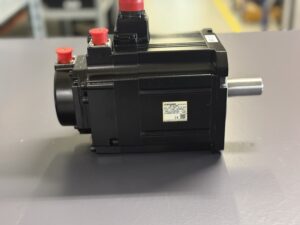
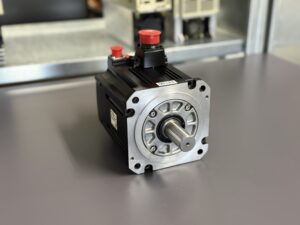
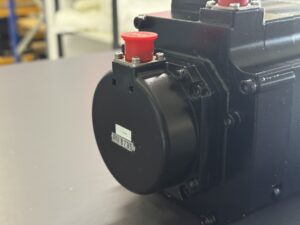
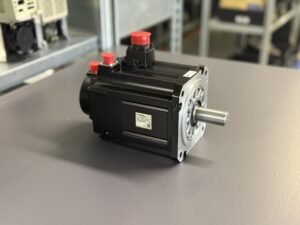
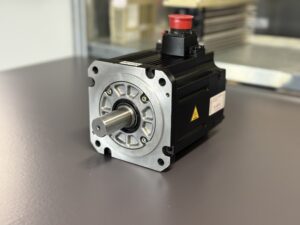
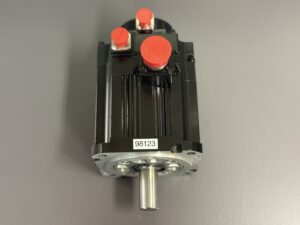
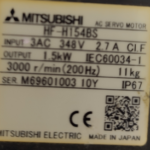
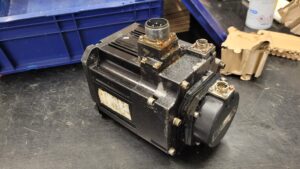
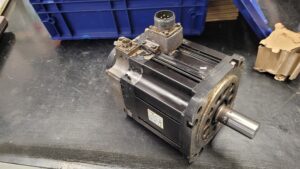
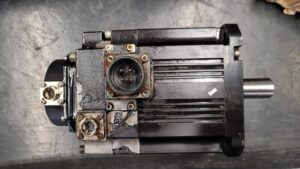
To mentioned Mitsubishi Motor:
Mitsubishi HF-H154BS AC Servo Motor
More details about our Mitsubishi repair services can be found here:
Mitsubishi motor Repair by Industrypart
📞 Feel free to contact us with any questions about your Mitsubishi drive technology.
Our expert team is happy to help!
Technical Specifications
| Feature | Value |
|---|
| Manufacturer | Mitsubishi Electric |
| Device Type | AC Servo Motor |
| Model | HF-H154BS |
| Series | HF Series |
| Power | 1.5 kW |
| Input Voltage | approx. 3AC 348 V |
| Output Voltage | approx. 200 V class |
| Rated Current | approx. 2.7 A |
| Control Type | Speed and position control |
| Feedback | Incremental encoder Mitsubishi OSA18-100 |
| Cooling | Self cooled |
| Protection Class | IP67 |
| Ambient Temperature | 0 to 40 °C |
| Mounting | Flange mounting |
| Origin | Made in Japan |
| Product Status | Active |
Application Environment and Compatibility
Typical applications:
- CNC machining centers
- Machine tools
- Automation systems
- Positioning axes
Typical production years: approx. 2005 to 2015
Requirements:
- Dry environment or protected installation
- Clean cable routing
- Stable voltage supply
- Protection against coolant
Functional Description
The motor operates as a permanent magnet synchronous motor. Power control is provided by the MDS-DH-V2-2020 servo drive.
Feedback supplies position and speed information. Closed loop control is implemented.
Protection functions:
- Overcurrent monitoring
- Temperature monitoring
- Feedback signal monitoring
- Insulation protection
These functions are safety relevant for precise positioning.
Alarm Messages and Troubleshooting
Based on Alarme
| Alarm Code | Description | Possible Cause | Action |
|---|
| 10 | Insufficient voltage | Voltage drop | Check supply |
| 17 | A/D converter error | Current feedback error | Check drive |
| 24 | Grounding | Motor to ground fault | Measure insulation |
| 30 | Over regeneration | Brake resistor overload | Check resistor |
| 31 | Overspeed | Speed exceeded | Check parameters |
| 32 | Power module overcurrent | Power stage overload | Check motor |
| 33 | Overvoltage | DC bus too high | Check supply |
| 46 | Motor overheat | Temperature too high | Check cooling |
| 50 | Overload 1 | Motor overload | Reduce load |
| 51 | Overload 2 | Continuous high current | Check parameters |
Assembly Overview
| Assembly | Description | Function | Notes |
|---|
| Stator | Winding unit | Torque generation | Check insulation |
| Rotor | Permanent magnet unit | Magnetic field | Mechanical check |
| Feedback | Incremental encoder | Position feedback | Check signal |
| Holding brake | 24 V DC brake | Holding function | Check switching time |
| Bearings | Shaft bearings | Mechanical guidance | Check play |
| Sealing system | Shaft seal | Protection against fluid | Regular inspection |