06.09.2026 by Viktor Siebert
Production Risk Due to a Sporadic Encoder Fault, Mitsubishi HF154BT AC Servo Motor Repaired
A sporadic encoder fault is particularly critical in a CNC machine: the motor may initially operate without any abnormalities, while the feedback intermittently fails and the machine control interrupts the machining process. This was exactly the fault pattern presented by a Mitsubishi AC Servo Motor HF154BT, alternatively designated HF154BT-A48, when it arrived at our workshop.
The fault was not permanent. This made it difficult to isolate during operation and created an unpredictable risk of machine downtime. With this type of damage, simply resetting the most recently displayed alarm is not sufficient. The decisive factor is an inspection of the complete motor system, including the encoder, bearings, brake and seals.
Initial Diagnosis
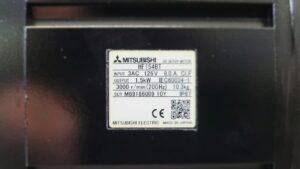
The nameplate clearly identified the unit as a Mitsubishi HF154BT. An OSA18-100 encoder and an SBR-110-057 electromagnetic brake rated for 24 V DC were installed.
During disassembly, it became apparent that an oil mixture had entered the motor and the encoder area. The seals had become porous after many years of ageing and had lost their protective function. In addition to the encoder, the brake and ball bearings were also affected.
The diagnosis therefore focused on:
- the condition and signal stability of the OSA18-100 encoder
- traces of the penetrated oil mixture in the encoder area
- the mechanical running characteristics and condition of the ball bearings
- operation of the SBR-110-057 holding brake
- the condition of all sealing points
- final operation with a suitable Mitsubishi Servo Drive
IGBTs, gate drivers, DC-link capacitors and power-supply components are parts of a Servo Drive, not of the servo motor repaired in this case. They were therefore not part of this motor repair.
Actual Cause of the Fault
The fault analysis did not reveal an isolated encoder defect, but rather age-related consequential damage:
- The motor seals had become porous over the years of operation.
- The weakened sealing points allowed an oil mixture to enter the motor and reach the encoder area.
- The contamination affected the OSA18-100 encoder and caused sporadic position-feedback faults.
- The SBR-110-057 brake was also no longer operating correctly.
- The ball bearings were defective and had to be replaced as part of the mechanical overhaul.
The sporadic nature of the fault is consistent with an encoder whose operation has been impaired by penetrating fluids: at times, the feedback may still appear plausible before failing again. The specific alarm code displayed on the customer’s machine was not documented. For this reason, no individual MDS-D alarm is retrospectively presented as the alarm that actually occurred.
Repair Measures
The Mitsubishi HF154BT was fully repaired. The work included:
- disassembly and detailed inspection of the servo motor
- removal of contamination that had entered the motor
- replacement of the defective OSA18-100 encoder
- repair of the SBR-110-057 brake
- replacement of the defective ball bearings
- replacement of the aged and porous seals
- mechanical inspection after reassembly
- functional testing of the motor, encoder and brake
- test run using a Mitsubishi MDS-D-V1-20 Servo Drive
Replacing the encoder alone would not have eliminated the actual point of entry. Only by replacing the seals was the underlying cause addressed and the new encoder protected against an immediate recurrence of the same damage mechanism.
Final Test and Return Shipment
After completion of the mechanical and electrical work, the HF154BT was operated using a Mitsubishi MDS-D-V1-20. Motor operation, encoder feedback and the function of the repaired brake were tested together with the Servo Drive.
Only after the test had been completed successfully was the motor prepared for return shipment. This made it possible to evaluate not only the individual components but also the behaviour of the complete servo system under realistic control conditions.
Customer Feedback
No specific customer feedback following reinstallation was available for this repair report. For this reason, no customer statement has been invented.
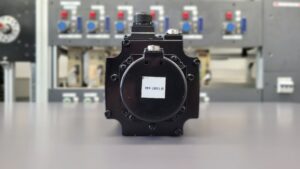
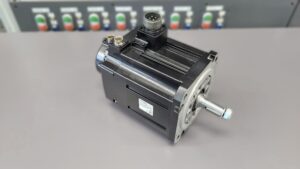
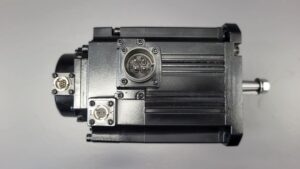
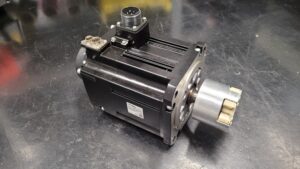
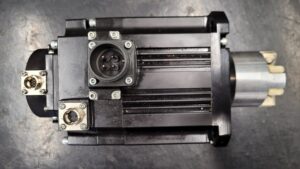
To mentioned Mitsubishi Motor:
Mitsubishi HF154BT-A48 AC Servo Motor
Mitsubishi MDS-D-V1-20 AC Servo Drive Unit
Encoder Mitsubishi OSA18-100
Bremse SBR-110-057, 24 V DC
More details about our Mitsubishi repair services can be found here:
Mitsubishi motor Repair by Industrypart
📞 Feel free to contact us with any questions about your Mitsubishi drive technology.
Our expert team is happy to help!
Technical Data of the Mitsubishi HF154BT
| Feature | Specification |
|---|
| Manufacturer | Mitsubishi Electric |
| Device class | AC servo motor |
| Model | HF154BT |
| Alternative designation in this repair case | HF154BT-A48 |
| Input | 3 AC, 126 V |
| Current | 8.0 A |
| Output power | 1.5 kW |
| Rated speed according to the nameplate | 3,000 r/min |
| Frequency | 200 Hz |
| Insulation class | F |
| Weight | 10.3 kg |
| Degree of protection | IP67 |
| Standard stated on the nameplate | IEC 60034-1 |
| Encoder | OSA18-100 |
| Brake | SBR-110-057, 24 V DC |
| Axes | Not applicable; individual motor |
| Communication interface | Encoder feedback to the Servo Drive; no further specification documented |
The degree of protection stated on the nameplate describes the intended protection of an intact motor. Aged, porous or mechanically damaged seals can compromise this protection in actual operation.
Interaction with Other Devices
- Installed in the motor: Mitsubishi OSA18-100 encoder
- Installed in the motor: SBR-110-057 brake, 24 V DC
- Used for the final test: Mitsubishi MDS-D-V1-20 AC Servo Drive Unit
- Motor-side encoder connection in the MDS-D/DH Series: CN2 according to the available alarm documentation
- Other compatible Servo Drives, power supplies, CNC controls or fieldbus systems cannot be reliably derived from the provided documents and are therefore not listed.
Functional Description
The Mitsubishi HF154BT is an AC servo motor for controlled-axis applications. The Servo Drive controls the motor and processes the feedback from the motor-side encoder. This feedback is required to determine position and rotary movement. If encoder data is transmitted incorrectly or communication is interrupted, the drive can no longer control the axis reliably and triggers a protective response.
The SBR-110-057 serves as a holding brake. Its operation must be tested separately from the motor’s running performance. Mechanical damage to the ball bearings additionally affects smooth running and operational reliability. When a motor has been damaged by penetrating fluid, the electronics, mechanics, brake and sealing system must therefore be assessed together.
Mitsubishi MDS-D/DH Series Alarm and Error Codes
The customer’s fault was described as a sporadic encoder fault, but no recorded alarm code was provided. The following selection lists genuine alarms from the available MDS-D/DH documentation that are relevant to the motor-side encoder path. It does not claim that all of these alarms occurred on the customer’s machine.
| Alarm | Error Name | Meaning | Reset | Measure According to the Manual |
|---|
| 18 | Main side detector: Initial communication error | An error was detected during initial communication with the motor-side detector | PR | Check the parameters and detector type; inspect connectors and detector cable; isolate the fault by substitution; check ambient conditions, grounding and shielding |
| 22 | Detector data error | An error was detected in the feedback data from the position detector | AR | Inspect the detector data path and determine the cause of the detector fault |
| 2B | Main side detector: Error 1 | The motor-side detector connected to CN2 detected an error; for the OSA18, the detector table identifies this as a CPU alarm | PR; AR may apply depending on the detector | Inspect connectors and cable; isolate the drive side from the detector side by substitution; check the detector environment |
| 2D | Main side detector: Error 3 | The motor-side detector detected an error; for the OSA18, the detector table identifies this as a data alarm | PR; AR may apply depending on the detector | As for detector alarm 2B: check the connection, cable, detector, drive side and ambient conditions |
| 2F | Main side detector: Communication error | An error was detected in communication data with the motor-side detector, or communication was interrupted | PR | Check connectors, cable routing, shielding, single-point grounding and the detector cable; isolate the fault between the drive and detector |
| 31 | Overspeed | The detected motor speed exceeded the permissible speed | PR | Check parameters and the speed waveform; if the displayed speed fluctuates while the motor is stopped, replace the detector or detector cable |
Reset legend: PR means switching the NC power supply on again; AR means switching the Servo Drive Unit power supply on again. Resetting an alarm does not eliminate its physical cause.
Conclusion
On this Mitsubishi HF154BT or HF154BT-A48, the sporadic encoder fault was caused by an oil mixture entering the motor. The original cause was age-related deterioration of the seals. The damage was not limited to the OSA18-100 encoder: the SBR-110-057 brake and ball bearings were also affected.
By replacing the encoder, repairing the brake, replacing the ball bearings and seals, and completing the final test using a Mitsubishi MDS-D-V1-20, the AC servo motor could be fully inspected. This case demonstrates why a sporadic encoder fault on a CNC Drive should not be treated as an isolated electrical defect. Particularly on older servo motors, the point of entry for oil or coolant must be addressed as an integral part of the repair.