04.07.2026 by Viktor Siebert
Mitsubishi AC Servo Motor HF104S-A48 with OSA18-100 Encoder. Coolant Contamination Led to Insulation Failure and Sporadic Encoder Errors
Industrial Service Case.
An industrial customer contacted our repair workshop after a CNC machine repeatedly reported sporadic axis faults. The machine was equipped with a Mitsubishi AC Servo Motor HF104S-A48 operating together with a Mitsubishi MDS-D-V1-10 Servo Drive. Initially, only occasional encoder errors appeared. Over time, however, the behaviour became increasingly unstable. The axis generated intermittent position faults, while insulation measurements revealed values far below the acceptable range.
The most critical aspect was that the motor continued operating despite the severe internal damage. Under less favorable conditions, the damaged motor could have permanently destroyed the connected servo drive. Because production downtime was becoming unavoidable, the customer immediately sent the motor to our workshop for inspection.
Initial Diagnosis
The incoming inspection immediately confirmed a serious defect.
The first measurements revealed:
- significantly reduced insulation resistance
- intermittent OSA18-100 encoder faults
- clear indication of moisture contamination
- worn motor bearings
- increased mechanical play
Since electrical and mechanical failures often influence each other, the motor was completely dismantled.
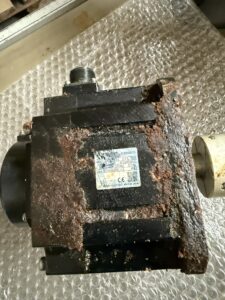
Immediately after opening the motor housing, the real cause became obvious.
A considerable amount of coolant emulsion drained from the motor. The shaft seals had completely lost their sealing capability, allowing coolant to enter the motor housing over an extended period.
The complete encoder assembly was contaminated with coolant and oil residue. At the same time, the motor bearings showed severe wear and early corrosion.
Root Cause Analysis
After complete disassembly, the failure could be clearly identified.
The following components were affected:
- worn shaft seals allowing coolant ingress
- heavily contaminated OSA18-100 encoder
- insulation deterioration caused by moisture
- worn motor bearings
- corrosion on several internal components
- contamination throughout the complete motor interior
The combination of poor insulation and encoder contamination represented the greatest risk.
The Mitsubishi MDS-D-V1-10 Servo Drive continuously monitors motor current, encoder feedback and multiple protection parameters. Even minor disturbances in encoder communication or insulation quality may trigger protective shutdowns. The Mitsubishi MDS-D/DH Instruction Manual describes detector errors, communication errors, grounding faults and thermal alarms that may occur under these conditions.
Fortunately, the customer was lucky.
Although the motor already suffered severe insulation deterioration, the connected servo drive itself had not yet been damaged. Continued operation could easily have resulted in permanent failure of the power stage.
Repair Procedure
Following the detailed inspection, the motor underwent a complete overhaul.
The repair included:
- complete disassembly
- removal of all coolant contamination
- intensive cleaning of every component
- replacement of all shaft seals
- replacement of all motor bearings
- cleaning and refurbishment of the Mitsubishi OSA18-100 encoder
- inspection of all electrical connectors
- insulation testing of the stator windings
- rotor inspection
- bearing seat inspection
- precise encoder alignment
- reassembly according to manufacturer specifications
With older CNC servo motors, simply repairing the visible defect is rarely sufficient. Once coolant enters the motor, seals, bearings and insulation systems usually deteriorate simultaneously. Therefore, all affected wear components were replaced during the overhaul.
Final Functional Testing
After reassembly, the motor underwent extensive testing on our test bench.
The final inspection included:
- insulation resistance measurement
- encoder signal verification
- feedback system testing
- operation on a Mitsubishi MDS-D-V1-10 Servo Drive
- servo control verification
- temperature monitoring
- mechanical vibration and smooth running inspection
Only after successfully completing all functional tests was the motor approved for shipment back to the customer.
The repaired motor is now ready to return to reliable operation within the customer’s CNC machine.
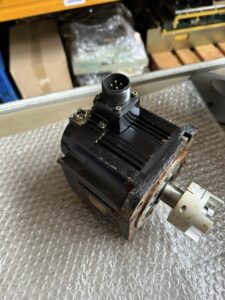
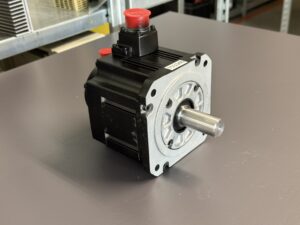
To mentioned Mitsubishi Motor:
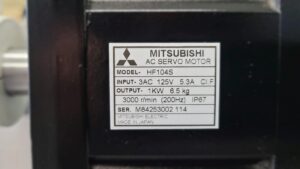
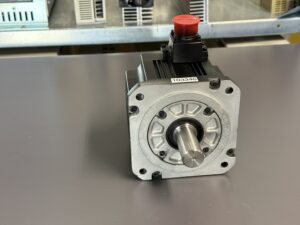
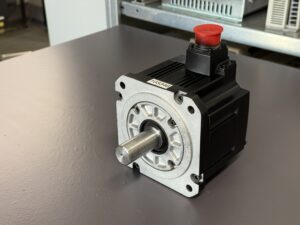
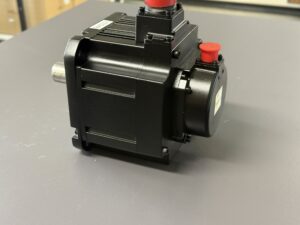
Mitsubishi HF104S-A48 AC Servo Motor
More details about our Mitsubishi repair services can be found here:
Mitsubishi motor Repair by Industrypart
📞 Feel free to contact us with any questions about your Mitsubishi drive technology.
Our expert team is happy to help!
Technical Specifications
| Specification | Description |
|---|
| Manufacturer | Mitsubishi Electric |
| Model | HF104S-A48 |
| Device Type | AC Servo Motor |
| Supply Voltage | 3 AC 125 V |
| Rated Current | 5.3 A |
| Rated Output | 1 kW |
| Rated Speed | 3000 rpm |
| Frequency | 200 Hz |
| Protection Class | IP67 |
| Insulation Class | Class F |
| Weight | 6.5 kg |
| Encoder | Mitsubishi OSA18-100 |
| Compatible Servo Drive | Mitsubishi MDS-D-V1-10 |
| Country of Origin | Made in Japan |
Operating Environment
The Mitsubishi HF104S-A48 has been designed for highly dynamic CNC axis applications and is typically operated together with Mitsubishi MDS-D series servo drives. Thanks to its IP67 protection rating, the motor is suitable for industrial environments where coolant is present. However, this level of protection depends on shaft seals remaining fully functional throughout the motor’s service life.
Typical applications include:
- CNC machining centres
- Machine tools
- Milling machines
- Turning centres
- Rotary tables
- Automatic tool changers
- Feed axes
- Automated production systems
Compatible Equipment
The motor is commonly operated together with:
- Mitsubishi MDS-D-V1-10 Servo Drive
- Mitsubishi MDS-D Servo Drives
- Mitsubishi MDS-DH Servo Drives
- Mitsubishi CNC Controls
- Mitsubishi OSA18-100 Encoder
- Mitsubishi feed axes
Functional Description
The Mitsubishi HF104S-A48 is a permanent magnet AC servo motor designed for highly accurate positioning of industrial CNC axes.
The Mitsubishi MDS-D-V1-10 Servo Drive performs the following functions:
- Current control
- Speed control
- Position control
- Encoder monitoring
- Motor insulation supervision
- Overcurrent protection
- Overload protection
- Ground fault monitoring
- Temperature monitoring
- Communication with the CNC controller
Position feedback is provided by the Mitsubishi OSA18-100 encoder. The Mitsubishi MDS-D/DH Instruction Manual includes dedicated diagnostic and protection functions for this encoder family.
Typical Failures of This Motor Type
Based on our repair experience, the following failures are frequently encountered:
| Failure | Cause |
|---|
| Coolant ingress | Worn shaft seals |
| Poor insulation | Moisture inside the stator windings |
| Encoder errors | Oil or coolant contamination inside the encoder |
| Bearing failures | Lubrication loss and wear |
| Corrosion | Long-term moisture exposure |
| Unstable motor operation | Bearing and encoder problems |
| Sporadic servo alarms | Disturbed feedback signals |
Main Components
| Component | Function | Inspection |
|---|
| Stator windings | Torque generation | Insulation measurement |
| Rotor | Magnetic field generation | Visual inspection |
| Bearings | Shaft support | Noise and radial play inspection |
| Shaft seals | Protection against coolant ingress | Visual inspection |
| OSA18-100 Encoder | Position feedback | Signal verification |
| Power connector | Electrical connection | Contact inspection |
| Motor housing | Heat dissipation | Corrosion inspection |
| Output shaft | Mechanical power transmission | Runout measurement |
Alarm and Fault Codes (MDS-D Servo Drive)
The following alarms originate from the Mitsubishi MDS-D/DH Instruction Manual and are particularly relevant for motor, encoder and insulation related failures.
| Alarm | Fault Name | Meaning | Reset | Corrective Action |
|---|
| 18 | Main side detector Initial communication error | Encoder communication failure | PR | Check encoder, cable and connectors |
| 22 | Detector data error | Invalid encoder data | AR | Inspect or replace encoder |
| 24 | Grounding | Motor cable connected to ground | PR | Measure insulation and inspect motor |
| 2B | Main side detector Error 1 | Internal encoder fault | PR | Inspect encoder |
| 2F | Main side detector Communication error | Encoder communication interrupted | PR | Check cable shielding and connectors |
| 31 | Overspeed | Motor exceeded permissible speed | PR | Verify control parameters and encoder |
| 32 | Power module overcurrent | Overcurrent detected | PR | Inspect motor insulation and power stage |
| 41 | Feedback error 3 | Missing Z pulse or encoder fault | PR | Check encoder |
| 42 | Feedback error 1 | Position feedback error | PR | Inspect encoder or feedback cable |
| 43 | Feedback error 2 | Difference between feedback systems | PR | Verify encoder alignment |
| 46 | Motor overheat / Thermal error | Motor or thermal monitoring detected overheating | NR | Inspect motor cooling |
| 50 | Overload 1 | Motor or drive overloaded | NR | Reduce mechanical load |
| 51 | Overload 2 | Continuous high motor current | NR | Check load and parameters |
Why Did the Failure Occur?
In this repair case, the encoder itself was not the primary cause of failure.
The original defect was caused by worn shaft seals.
As a result, coolant entered the motor over an extended period.
The consequences were:
- deterioration of winding insulation
- corrosion
- bearing failure
- encoder contamination
- intermittent positioning errors
- increased risk of damaging the connected servo drive
The poor insulation represented the greatest risk.
The Mitsubishi manual explicitly states that Grounding Alarm 24 may be caused by insulation failure of either the motor or motor cable and recommends insulation testing as part of the troubleshooting procedure.