03.05.2026 by Viktor Siebert
Haas 93-32-5552F / 32-5552F Servo Amplifier 60A Overtemperature Due to Cooling Fan Failure and Secondary Damage in the Power Stage
Initial Situation and Fault Description
At the customer site, the alarm 991 amplifier overtemperature occurred repeatedly along with 1.994 to 11.994 cooling fan fault. The system initially continued running, but shutdowns became more frequent under load. It was noticeable that the fault did not appear immediately after startup, but only after some operating time. This clearly indicates a thermal issue rather than a typical electrical fault such as a short circuit or communication error.
The amplifier had been operated for an extended period without proper cooling. This led to gradual overloading of internal components. The machine still ran intermittently, which is typical when thermal limits are only occasionally exceeded.
Incoming Inspection and Initial Diagnosis
During incoming inspection, a significantly increased level of contamination was visible in the cooling area. The fan was mechanically blocked and no longer operational. Deposits were also found inside the cooling channels.
Electrically, the unit was not completely failed. The amplifier powered on, but temperatures inside the power stage increased rapidly. Initial measurements showed uneven heat distribution.
This clearly indicated that not only the fan was defective, but that thermal damage had already occurred in the power stage.
Technical Analysis
The fault can be clearly explained:
Cause → fan failure
Effect → no heat dissipation
Result → thermal overload of power electronics
Symptom → overtemperature alarm and shutdown
Power modules and internal current paths rely on proper cooling. Without it, the following occurs:
- thermal aging of components
- increasing internal resistance
- higher power losses
- further temperature rise
This process reinforces itself. Typically, the unit continues to function initially but becomes unstable under load.
Repair Measures and Refurbishment
The amplifier was completely disassembled and refurbished.
Actions performed:
- full disassembly of the unit
- cleaning of all cooling channels and airflow paths
- replacement of the defective cooling fan
- inspection of the power stage for thermal damage
- replacement of thermally stressed components
- rework of electrical connections in the power section
- verification of current paths and insulation
Additionally, components affected by overheating were replaced preventively.
The goal was not only to fix the failure but to restore long-term operational reliability.
Final Function Test
The amplifier was tested under realistic conditions on a test bench.
Test procedure:
- power-on behavior and enable testing
- operation at low load
- operation at medium load
- operation under high load
- thermal stability testing
- temperature monitoring
Special focus was placed on temperature behavior during continuous operation. After repair, the unit showed stable thermal performance without abnormalities.
Cooling worked correctly and temperature remained stable even under load.
Conclusion
The root cause was a failed cooling fan. The critical damage, however, occurred due to prolonged operation without proper cooling.
This case clearly shows that a seemingly small issue like a fan failure can cause major secondary damage in the power stage.
Through complete refurbishment, the amplifier was restored to a stable and safe operating condition.
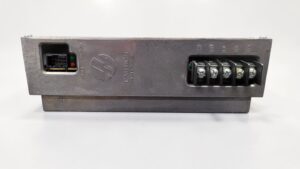
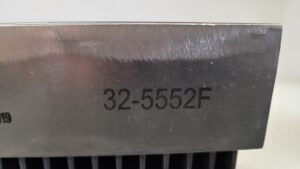
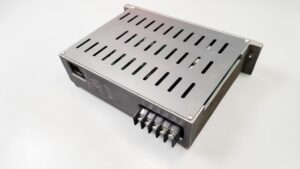
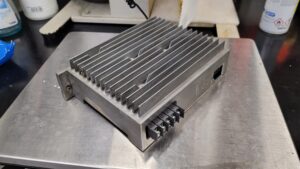
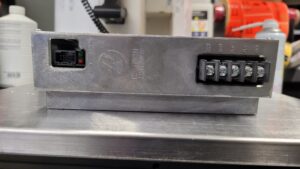
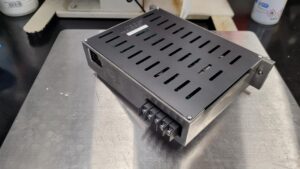
To mentioned HAAS Drive: HAAS Servo Amplifier 93-32-5552F / 32-5552F
More details about our HAAS repair services can be found here:
HAAS drive Repair by Industrypart
📞 Feel free to contact us with any questions about your HAAS drive technology.
Our expert team is happy to help!
Technical Specifications
| Parameter | Value |
|---|
| Manufacturer | Haas Automation |
| Device Type | Servo Amplifier |
| Model | 93-32-5552F / 32-5552F |
| Series | NGC Servo System |
| Power | approx. 60 A |
| Input Voltage | approx. 3x 200 to 240 V |
| Output Voltage | motor dependent |
| Rated Current | approx. 60 A |
| Control Type | PWM controlled servo drive |
| Feedback | encoder dependent |
| Cooling | forced air cooling |
| Protection Class | control cabinet installation |
| Ambient Temperature | approx. 0 to 40 °C |
| Mounting | control cabinet |
| Origin | USA |
| Product Status | active / in use |
Operating Environment and Applications
Typical machines:
- CNC machining centers
- milling machines
- lathes
Typical production years:
Typical applications:
- axis drives
- spindle control
- positioning systems
Requirements:
- clean control cabinet environment
- stable power supply
- proper cooling
Thermal load is critical. Even small airflow issues can lead to long-term damage.
Functional Description
The servo amplifier controls power delivery to the motor.
It consists of:
- power stage for motor supply
- control electronics for current and speed
- feedback evaluation
- protection logic
Thermal monitoring is a key protection feature. When limits are exceeded, the system shuts down to prevent damage.
Alarm Messages and Troubleshooting
| Alarm Code | Description | Possible Cause | Recommended Action |
|---|
| 993 | Amplifier short circuit | short circuit detected | check cables for damage |
| 2040 | spindle/vector drive short circuit | internal fault | inspect amplifier |
| 986 | calibration error | internal calibration issue | check control cable and DC voltage |
| 992 | overcurrent | mechanical blockage | check axis |
| 994 | overload | incorrect application or blockage | adjust speed, remove blockage |
| 991 | amplifier overtemperature | cooling fan problem | check fan |
| 1.9911 | cable disconnected | damaged or loose cable | check wiring |
| 3.991 | Z-axis overtemperature | electrical noise or real overheating | install ferrite, check cooling |
| 4.9921 | excessive speed error | incorrect wiring | inspect wiring |
| Fan fault | cooling failure | fan defect or blockage | replace fan |
Component Overview
| Assembly | Functional Name | Function | Notes |
|---|
| Power stage | output module | motor control | thermally critical |
| Control board | regulation | signal processing | sensitive |
| Cooling system | fan and heatsink | heat dissipation | must be clean |
| Power supply | internal voltage | system supply | stable required |
| Interfaces | communication | control signals | check if faulty |