22.12.2025 by Viktor Siebert
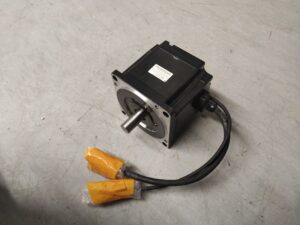
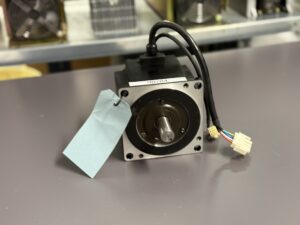
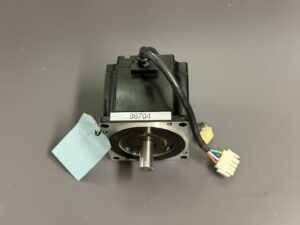
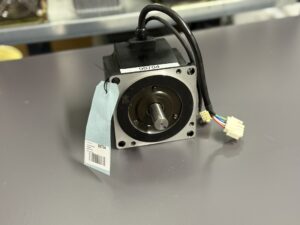
Repair of a Yaskawa AC Servo Motor SGMP-15A312 with UTMSH-20ANP Encoder
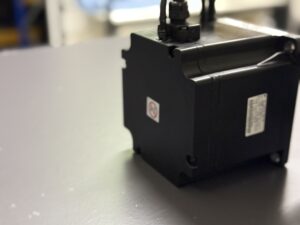
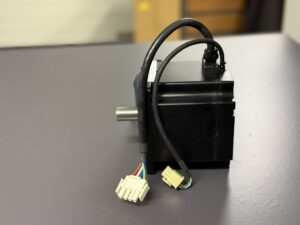
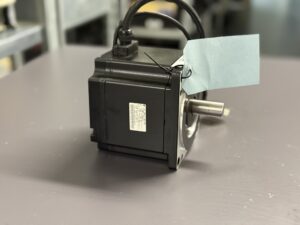
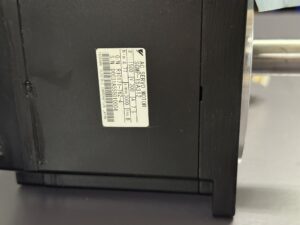
The Yaskawa AC servo motor SGMP-15A312 was delivered to us following an acute overload alarm. The repair request was time critical, as the affected machine was essential for production.
From the service history it was already known that the motor had been overhauled approximately 15 months earlier by an external motor service company. At that time, vibration issues occurred on the axis after the repair, which required several rework attempts. According to the customer, the cause was an incorrect encoder positioning. Since the previous repair company did not have a suitable servo drive for testing, the final encoder adjustment was carried out directly on the machine.
After a longer period of trouble free operation, the machine recently reported an overload condition. Initially, a mechanical blockage of the axis was suspected. After releasing the axis, it became clear that the motor shaft could barely be rotated by hand.
The motor was then delivered directly to our facility.
Already during the first manual rotation, significantly increased resistance was noticeable. After opening the motor, a severe internal damage pattern became evident. The interior of the motor was heavily contaminated with metallic abrasion. These particles were distributed throughout the entire interior and had penetrated into the encoder area.
The root cause could clearly be traced back to the installed ball bearings. Bearings were fitted that appeared geometrically similar but were not suitable for this motor type from a technical standpoint. Despite having matching designations, they did not meet the required tolerances or material properties.
Due to the incorrect bearing selection, progressive wear developed over time. Friction continuously increased, causing the motor to draw higher current. The servo control attempted to compensate for this resistance, which ultimately resulted in the overload alarm.
Additionally, the abrasion led to contamination of the encoder, further degrading control stability.
The next step involved complete disassembly of the motor. All components were thoroughly cleaned to remove even the finest abrasion particles. The bearing system was completely renewed using only original specified components. The encoder was removed, inspected and precisely re adjusted.
Particular attention was paid to exact mechanical alignment, as even minimal deviations can lead to vibration and control instability.
Following mechanical reassembly, comprehensive testing was performed on our test bench using a compatible Yaskawa servo drive. The motor was operated under various load conditions, thermally monitored and evaluated for smooth running behavior.
The result was stable, vibration free operation with normal current consumption.
This case clearly demonstrates the consequences of repairs carried out without proper test equipment and without a thorough understanding of original component specifications. Failures do not always occur immediately but often develop gradually over many months. For the customer, this means seemingly low cost repairs that ultimately result in significantly higher long term costs.
Preventive Measures for the Customer
| Measure | Benefit |
|---|
| Use of original components | Avoidance of secondary damage |
| Test run with compatible drive | Early fault detection |
| Regular operational monitoring | Prevention of overload conditions |
| Clean operating environment | Protection of bearings and encoder |
| Documented repair process | Traceability |
| Preventive bearing replacement | Extended service life |
Conclusion
The Yaskawa SGMP-15A312 is a precise and robust servo motor, but its reliability strongly depends on professional repair procedures.
Only repairs using original components, correct encoder adjustment and realistic load testing ensure long term machine availability and prevent unplanned downtime.
Information about the mentioned Servopack and Servomotor:
More information about our Yaskawa repairs can be found here.
📞 Feel free to contact us if you have any questions regarding your Yaskawa drive technology. Our experie
Device Data (Technical Specifications)
| Feature | Value |
|---|
| Manufacturer | Yaskawa Electric Corporation |
| Motor type | AC servo motor |
| Model | SGMP-15A312 |
| Rated power | approx. 1.5 kW |
| Rated voltage | approx. 200 V |
| Rated speed | approx. 3000 rpm |
| Encoder | UTMSH-20ANP |
| Feedback type | Incremental |
| Cooling | Self cooling |
| Protection class | approx. IP54 |
| Insulation class | B |
| Shaft design | Smooth output shaft |
| Compatible drive | Yaskawa SGDB-10ADG |
| Country of origin | Japan |
Operating Environment and Compatible Devices
The Yaskawa SGMP-15A312 is typically used in CNC machines, machining centers, handling systems and special purpose machines.
The combination with the SGDB-10ADG servo drive is designed for applications requiring precise positioning, stable torque and smooth speed control.
Typical operating conditions include multi shift operation, varying loads and machine environments with dust, oil mist or temperature fluctuations.
Functional Description
The motor operates as a brushless AC servo motor with encoder based position and speed feedback.
The UTMSH-20ANP encoder supplies position signals to the servo drive, which regulates current, torque and speed based on this feedback.
The mechanical precision of the motor, especially the bearing system, shaft alignment and encoder adjustment, is critical for smooth operation and low control deviation.
Even minor deviations in encoder positioning or increased friction in the bearing system have a direct impact on control behavior, vibration levels and current consumption.
Alarm Messages and Troubleshooting
| Code | Description | Cause | Corrective action |
|---|
| Overload | Overload alarm | Increased friction or blockage | Check mechanics and motor |
| Overcurrent | Overcurrent | Restricted shaft movement | Inspect bearings and load |
| Encoder error | Encoder fault | Incorrect adjustment or signal disturbance | Inspect and realign encoder |
| Speed deviation | Speed deviation | Mechanical instability | Check bearing condition |
| Servo alarm | Control deviation | Unstable feedback | Verify encoder position |
| Motor overheat | Overtemperature | Increased internal losses | Eliminate mechanical causes |
| Vibration alarm | Mechanical vibration | Imbalance or incorrect bearings | Restore mechanical integrity |
| Position error | Position deviation | Encoder fault | Re adjust encoder |
| Torque limit | Torque limitation | Increased friction | Remove mechanical cause |
| Axis error | Axis fault | Blockage or restricted movement | Inspect motor |
Components
| Component | Function | Notes |
|---|
| Stator | Magnetic field generation | Insulation inspection |
| Rotor | Torque transmission | Check for imbalance |
| Ball bearings | Mechanical support | Correct fit essential |
| Encoder | Position feedback | Precise adjustment required |
| Encoder coupling | Torque transfer | Avoid play |
| Seals | Protection against contamination | Replace regularly |
| Housing | Mechanical protection | Cleanliness critical |
| Connectors | Power and signal transmission | Inspect contacts |