02.08.2025 by Viktor Siebert
A special Case – Encoder Faults on the SGMGS‑05A5W-SE11
A customer brought us a Yaskawa SGMGS‑05A5W‑SE11 servo motor with a UTSAH‑B17BE encoder. His machine exhibited sporadic encoder faults. After each failure he had to realign the machine, and tools were damaged in the process. Because the motor was not available on the open market, he first replaced the matching Servopack SGDK‑050505AEA‑V without success. Only later did he learn that this was an old development from a joint venture between Yaskawa and Siemens, and the parts had been discontinued for years.
Why Conventional Parts Procurement Fails
The motor originates from a series that was produced only briefly. After the joint venture was dissolved, the components were withdrawn from the market. Machine operators tried to buy used motors through online platforms but often encountered counterfeit or already defective units. Even replacing the drive does not help when the real fault is inside the motor.
Our Solution, Repair Instead of Replacement
We have been familiar with this problem for years. In most cases the encoder is the weak point. Instead of risky used purchases, we have developed a structured repair process. We replace the defective encoder with a new original part and program it precisely for the motor. This preserves the original performance and avoids costly downtime.
How We Test and Repair
Our repair follows a clearly defined process that reliably restores each motor to its intended condition:
- Incoming inspection and documentation
When the motor arrives, it is carefully recorded, visually inspected and photographed. Serial numbers and labels are documented.
- Preliminary electrical testing
Before opening the motor, we check winding resistances, insulation values, PE connection, encoder connection and brake voltage.
- Mechanical and thermal visual inspection
We examine the shaft, bearing seats and flange for damage. Oil residues or corrosion indicate deeper issues.
- Disassembly and cleaning
The motor is completely disassembled. All parts are cleaned; the housing and windings are dried and thermally treated.
- Fault analysis and replacement of defective components
Defective bearings, encoders, seals or brakes are identified and replaced with new parts. The new encoder is installed and programmed.
- Assembly and mounting
We use brand‑name bearings, inspect the shaft and reassemble the motor precisely according to the manufacturer’s specifications.
- Load testing on the test stand
On an original servopack we check encoder feedback, torque build‑up, brake function, no‑load current and temperature behaviour.
- Final inspection and quality report
After passing all tests, the motor is sealed and delivered with a test report. On request the customer receives a detailed repair report.
- Return shipment
The motor is securely packaged for transport. Express delivery or advance exchange can be arranged.
Conclusion: Extending the Life of Discontinued Servo Motors
This story shows how important it is to have a reliable partner for the overhaul of discontinued components. With our specialised repairs, customers keep their machines productive and avoid the risks of buying defective used parts. We give Yaskawa/Siemens servos a second chance: with warranty, transparency and predictable availability.
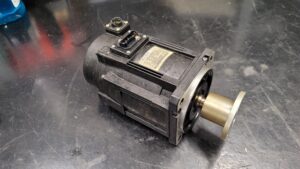
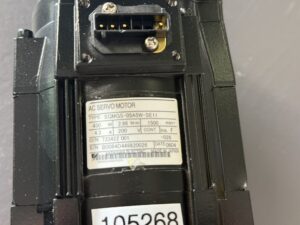
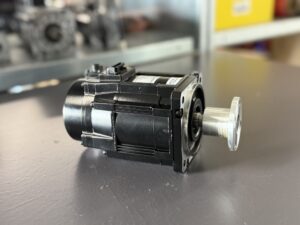
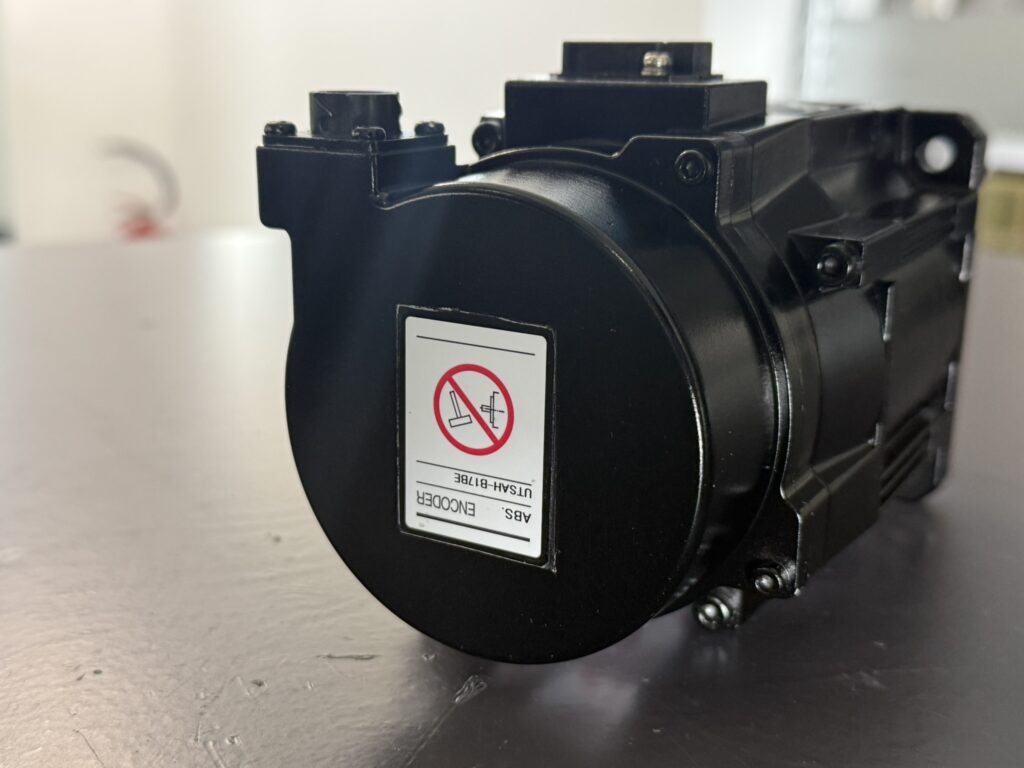
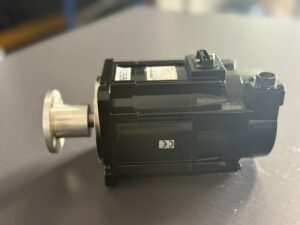
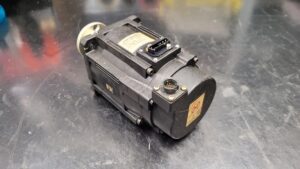
Information about the mentioned Servopack and Servomotor:
More information about our Yaskawa repairs can be found here.
📞 Feel free to contact us if you have any questions regarding your Yaskawa drive technology. Our experienced team is always ready to assist you.
Technical Data of the AC Servo Motor (SGMGS‑05A5W‑SE11)
The following information comes from the motor’s nameplate and from manuals and data sheets for similar 0.45 kW Yaskawa servo motors.
| Parameter | Value* |
|---|
| Rated output | approx. 450 W |
| Rated torque | 2.86 N·m |
| Maximum torque | approx. 8.92 N·m |
| Rated speed / maximum speed | 1 500 min⁻¹ (max. ~4 000 min⁻¹) |
| Rated current | 4.3 A |
| Rated voltage | 200 V AC |
| Duty / insulation class | Continuous operation (insulation class F) |
| Encoder | Absolute/incremental encoder UTSAH‑B17BE |
| Moment of inertia | ≈ 3.33 × 10⁻⁴ kg·m² |
| Mechanical dimensions | Flange 90 mm, flange diameter 100 mm, shaft diameter 16 mm, shaft length 30 mm, depth approx. 185 mm |
| Weight | approx. 3.2 kg |
Functional Description
The Yaskawa SGMGS‑05A5W‑SE11 is a three-phase permanent‑magnet synchronous servo motor. It belongs to the Σ‑V series (Sigma V) and delivers a rated torque of 2.86 N·m at 450 W output. The motor comprises a laminated stator with distributed windings, a high‑energy magnet rotor with low inertia, precision bearings and an integrated encoder (UTSAH‑B17BE) for position and speed feedback. This encoder provides incremental and absolute signals, enabling the controller to know the motor position at all times. Brakes (24 V DC or 90 V DC) and oil seals can be fitted to hold vertical axes when power is off or to protect the motor from oil or coolant ingress.
The servo amplifier SGDK‑050505AEA‑V forms the power and control unit. It converts the mains supply into a regulated voltage for the motor, controls current, torque, speed and position using vector current control and processes the feedback signals from the encoder. Motion commands can be issued via digital inputs from a PLC or CNC. The amplifier includes a regenerative braking stage that converts the braking energy into heat or passes it to an external brake resistor. Protective functions such as over‑current and over‑temperature protection, under‑voltage monitoring and communication fault diagnostics are built in. Together, motor and amplifier enable precise positioning and speed control for machine tools, printing presses, robots or packaging machines.
Alarm Messages and Troubleshooting
The table lists selected alarm messages from the inverter fault list. The CNC‑Code column is included where available; the Drive Code is critical. The Possible solution column gives troubleshooting hints based on general servo experience.
| Drive‑Code (CNC‑Code) | Alarm / Description | Possible solution |
|---|
| 0x10 (16) | Over‑current (short‑circuit current) – The drive detects a very high current. | Check motor power cables for short‑circuits or loose conductors. Ensure the load torque is within the permissible range and reduce acceleration ramps. |
| 0x11 (17) | Ground fault – Earth fault in the power stage. | Test the motor and cables with an insulation tester. Check for moisture or metal chips in the terminal box and eliminate the fault. |
| 0x14 (20) | Motor over‑current – Motor current exceeds the rated value. | Reduce the load or acceleration. Check whether the mechanical axis is blocked. |
| 0x20 (32) | Fuse blow‑out – Fuse in the power stage has tripped. | Replace the fuse after identifying the cause (short circuit in the motor or amplifier). |
| 0x30 (48) | Regeneration error – Error in dissipating braking energy. | Inspect the regeneration resistor (internal or external). Ensure that braking energy is dissipated and the braking circuit is correctly dimensioned. |
| 0x41 (65) | Low‑voltage – Supply voltage too low. | Check the mains supply and ensure the input voltage is stable. Inspect line filters and wiring. |
| 0x51 (81) | Overspeed (motor) – Speed above the limit. | Verify that speed/position commands are correct. Reduce the target speed. |
| 0x52 (82) | Overspeed (machine) – Machine torque or feedback outside the permissible range. | Check that the encoder functions correctly. Ensure the mechanical axis is not slipping and that the load is not too low (avoid overshoot). |
| 0x53 (83) | Excessive speed deviation – Difference between target and actual speed is too high. | Adjust the control parameters (P/I gains) or reduce load changes. Check the encoder connection for open circuits. |
| 0x60 (96) | Tuning incomplete (encoder used) – Automatic motor tuning was not completed successfully. | Perform the tuning procedure with a free axis. Ensure no mechanical load is on the axis and parameters are set correctly. |
| 0x61 (97) | C‑phase signal failure – C‑phase signal from the encoder is missing. | Check the encoder cable; replace the encoder if the signal is absent. |
| 0x62 (98) | C‑phase signal wire break – Wire break in the encoder. | Inspect connectors and replace damaged cables. |
| 0x64 (100) | Position feedback wire break – Position feedback cable faulty. | Check the feedback cables and plug. Replace if necessary. |
| 0x72 (114) | Over‑load (maximum continuous load) – Motor or amplifier is overloaded for an extended period. | Reduce the load torque or duty cycle. Use a motor with higher power if needed. |
| 0x92 (146) | Regeneration over‑load warning – Too much braking energy in the resistor. | Check the resistor and duty cycles. Install an external resistor with higher power if necessary. |
| 0x97 (151) | Heat sink overheat (warning) – Servo amplifier temperature too high. | Improve cooling; ensure fans are operating and air flow is unobstructed. |
| 0x98 (152) | Motor over‑heat (warning) – Motor temperature too high. | Check the ambient temperature and load. Allow the motor to cool and reduce the load profile. |
| 0xB3 (179) | U‑phase/V‑phase A/D converter error – Error in current detection. | Switch off the servopack and arrange for repair; possible cause is a defective A/D converter in the amplifier. |
| 0xC4 (196) | Wire break in pulse encoder C‑phase – C‑phase feedback cable interrupted. | Check and replace the cables; inspect the encoder plug. |
| 0xC5 (197) | Motor magnetic pole detection error – The motor pole count does not match. | Check motor parameters (number of pole pairs) in the amplifier, re‑initialise the motor encoder. |