27.12.2025 by Viktor Siebert
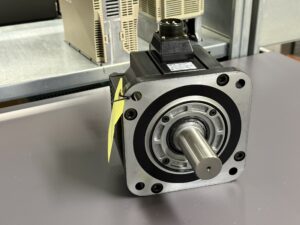
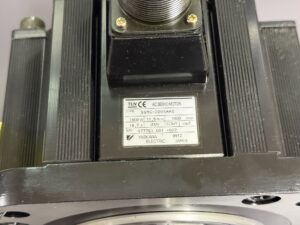
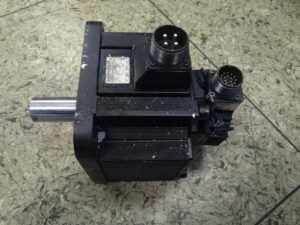
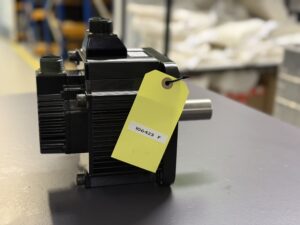
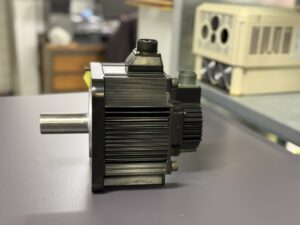
Repair of a Yaskawa AC Servo Motor SGMG-20VSAAS with intermittent encoder faults
Initial Situation and Background
The Yaskawa AC servo motor SGMG-20VSAAS was submitted to our workshop after a long period of sporadic machine stoppages. The motor was installed in a CNC machine and had been operating reliably for many years. Over time, however, the customer began experiencing occasional axis interruptions accompanied by encoder-related fault messages.
What made this case particularly challenging was the irregular nature of the failure. The machine could run without issues for days or even weeks, followed by sudden stoppages. In most cases, restarting the machine and manually moving the axis allowed production to continue. As a result, the problem was tolerated for a long time, even though confidence in the system steadily declined.
Due to the age of the machine and limited availability of original spare parts, it was initially unclear whether the root cause was located in the servo drive or within the motor itself.
Observed Fault Pattern and Symptoms
A closer analysis of the failure history revealed a noticeable pattern. The encoder faults occurred more frequently during cold and humid environmental conditions, especially after longer machine downtimes. Once the machine had warmed up, the error often disappeared temporarily.
This behavior is typical for aging feedback systems. Intermittent faults of this type are particularly deceptive because they are difficult to reproduce under standard test conditions and often disappear during short inspections. However, they usually indicate progressive degradation rather than a random malfunction.
At this stage, a clear separation of motor and servo drive diagnostics became essential.
Diagnostic Approach and Findings
Both the servo motor and the corresponding Yaskawa SGDB-20ADG servo drive were sent to our facility for evaluation. The components were tested independently under controlled conditions.
The servo drive showed stable behavior across all operating modes. Voltage levels, current control, and response characteristics remained within specification. No anomalies were detected during extended runtime testing.
The motor, however, exhibited unstable feedback behavior. While the encoder power supply remained stable, the feedback signals showed irregularities that became more pronounced under temperature variation. These findings clearly pointed toward a failing encoder system rather than a drive-related issue.
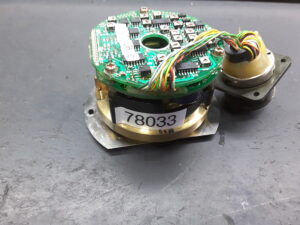
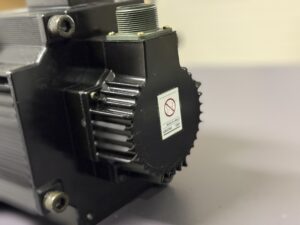
The UTMAH-B15ASB encoder installed on the motor was identified as the root cause of the intermittent faults.
Repair Strategy and Preventive Measures
Instead of performing a minimal intervention, a comprehensive repair strategy was chosen. Experience has shown that partial repairs on aging servo motors often lead to follow-up failures in a short period of time.
The motor was fully disassembled and thoroughly cleaned to remove residues of moisture, dust, and contamination. All mechanical wear components were inspected. Bearings and sealing elements showed clear signs of age-related degradation and were replaced as part of a preventive overhaul.
The defective encoder was replaced with a tested and compatible unit. Precise mechanical alignment and adjustment were performed to ensure reliable signal quality under all operating conditions.
Throughout the process, special attention was paid to restoring the motor to a condition suitable for long-term operation rather than short-term fault elimination.
Testing and Validation
After reassembly, the motor underwent extensive testing on a compatible Yaskawa test setup. The tests were conducted under realistic operating conditions, including extended runtime and varying load scenarios.
Thermal behavior, signal stability, and dynamic response were continuously monitored. The encoder feedback remained stable throughout the entire test cycle, including cold start simulations.
No further encoder faults or irregularities were observed. The motor operated smoothly and consistently, confirming the success of the repair and overhaul process.
Lessons Learned from Practice
This case clearly demonstrates how intermittent encoder faults can develop gradually over time and remain undetected for extended periods. Environmental influences such as humidity and temperature changes often accelerate these effects.
It also highlights the importance of treating servo motor, encoder, and servo drive as a complete system during diagnostics. Only a structured and experience-based approach makes it possible to identify the true root cause in such cases.
Preventive refurbishment of aging components significantly reduces the risk of unexpected downtime and improves overall machine reliability.
Conclusion
The Yaskawa SGMG-20VSAAS servo motor was successfully restored through a combination of targeted diagnostics, encoder replacement, and comprehensive mechanical overhaul. The motor now operates reliably and is prepared for continued service in its original CNC application.
This repair case underlines the value of systematic troubleshooting and preventive maintenance when dealing with aging industrial drive systems.


formation about the mentioned Servopack and Servomotor:
More information about our Yaskawa repairs can be found here.
📞 Feel free to contact us if you have any questions regarding your Yaskawa drive technology. Our experienced team is always ready to assist you.
Technical Specifications
| Feature | Value |
|---|
| Manufacturer | Yaskawa Electric |
| Motor type | AC servo motor |
| Model | SGMG-20VSAAS |
| Rated power | 1.8 kW |
| Rated voltage | 200 V AC |
| Rated current | approx. 16.7 A |
| Rated speed | 1500 rpm |
| Rated torque | approx. 11.5 Nm |
| Duty type | Continuous duty |
| Insulation class | F |
| Encoder | UTMAH-B15ASB |
| Year of manufacture | approx. 1999 |
| Cooling | Natural convection |
| Typical servopack | SGDB-20ADG |
Application environment and compatible devices
The Yaskawa SGMG-20VSAAS is used in older CNC machines and special machinery, mainly in combination with Yaskawa Sigma-II servopacks of the SGDB series. Typical applications include feed axes and positioning systems. The motor operates in a 200-V system and is not compatible with 400-V servo drives.
Functional description
The motor is a brushless permanent magnet synchronous servo motor. Position feedback is provided by the UTMAH-B15ASB encoder. Stable encoder signals are essential for current, speed and position control. Even minor disturbances in encoder feedback can cause axis faults or machine stoppages, especially under harsh environmental conditions.
Alarm messages and troubleshooting
| Code | Description | Cause | Solution |
|---|
| A.80 | Absolute encoder error | Invalid encoder data | Replace encoder |
| A.81 | Encoder backup error | Internal memory fault | Replace encoder |
| A.82 | Encoder checksum error | Data inconsistency | Replace encoder |
| A.83 | Encoder battery alarm | Voltage issue | Check or replace encoder |
| A.84 | Encoder data error | Communication fault | Check cable or encoder |
| A.C2 | Encoder phase fault | Signal instability | Replace encoder |
| A.C5 | Incremental pulse error | Pulse loss | Replace encoder |
Components
| Component | Description | Function | Notes |
|---|
| Encoder | UTMAH-B15ASB | Position feedback | Age-related failure |
| Bearings | Precision ball bearings | Mechanical support | Preventive replacement |
| Seals | Shaft seals | Moisture protection | Critical in humid environments |
| Windings | Three-phase | Torque generation | Insulation test required |