29.07.2026 by Viktor Siebert
Repair of a Yaskawa SGDV-3R5D11A020000 AC SERVOPACK After Complete Failure with No Function
The failure of a servo amplifier in industrial production often occurs without any prior warning. While some systems initially exhibit sporadic faults or communication errors, other cases result in a complete loss of functionality. This was exactly the condition of a Yaskawa SGDV-3R5D11A020000 AC SERVOPACK from the Sigma-5 series that arrived at our service center. The unit showed absolutely no function. Neither the status LEDs nor the internal initialization sequence were active. The connected machine could no longer be powered up, and the complete drive system was out of operation.
Failures of this type are among the most critical faults in modern CNC machines and industrial automation systems. Once the servo electronics fail completely, entire production lines frequently come to a standstill. Since replacement units of this generation are often difficult to obtain at short notice or are only available at very high prices, a professional repair is in many cases the most economical solution.
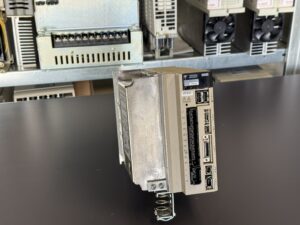
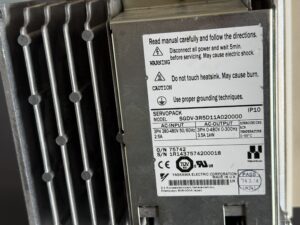
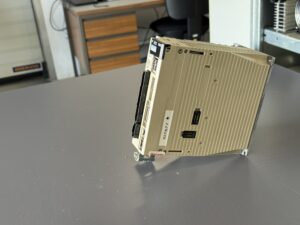
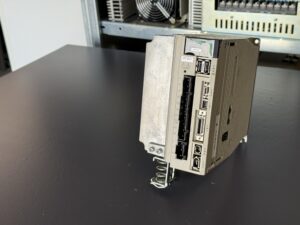
After the unit arrived, it first underwent a complete visual inspection. Even externally it became evident that the servo drive had been operating in industrial service for many years. Dust accumulation, thermal aging, and typical signs of long-term operation indicated extensive service life under demanding conditions. However, no external damage to the housing or connectors was found. The nameplate confirmed the model SGDV-3R5D11A020000, featuring an output rating of 1 kW, a supply voltage of 3 × 380 to 480 VAC, and an integrated MECHATROLINK communication interface.
Following the external inspection, the electrical initial diagnosis was carried out. During the controlled power-up procedure it immediately became apparent that the unit performed no initialization whatsoever. The status LEDs remained dark, and the internal electronics never started. This type of behavior typically indicates a failure within the primary power supply or the internal control power supply. Since every voltage level inside a modern servo amplifier depends on the proper operation of the others, the failure of a single supply voltage is enough to prevent the entire controller from starting.
The next step involved complete disassembly of the unit. After opening the housing, all assemblies were thoroughly cleaned. Servo amplifiers that have operated for many years inside machine tools often accumulate dust, oil mist, and microscopic metal particles on the circuit boards and heat sinks. These deposits reduce heat dissipation efficiency and may eventually cause leakage currents or corrosion.
Once the cleaning process had been completed, systematic troubleshooting at board level began. Every input stage, rectifier, DC bus, switching power supply, voltage regulator, and power output stage was carefully inspected. At the same time, all relevant measuring points were checked in order to determine exactly where the internal power supply collapsed.
Particular attention was paid to the internal switching power supply. This assembly generates all supply voltages required for the processor, communication circuits, gate drivers, and signal processing electronics. Even slight aging of individual electronic components can prevent stable operating voltages from being generated. Without these voltages, the entire servo controller remains inactive.
At the same time, all electrolytic capacitors were examined in detail. In equipment of this age, capacitor aging represents one of the most common causes of complete failure. As operating time increases, the ESR value rises, resulting in unstable power supply voltages. In many cases these faults first appear only under elevated operating temperatures. If left undetected for an extended period, additional assemblies are subjected to increasing electrical stress.
The power electronics were also thoroughly inspected. Modern Sigma-5 servo amplifiers employ high-speed IGBT power stages together with sophisticated gate driver circuits. Even minor defects within these assemblies may cause internal protection circuits to block the entire drive or prevent startup altogether. At the same time, all current sensing circuits were checked, since faulty feedback signals can likewise inhibit proper initialization of the servo amplifier.
In addition to repairing the actual defect, the servo amplifier underwent a complete preventive overhaul. All components subject to age-related wear were inspected and replaced where necessary. Particular attention was paid to electrolytic capacitors as well as other thermally stressed components within the power supply circuitry. The objective of preventive maintenance is not only to eliminate the existing fault but also to restore long-term operational reliability for many additional years.
After completion of all repair work, the servo amplifier was completely reassembled and prepared for functional testing.
The final testing procedure at industrypart is always performed under realistic operating conditions. The servo amplifier is first powered up under controlled conditions while all internal supply voltages are monitored continuously. Only after every voltage has reached the manufacturer’s specified values is further commissioning performed.
The next step is communication testing. In this particular model, special attention is paid to the integrated MECHATROLINK interface, which is widely used in machine tools, robotic systems, and industrial automation equipment for controlling multiple servo axes. In addition, all diagnostic and status functions are thoroughly verified.
This is followed by the actual load test. During this procedure, the servo amplifier operates together with a suitable servo motor under varying load conditions over several hours. Acceleration and deceleration cycles, changing torque demands, and different speed ranges simulate real machine operation as closely as possible. Throughout the entire test, temperatures, DC bus voltage, output currents, and all protective functions are continuously monitored.
The Sigma-5 system incorporates numerous protective functions that safeguard both the servo amplifier and the connected motor against overcurrent, overvoltage, undervoltage, overload, heat sink overtemperature, communication errors, and encoder faults. Only after every function has been verified successfully during extended load testing is the unit approved for return to the customer. These comprehensive diagnostic and protection systems are a major reason for the outstanding reliability of the Sigma-5 series.
Especially for servo amplifiers that have been operating continuously for many years, a preventive overhaul is strongly recommended before a complete failure occurs. Aging capacitors, thermally stressed power semiconductors, and contaminated cooling systems typically deteriorate gradually and often remain unnoticed for a long period. Timely maintenance significantly reduces the risk of unexpected machine downtime while considerably extending the service life of the complete drive system.
The Yaskawa SGDV-3R5D11A020000 presented in this case was successfully repaired and subjected to comprehensive functional and load testing. Through the combination of precise fault diagnosis, replacement of age-sensitive components, and extensive endurance testing, the customer once again received a highly reliable servo amplifier ready for many more years of industrial operation.
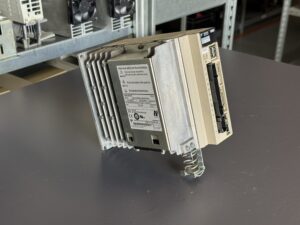
Information about the mentioned Servopack: Yaskawa SGDV-3R5D11A020000 AC Servopack
For more details about our Yaskawa repair services, visit: Yaskawa Sigma V Repairs
📞 Feel free to contact us if you have any questions about your Yaskawa drive technology!
Technical Specifications
| Specification | Value |
|---|
| Manufacturer | Yaskawa Electric Corporation |
| Model | SGDV-3R5D11A020000 |
| Series | Sigma-5 SERVOPACK |
| Device Type | Digital AC Servo Amplifier |
| Motor Output | 1.0 kW |
| Input Voltage | 3 × 380–480 VAC |
| Supply Frequency | 50/60 Hz |
| Input Current | 2.5 A |
| Output Voltage | 3 × 0–480 VAC |
| Output Frequency | 0–300 Hz |
| Output Current | 3.5 A |
| Communication Interface | MECHATROLINK |
| Protection Class | IP10 |
| Ambient Temperature | 0 to +55 °C |
| Cooling | Heat sink with convection cooling |
| Country of Manufacture | United Kingdom |
| Manual Reference | Yaskawa Sigma-5 Servo Drive Documentation |
Application Environment & Compatible Equipment
The Yaskawa SGDV-3R5D11A020000 belongs to the high-performance Sigma-5 servo drive family and was specifically developed for highly dynamic positioning applications. Thanks to its outstanding control accuracy and extremely fast response time, this SERVOPACK is used in a wide variety of industrial automation systems.
Typical applications include:
- CNC lathes
- CNC milling machines
- Machining centers
- Grinding machines
- Packaging machines
- Assembly systems
- Industrial robots
- Pick-and-place systems
- Handling equipment
- Special-purpose machinery
The servo amplifier communicates with the machine controller via MECHATROLINK and operates together with various Sigma-5 servo motors. Its fully digital control system continuously monitors position, speed, and torque while performing real-time corrections within microseconds.
Especially in modern machine tools, this technology enables maximum machining precision while maintaining extremely short cycle times.
Alarm Messages & Troubleshooting
| Alarm | Description | Typical Cause | Troubleshooting |
|---|
| A.020 | Parameter Checksum Error | Corrupted parameter data | Initialize the parameters or inspect the SERVOPACK |
| A.030 | Input Voltage Detection Error | Input voltage detection fault | Check the power supply and inspect the SERVOPACK |
| A.050 | Combination Error | Servo motor and SERVOPACK combination is incompatible | Verify motor specifications and SERVOPACK compatibility |
| A.100 | Overcurrent or Heat Sink Overheat | IGBT overcurrent or heat sink overheating | Inspect the power stage, motor wiring, and cooling system |
| A.300 | Regeneration Fault | Braking resistor or regenerative circuit fault | Check the braking resistor and wiring |
| A.320 | Regenerative Overload | Excessive regenerative energy | Verify braking resistor sizing and operating conditions |
| A.400 | Overvoltage | DC bus voltage too high | Check the incoming supply voltage and regenerative circuit |
| A.410 | Undervoltage | DC bus voltage too low | Check the power supply and DC bus circuit |
| A.510 | Overspeed | Motor speed exceeds the allowable limit | Verify control parameters and mechanical system |
| A.710 | Overload High Load | Short-term excessive motor load | Reduce machine load and inspect the motor |
| A.720 | Overload Low Load | Continuous overload condition | Review operating conditions and machine load |
| A.7A0 | Heat Sink Overheat | Heat sink temperature exceeds the allowable limit | Clean the cooling system and check the ambient temperature |
| A.7AB | Cooling Fan Failure | Internal SERVOPACK cooling fan has stopped | Inspect or replace the cooling fan |
| A.C90 | Encoder Communication Error | Communication failure between the encoder and SERVOPACK | Check the encoder cable and all electrical connections |
| A.F10 | Power Supply Open Phase | One phase of the input power supply is missing | Inspect the incoming power supply and wiring |
Main Components
| Assembly | PCB Designation | Function | Inspection / Repair Notes |
|---|
| Control Board | SGDV-IFA11B | Digital servo control, signal processing, and MECHATROLINK communication | Check power supply, DSP, memory devices, and communication circuits |
| DC Bus Capacitor Board | 5R4DAA | DC bus energy storage and voltage stabilization | Measure capacitor ESR, inspect for aging and thermal stress |
| Power Board | 3R5DAB | Power stage control and IGBT gate driver circuitry | Inspect gate drivers, current sensing circuits, and power paths |
| Power Module | Power Module | IGBT output stage for servo motor control | Perform short-circuit testing, insulation testing, and full-load functional testing |
Functional Description
The SGDV-3R5D11A020000 performs all control tasks between the CNC controller and the servo motor. The machine controller transmits position, speed, or torque commands to the SERVOPACK. The servo amplifier processes this information in real time and generates highly precise output voltages for the connected motor.
During operation, the servo amplifier continuously monitors:
- DC bus voltage
- Motor current
- Output power
- Encoder feedback
- Communication
- Power module temperature
- Internal supply voltages
- Safety functions
The integrated power stage uses modern IGBT power semiconductors driven by high-frequency PWM technology to control the motor with exceptional precision. At the same time, multiple protective functions ensure that both the motor and the electronics remain protected against damage.
The most important integrated protection functions include:
- Overcurrent protection
- Overvoltage protection
- Undervoltage protection
- Overload protection
- Heat sink temperature monitoring
- Regeneration monitoring
- Communication monitoring
- Encoder monitoring
- CPU monitoring
- Ground fault monitoring
These comprehensive protection mechanisms allow even the smallest irregularities to be detected before they develop into major failures.
Preventive Maintenance Recommendations
A complete servo amplifier failure rarely occurs suddenly. In most cases, the underlying causes develop gradually over many years. For this reason, we recommend regular preventive maintenance and inspection of servo drive systems.
The following maintenance measures have proven highly effective in industrial environments:
- Regular cleaning of heat sinks
- Inspection of all cooling paths
- Visual inspection for discolored circuit boards
- Inspection of all electrical connectors
- Retightening of power terminals
- Inspection of DC bus capacitors
- Replacement of aged electrolytic capacitors
- Verification of all supply voltages
- Inspection of grounding connections
- Regular load testing during scheduled maintenance shutdowns
Preventive maintenance significantly reduces unexpected machine downtime while extending the service life of the complete servo drive system.
Conclusion
The Yaskawa SGDV-3R5D11A020000 is a highly precise servo amplifier designed for demanding positioning applications in CNC machines and industrial automation systems. When the unit fails completely and shows no signs of operation, the root cause is often found within the internal power supply or the power electronics.
Through systematic board-level diagnostics, replacement of age-related wear components, and comprehensive long-term load testing, the original operational reliability can often be fully restored.
A preventive overhaul additionally protects the servo amplifier against future failures and significantly increases long-term machine availability.