09.01.2026 by Viktor Siebert
Repair of a Yaskawa SGDH-20EEY338 Servopack from a Brother CNC Machining Center
The repair case described here concerns a Yaskawa SGDH-20EEY338 Servopack that was used in a Brother CNC machining center as the drive for the Y axis.
The unit was sent in with the fault description that the Y axis does not run smoothly, behaves irregularly especially when load is applied, and switches off with an overload alarm after a short increase in force. The problem was reproducible and clearly noticeable for the machine operator, as clean circular movements and uniform feed motions were no longer possible.
Initial Situation and Fault Symptoms
Even during the first functional check, abnormal axis behavior was evident. In no-load operation, slight irregularities could already be detected, and under load the problem became significantly more pronounced. The axis reacted with a delay, built up torque in a jerky manner, and responded to higher loads with an overload shutdown.
In practice, such symptoms are typical of a combination of control deviations, internal aging effects within the servopack, or faulty feedback signals, without an immediately obvious hard alarm being present.
Externally, the servopack showed no visible damage. Fan, heatsink, and connectors appeared intact, which initially made fault localization more difficult.
Diagnosis and Systematic Analysis
As with all axis-related issues, the fault was not viewed in isolation but analyzed in the interaction between mechanics, motor, encoder, cabling, and servopack.
After removal from the machine, an initial electrical baseline check was performed. Power supply, DC link voltage, and control signals were all within the expected ranges. However, during dynamic tests under load, clear abnormalities appeared in the current behavior of the axis.
The behavior during sudden load demand was particularly critical. Strong current fluctuations occurred, ultimately triggering the overload monitoring. Such behavior often indicates that the servopack is no longer able to regulate the required torque cleanly or that internal measurement values are no longer stable.
Internal Inspection of the Servopack
After opening the SGDH-20EEY338, a detailed visual and measurement inspection was carried out. A typical age-related condition became apparent, as is frequently observed in servopacks of this generation.
Certain assemblies responsible for accurate current measurement and control showed deviations. These deviations result in the servopack still functioning in principle, but making incorrect control decisions under dynamic load. The consequence is an irregular axis motion and premature overload tripping.
In highly dynamic CNC axes, such as those commonly found in Brother machines, this condition becomes noticeable very quickly, since control quality plays a decisive role.
Repair Process and Refurbishment
As part of the refurbishment, the servopack was completely overhauled. This included thorough cleaning, inspection of all relevant assemblies, and the preventive replacement of critical components that experience shows to be responsible for such fault patterns.
Particular attention was paid to the power section, the internal power supply, and the control and measurement circuits.
After completion of the repair, the servopack was tested on our test bench under realistic conditions. Both static and dynamic load cases were simulated. The Y axis could now be controlled smoothly, quietly, and reproducibly again, even under higher torque demands. The overload shutdown no longer occurred.
Test Result and Finalization
Following successful repair, the SGDH-20EEY338 showed stable control behavior across the entire operating range. The axis ran smoothly, responded precisely to setpoint changes, and remained within permissible operating limits even under load.
The servopack was then returned to the customer and now ensures reliable operation of the Brother CNC machining center.
Conclusion
This repair case clearly demonstrates that irregular motion and overload shutdowns are not necessarily caused by the motor or the mechanical system. Very often, the root cause lies within the servopack itself, particularly due to age-related changes in the internal control circuits.
A professional refurbishment of the Yaskawa SGDH-20EEY338 restores full functionality, extends the service life of the machine, and prevents costly downtime.
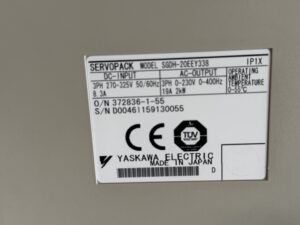
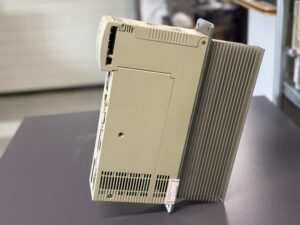
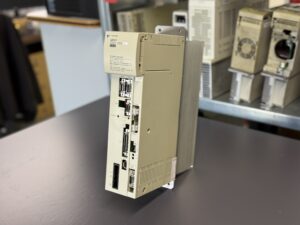
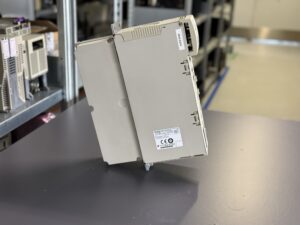
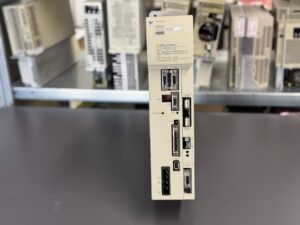
Further information such as price and delivery time for:
Yaskawa SGDH-20EEY338 Servopack
More details about our Yaskawa repair expertise can be found here: Yaskawa Brother SIGMA II repairs by Industrypart
Technical Specifications
| Parameter | Value |
|---|
| Manufacturer | Yaskawa Electric |
| Model | SGDH-20EEY338 |
| Device category | AC Servo Drive, Sigma-II series |
| Rated power | approx. 2.0 kW |
| Input voltage | DC 270–325 V |
| Input frequency | 50 / 60 Hz |
| Output voltage | 3-phase 0–230 V AC |
| Output frequency | 0–400 Hz |
| Rated output current | approx. 19 A |
| Protection class | IP1X |
| Cooling | Convection cooling with fan |
| Operating temperature | 0 to +55 °C |
| Mounting | Control cabinet |
| Series | Yaskawa Sigma-II |
| Origin | Made in Japan |
Typical Applications
| Application area | Description |
|---|
| CNC machining centers | Feed axes with high dynamics |
| Brother CNC machines | Axis drives for X, Y or Z axis |
| Machine tools | Precise positioning and feed drives |
| Automation technology | Servo axes with high control accuracy |
| Special machines | Dynamic axis movements with load changes |
Compatible Motors and Systems
| Category | Description |
|---|
| Servo motors | Yaskawa Sigma-II servo motors |
| Encoder | Incremental and absolute encoders |
| Controllers | CNC controllers used in Brother machines |
| Feedback | Encoder-based |
| Axis types | Linear and rotary |
Functional Description
| Function | Description |
|---|
| Torque control | Precise current control for constant torque |
| Speed control | Stable control even with load changes |
| Position control | Exact axis positioning via encoder feedback |
| Protective functions | Overcurrent, overload, overtemperature |
| Diagnostics | Error display via LED and CNC controller |
| Communication | Machine-integrated axis interface |
Alarms and Troubleshooting (Excerpt)
| Alarm / Condition | Meaning | Typical cause | Action |
|---|
| Overload | Current or torque too high | Mechanical resistance | Check mechanics |
| Overcurrent | Limit exceeded | Power stage or motor | Check servopack |
| Overtemperature | Temperature too high | Cooling or environment | Check cooling |
| Encoder error | Feedback faulty | Encoder or cable | Check encoder |
| Axis deviation | Irregular motion | Control instability | Service servopack |
| Shutdown under load | Protective function active | Aging of internal assemblies | Repair required |
Main Assemblies
| Assembly | Function | Notes |
|---|
| Power module | Motor current generation | Critical in overload faults |
| Control and regulation board | Signal processing and control | Aging-related drift possible |
| DC link | Energy buffering | Voltage stability is essential |
| Heatsink | Heat dissipation | Avoid contamination |
| Fan | Active cooling | Check regularly |
| Connectors | Signal and power connection | Contact issues possible |
Service and Maintenance Notes
| Measure | Recommendation |
|---|
| Regular cleaning | Remove dust and debris |
| Fan inspection | Check operation and noise |
| Visual inspection | Connectors and cables |
| Thermal monitoring | Monitor control cabinet temperature |
| Preventive servicing | Perform before production downtime |
| Load monitoring | Check mechanics regularly |