09.08.2025 by Viktor Siebert
Yaskawa SGDA-08AS AC Servopack repair Story
Incoming Unit and Fault Description.
The Yaskawa SGDA-08AS AC Servopack arrived at our workshop after a failure during production. The customer reported recurring malfunctions, accompanied by irregular axis movements and occasional alarm messages on the drive. An on-site self-check had not revealed a clear defect, so the unit was sent in for professional analysis.
Visual Inspection and Documentation
Before starting any work, the housing was inspected for external damage, signs of overheating, or moisture ingress. Screw seals and tamper indicators were checked to identify any previous interventions. All observations were recorded in our repair log to ensure complete traceability of the process.
Electrical Input Check
The first technical step was to check the mains connections and internal fuses. This included insulation measurements as well as tests for short circuits and earth faults. The aim was to obtain a clear assessment of the electrical condition of the primary side.
Diagnosis on the Test Bench
For fault detection, we used our specially developed test bench system, which simulates the operation of the Servopack under real machine conditions. Input and output voltages, control terminal signals, and encoder feedback were recorded. The fault analysis revealed an unstable signal in the power stage, caused by a defective IGBT module section.
Disassembly and Cleaning
Before the actual repair, the unit was fully disassembled. All assemblies were carefully separated to allow targeted access to the affected components. A thorough cleaning of the PCBs, heat sinks, and ventilation channels was performed using an ESD-safe compressed air system and an ultrasonic bath for smaller parts. This not only removed dust and debris but also residues that could lead to long-term corrosion.
Component Replacement and Preventive Servicing
The defective IGBT section was replaced with an original component. In addition, all relevant electrolytic capacitors in the power and control sections were renewed to prevent future failures. Connectors were re-soldered and replaced where necessary. Relays and optocouplers were checked and replaced as part of preventive maintenance.
Thermal Optimization
During reassembly, fresh thermal compound was applied between the IGBT modules and heat sinks. Fans and temperature sensors were tested to ensure optimal heat dissipation during later operation.
Full-Load Functional Test
After reassembly, the Servopack underwent a multi-stage functional test. First, the unit was operated in idle mode to check basic parameters such as voltage, current draw, and signal quality. This was followed by a load test with a suitable servo motor, simulating all movement profiles. The unit was pushed to its specified limits to verify stability and control accuracy.
Long-Term Testing and Quality Approval
Finally, the SGDA-08AS completed a multi-hour endurance test. Temperature behavior, signal quality, and communication stability were continuously monitored. Only after successfully passing all tests did the unit receive our internal quality approval and was cleared for shipment.
Shipping and Final Report
The Servopack was shipped back to the customer in shock-proof packaging. An extensive test report with all measurements, details of the work performed, and recommendations for preventive maintenance was included. This way, the customer not only received a fully functional unit but also valuable information for the long-term operation of their machine.
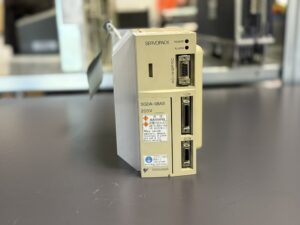
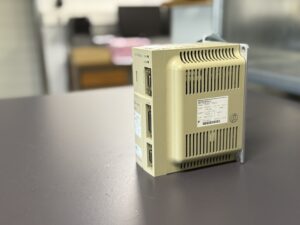
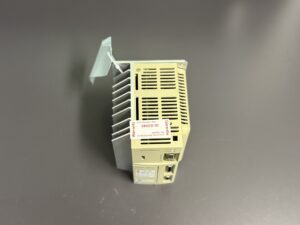
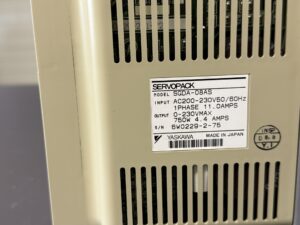
Information about the mentioned Servopack: Yaskawa SGDA-08AS AC Servopack
For more details about our Yaskawa repair services, visit: Yaskawa Repairs
📞 Feel free to contact us if you have any questions about your Yaskawa drive technology!
Technical Specifications
| Parameter | Value |
|---|
| Model | SGDA-08AS |
| Input Voltage | AC 200–230 V, 50/60 Hz |
| Input Current | 11.0 A (single-phase) |
| Output Voltage | 0–230 V max |
| Output Power | 750 W |
| Output Current | 4.4 A |
| Weight | Approx. 3.5 kg (according to manual, varies by version) |
| Manufacturer | Yaskawa Electric Corporation, Japan |
| Series | Σ (Sigma) Series |
| Control Type | Speed/Torque Control (S-Type) |
Operating Environment
The SGDA-08AS is typically used in industrial CNC machines, packaging equipment, printing machines, and automation lines.
It operates with Σ-Series SGM/SGMP servo motors and is controlled via a host controller or CNC system.
Recommended operating environment according to the manual:
- Ambient temperature: 0 °C to +55 °C (non-condensing)
- Relative humidity: 20% to 90% (non-condensing)
- Use in a clean, dust-free environment free from corrosive gases
- Installation inside a closed control cabinet with adequate ventilation
Functional Description
The Yaskawa SGDA-08AS is a Σ-Series servo amplifier designed for precise control of AC servo motors in speed or torque control mode.
It receives control signals from the host controller, regulates motor current, and continuously monitors motor position, speed, and temperature.
Key functions include:
- High-precision speed control
- Fast response through digital control
- Integrated protection features (overcurrent, overvoltage, overheating)
- Automatic tuning function to optimize control parameters
- Compatibility with digital operators (JUSP-OP02A-1, JUSP-OP03A)
Alarm Messages and Troubleshooting
| Alarm Code | Description | Possible Cause(s) | Recommended Solution(s) |
|---|
| A.30 | Overcurrent | Motor short circuit, defective power stage | Check motor and cables, repair power stage |
| A.31 | Overvoltage | Input voltage too high, braking energy not dissipated | Check supply voltage, test braking resistor |
| A.32 | Undervoltage | Input voltage too low | Check power supply, verify wiring |
| A.33 | Servopack Overheating | Insufficient cooling, fan failure | Check ventilation, clean heat sink |
| A.34 | Motor Overheating | Overload, insufficient cooling | Reduce load, check cooling |
| A.35 | Encoder Error | Broken cable, encoder malfunction | Check encoder and cable, replace if necessary |
| A.36 | Communication Error | Control line interrupted, EMC interference | Check wiring, improve shielding |
| A.37 | Overload | Continuous motor overload | Adjust motion profile, review motor sizing |
| A.38 | Brake Error | Brake cable defective, holding brake stuck | Check brake wiring, repair brake |
| A.39 | Memory Error | Internal memory fault | Reinitialize or repair Servopack |