28.09.2025 by Viktor Siebert
When the Interface Fails: Repair Story of the Yaskawa Serial Encoder UTSJB-B18BDDAC
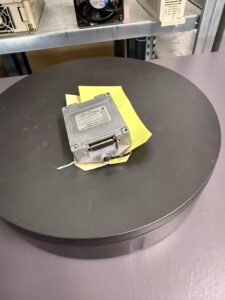
The Yaskawa Serial Encoder UTSJB-B18BDDAC is an inconspicuous yet crucial device in many CNC machines. We have repaired several of these encoders over the past years, and each case highlighted their critical role.
In one case, a machine sporadically reported a Communication Error. Initially, the issue occurred only rarely, but over time it became more frequent until the machine finally came to a complete halt. The cause: delicate components inside the encoder had been destroyed by voltage spikes.
For the customer, the failure was catastrophic: production downtime, delayed deliveries, and enormous pressure from deadlines. If the encoder had continued to run in this defective state, the machine could have performed uncontrolled movements risking workpieces, tools, and even operator safety.
When we opened the encoder in our workshop, we immediately noticed discoloration on some PCB tracks. The first step was a thorough cleaning to remove oil residues and dust. Next, we identified the damaged electronic components. These were replaced preventively, even if they had not yet completely failed.
The repair process followed our standardized checklist:
- Visual inspection housing, connectors, solder joints.
- Electrical measurements voltages, signal traces.
- Component replacement defective and at-risk components.
- Test run our special test machine simulates real motor-drive communication.
The test bench plays a key role: we can monitor all signals, simulate thermal loads, and ensure reliable operation under real conditions.
After successful testing, the encoder was parameterized, documented, and returned to the customer. The downtime was resolved, and the machine resumed stable operation.
This experience shows that the encoder is not just an accessory but a safety-critical component. Its reliability determines the availability of entire production lines.
Preventive Measures for Customers
- Regular visual inspection of cables and connectors
- Clean environment, free of oil, dust, and chips
- Monitor supply voltage stability
- Perform insulation measurements if moisture is suspected
- Replace seals to prevent oil ingress
- Preventive replacement after approx. 8–10 years of operation
Conclusion
The Yaskawa Serial Encoder UTSJB-B18BDDAC is an essential part of many CNC machines. Its failure inevitably leads to production downtime. Through targeted repairs, preventive replacement of critical components, and regular maintenance, downtime can be significantly reduced and service life extended.
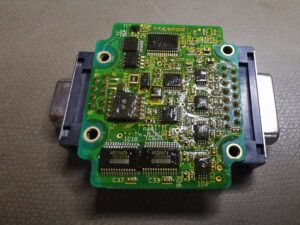
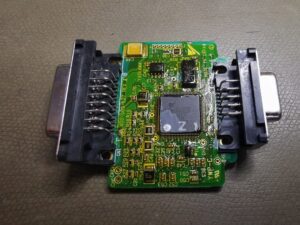
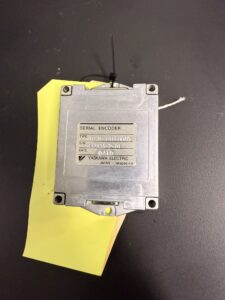
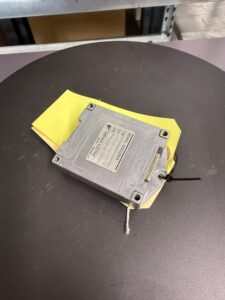
Further information such as price and delivery time for:
Yaskawa Serial Encoder UTSJB-B18BDDAC
More details about our Yaskawa repair expertise can be found here: Yaskawa repairs by Industrypart
As an example, it can be installed between the CIMR-MXN27P5 spindle amplifier and the Yaskawa AC Servo Motor USAIKM-15-MN34.
To mentioned articles:
Yaskawa Inverter CIMR-MXN27P5
Yaskawa AC Servo Motor USAIKM-15-MN34
📞 Feel free to contact us with any questions about your Yaskawa drive technology.
Our expert team is happy to help!
Technical Specifications
| Feature | Value (approx. if not specified) |
|---|
| Manufacturer | Yaskawa Electric, Japan |
| Type | UTSJB-B18BDDAC |
| Serial Number | A32836-01 |
| Design | Serial Encoder (feedback unit) |
| Supply Voltage | approx. 5 V DC |
| Current Consumption | approx. 150 mA |
| Resolution | 18-bit serial |
| Interface | Serial protocol (Yaskawa / Siemens compatible) |
| Weight | approx. 0.6 kg |
| Dimensions | approx. 100 × 90 × 40 mm |
| Cooling | Passive cooling via housing |
| Protection Class | IP54 (estimated, depending on mounting) |
Operating Environment & Compatible Devices
Typical machines: Machine tools, production lines, handling and robotic systems.
Compatible controllers/drives: Yaskawa drive amplifiers and spindle amplifiers from the CACR/Sigma and CIMR families, selected Siemens CNCs combined with Yaskawa hardware.
Compatible motors: Yaskawa AC servo and spindle motors with external serial feedback unit.
Example configurations from practice
The UTSJB-B18BDDAC acts as an intermediate feedback converter between the Yaskawa spindle amplifier CIMR-MXN27P5 and a Yaskawa AC Servo Motor USAIKM-15-MN34, conditioning the feedback signals for the amplifier.
It is also found as an interface in connection with the Yaskawa inverter CIMR-MXN27P5, when serial encoder signals need to be adapted on the machine side.
Functional Description
The UTSJB-B18BDDAC operates as a serial encoder unit between motor and drive module. In many machines, it is installed specifically between the spindle amplifier CIMR-MXN27P5 and the Yaskawa AC Servo Motor USAIKM-15-MN34.
Alarm Messages & Troubleshooting
| Code | Error Description | Cause | Solution |
|---|
| 01 | Encoder Communication Error | Cable break, poor connector contact | Check cables, clean connectors |
| 02 | Encoder Power Fault | Supply voltage < 4.5 V | Check power supply, stabilize voltage |
| 03 | Position Error | Feedback signal loss | Test encoder, replace if necessary |
| 04 | Overcurrent Detected | Disturbances caused by overvoltage | Check PCB components, install surge protection |
| 05 | Parameter Error | Incorrect parameters in memory | Reload or reprogram parameters |
| 06 | Overtemperature | Excessive ambient temperature | Improve cooling, check environment |
| 07 | Memory Checksum Error | Memory chip damaged | Replace memory component |
| 08 | Signal Distortion | EMC issues, faulty electronics | Check EMC protection, perform repair |
| 09 | Encoder Timeout | No response from motor | Check wiring, replace motor encoder |
| 10 | Internal Circuit Fault | Faulty PCB components | Repair or replace electronics |
Components
| Component | Function |
|---|
| Control board | Signal processing, communication |
| Power electronics | Supply and protection |
| Memory chip | Parameter storage, firmware |
| Connectors | Motor ↔ Drive connection |
| Aluminum housing | Mechanical protection, cooling |