13.12.2025 by Viktor Siebert
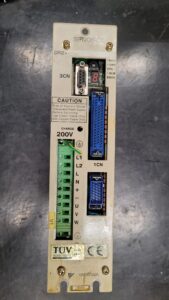
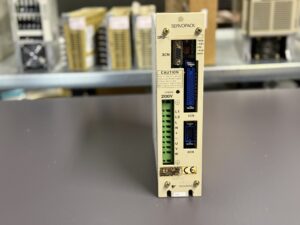
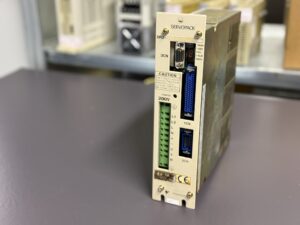
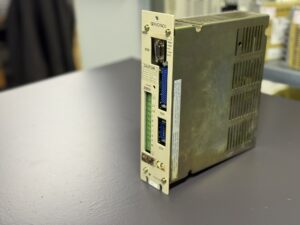
Repair of a Yaskawa DR2-01AC Servopack with Alarm A.31
Repair of a Yaskawa DR2-01AC Servopack with Alarm A.31 Complete Workshop Report.
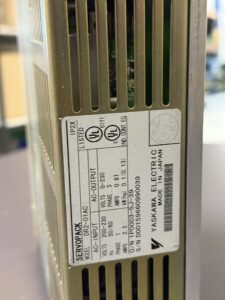
The DR2-01AC Servopack arrived at our facility with a clear customer complaint: “Whenever the motor is supposed to start, Alarm A.31 appears immediately.” According to the Yaskawa documentation, alarm A.31 indicates a motor start malfunction. This occurs when the drive cannot generate the necessary initial torque or when the mechanical load cannot be moved. Since the customer uses two compatible motors SGMPH-01AAA61D-L and SGMPH-01AAA6CD-L our first assumption was a defect in the power output stage or an irregularity in the feedback loop.
After the initial registration and documentation of the device, the Servopack was integrated into our diagnostic setup. A thorough visual inspection revealed typical signs of aging: slightly discolored solder joints in the power section, two DC bus capacitors showing visible signs of thermal stress, and a suspicious darkened area near one of the shunt resistors. No obvious mechanical damage or corrosion was found. However, devices of this generation frequently show stress-related degradations in the output stage, which often manifest exactly in dynamic scenarios like motor startup. Alarm A.31 is often triggered when the current feedback path cannot deliver a stable signal to the controller.
The device was fully disassembled for deeper inspection. The power module was removed and examined under the microscope. Here, the root cause became immediately apparent: the U-phase shunt path showed an abnormal response which would interrupt the current loop during startup. The gate driver circuitry exhibited increased leakage currents, pointing to a partially degraded IGBT. These partial defects are notoriously difficult because they do not always cause an immediate short circuit but destabilize the current regulation, especially during the rapid current ramp required at motor startup.
Parallel to the electronics inspection, both motors provided by the customer were tested on a reference SGDH test system. Both motors started flawlessly, which excluded mechanical or encoder-based faults. This clearly pointed back to the Servopack itself.
The repair process included replacement of all three IGBTs to ensure phase symmetry, renewal of the driver ICs, replacement of the damaged shunt resistor and installation of new DC bus capacitors. Additionally, we reflowed several solder joints on the control PCB to eliminate potential micro-cracks which are common in older Yaskawa devices.
Once the power electronics were fully restored, the Servopack underwent a multi-stage load test. This included dynamic acceleration cycles, repeated direction changes, extended thermal load scenarios, and operation with simulated inertia. The drive remained completely stable. No current deviation, no thermal spike and, most importantly, no recurrence of Alarm A.31.
As a final confirmation, the repaired DR2-01AC was tested with one of the customer’s original motors to replicate real conditions. The motor started smoothly, held torque without deviation and performed multiple start-stop cycles without a single error. The drive was therefore released as fully operational. The repair not only removed the immediate cause of the A.31 alarm but significantly increased the expected service life of the device through the preventive replacement of critical aging components.
Preventive Measures
- annual cleaning of the control PCB and power section
- inspection of screw terminals and connectors
- preventive replacement of DC bus capacitors after approx. 10 years
- annual insulation test of the motor
- thorough inspection of encoder cables
- ensure ambient temperature remains below 45 °C
Conclusion
Alarm A.31 is typically caused by current regulation issues or partial failure in the power stage. A complete electronics restoration combined with extensive dynamic testing ensures long-term operational stability and reliability in the customer’s machine environment.
Further information such as price and delivery time for:
Yaskawa DR2-01AC Servopack
More details about our Yaskawa repair expertise can be found here: Yaskawa DR2 repairs by Industrypart
Mentioned Motors we regularly repair:
SGMPH-01AAA61D-L und SGMPH-01AAA6CD-L
📞 Please feel free to contact us if you have any questions regarding your Omron drive technology. Our experienced team is always available to assist you.
Device Data
| Parameter | Value |
|---|
| Model | Yaskawa DR2-01AC AC Servopack |
| AC Input | 200–230 V, 1-phase, 50/60 Hz |
| AC Output | 0–230 V, 3-phase, 0.87 A |
| Output Power | 0.1 kW (approx. 130 W) |
| Rated Input Current | 2.5 A |
| Protection Class | IP2X |
| Manufacturer | Yaskawa Electric |
| Compatible Motors | SGMPH-01AAA61D-L, SGMPH-01AAA6CD-L (100 W, Sigma-II, IP67) |
| Manual Reference | Alarm A.31 according to Yaskawa TSE-S800-17D-1, page 406 |
Operating Environment & Compatible Equipment
The DR2-01AC is typically used in compact automation axes, pick-and-place units, handling systems, small positioning applications and compact CNC modules in combination with Sigma-II motors up to 100 W output power.
The compatible motors mentioned by the customer – SGMPH-01AAA61D-L and SGMPH-01AAA6CD-L – match the electrical and mechanical requirements of this Servopack perfectly.
Control is performed analog or via discrete I/O signals, while feedback is provided by the incremental encoder of the motor (2048 ppr Sigma-II encoder).
Functional Description
The DR2-01AC Servopack performs the following tasks:
- power supply and three-phase motor drive
- torque, speed and position control via encoder feedback
- current control through internal current regulation
- active safety functions such as overcurrent, overvoltage, temperature and encoder monitoring
- internal diagnostics via LED indicators and alarm codes
Alarm A.31 appears when the motor fails to start or when the required current cannot be built up. According to the manual, the root cause can be a mechanical blockage, incorrect load, phase interruption, encoder malfunction or a defect in the power stage.
Alarms & Troubleshooting
| Code | Error Description | Cause | Solution |
|---|
| A.31 | Motor does not start / start malfunction | Mechanical blockage, missing phase, encoder error, power stage defect | Check mechanics, test motor, repair output stage |
| A.30 | Motor does not rotate | insufficient torque generation | test motor separately |
| A.70 | Overvoltage | excessive load, regeneration | check deceleration profile |
| A.10 | Overcurrent | short circuit, defective transistor | insulation test, repair |
| A.03 | Encoder error | signal failure, cable fault | check encoder connection |
| A.21 | Overload | mechanical resistance too high | inspect motor and load |
| A.71 | Undervoltage | unstable supply | check mains voltage |
| A.75 | Excessive regeneration | load too heavy | inspect brake resistor |
| A.81 | Overtemperature | insufficient cooling | clean heatsink, check airflow |
| A.01 | Internal error | control PCB issue | send for repair |
Components
| Component | Description | Function |
|---|
| Power Stage | IGBT bridge | Three-phase motor drive |
| Power Supply Section | Rectifier + DC bus capacitors | Internal supply generation |
| Control PCB | Signal processing, regulation | Control algorithms & I/O |
| Encoder Interface | Digital feedback | speed & position acquisition |
| Protection Circuits | Shunts, sensors | overcurrent and thermal monitoring |