15.03.2026 by Viktor Siebert
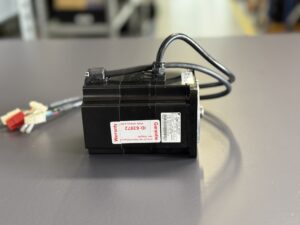
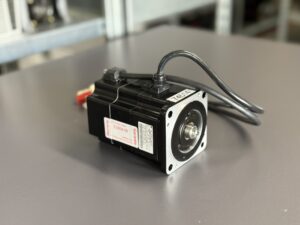
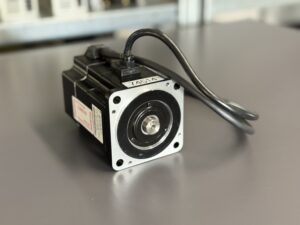
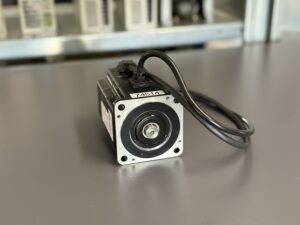
Repair of a Yaskawa AC servo motor SGMP-02AWYR12 with brake lining debris inside the motor and feedback failure
Initial situation and fault pattern.
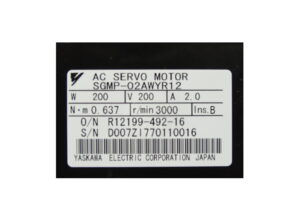
The AC servo motor SGMP-02AWYR12 arrived from a Yaskawa robot in which the holding brake operates very frequently. The operator noticed that the axis no longer holds cleanly and motion became unstable. Shortly afterwards, the axis feedback was no longer plausible and the drive could no longer be referenced reliably.
Incoming inspection and first diagnosis
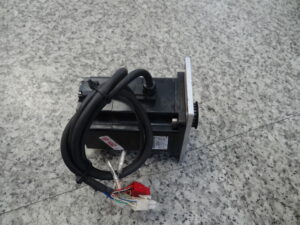
First the motor was received as an assembly and visually inspected from the outside. Then the ability to turn was checked carefully and the feedback was evaluated electrically. Even then it was clear that the motor runs mechanically rough and the feedback no longer works cleanly.
Technical analysis
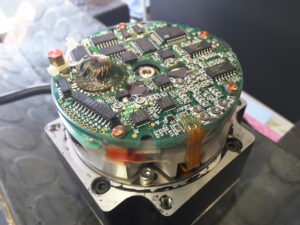
Inside, the suspicion was confirmed. Friction material had detached from the holding function and entered the motor interior. This damaged the bearing system and resulted in rough running. At the same time, the feedback unit was impaired by particles so severely that usable signals were no longer possible. The optical sensing was damaged by abrasion.
Repair actions and refurbishment
The motor was refurbished professionally without documenting at individual component level. The holding brake function unit and the feedback unit were completely renewed. In addition, the interior was cleaned and stabilized so that no remaining particles can damage the new feedback or the bearing system again.
Final functional test
The motor was tested in an in house robot system. The feedback was checked for stable signals and the holding function was evaluated in standstill holding operation. The motor ran smoothly, the feedback was stable, and the holding function held reproducibly. The condition is released for reuse.
Conclusion
Technically it was a typical consequential damage from frequent brake operation. A pure brake problem can quickly affect mechanics and feedback if lining debris enters the interior. By fully renewing the affected functional assemblies, cleaning, and testing in the robot system, the repair is sustainable and traceable.
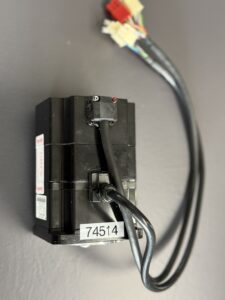
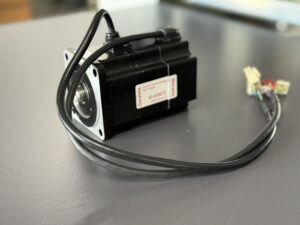
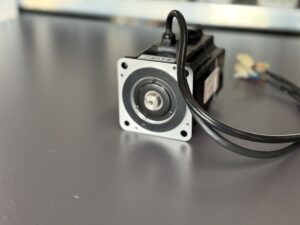
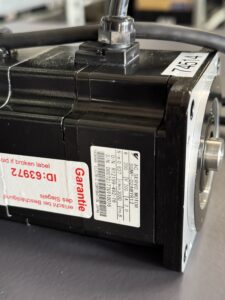
Information about the mentioned Servomotor and other components:
Yaskawa AC Servo Motors SGMP-02AWYR12
More information about our Yaskawa repairs can be found here.
📞 Feel free to contact us if you have any questions regarding your Yaskawa drive or Motor
Technical specifications
| Field | Value |
|---|
| Manufacturer | Yaskawa |
| Device type | AC servo motor |
| Model designation | SGMP-02AWYR12 |
| Series | SGMP |
| Power | approx. 0.2 kW |
| Input voltage | approx. 200 VAC, 3 phase |
| Output voltage | approx. 200 VAC, 3 phase |
| Rated current | approx. 1.5 A to 2.5 A |
| Control type | Servo control with closed loop control |
| Feedback | Yaskawa UTMAH-B12BF1S, incremental or absolute depending on version |
| Cooling | Self heating, housing cooling via ambient air |
| Protection rating | approx. IP54 to IP65 depending on version |
| Ambient temperature | approx. 0 to 40 °C |
| Mounting | Flange mounting |
| Origin | unknown |
| Product status | unknown |
| Power consumption | approx. 0.3 kVA to 0.6 kVA depending on load |
| Manual warnings | Before opening or unplugging connectors: switch off power, secure against restart, wait the discharge time, verify absence of voltage. Measurements on live parts only by a qualified electrician with suitable equipment and according to local rules. |
Operating environment and typical applications
Typical machines are industrial robots, handling systems, packaging machines, and assembly lines. Typical years of manufacture are approx. 1998 to 2010 depending on robot generation. Applications are positioning, pick and place, swivel axes, and axes with frequent standstill.
Clean environment, stable control cabinet temperature, and sufficient cooling of the servo controller are important. High holding brake cycle counts and frequent holding increase thermal and mechanical load. Plug connections should be checked externally for firm seating, as well as fan function, filter condition, and alarm history.
Functional description
The basic function is converting electrical energy into controlled torque and speed. The interaction between the servo controller power stage, the motor mechanics, and the feedback provides accurate positioning. The feedback delivers position and speed information. Based on that, the drive regulates current, torque, and speed.
Enable and protective logic are in the controller, but the motor provides the physical states. Thermal monitoring and signal monitoring are safety relevant because loss of feedback or a blocked run can lead to uncontrolled motion or axis loss. The holding brake is for safe standstill, not for braking during motion.
Alarm messages and troubleshooting
| Alarm code | Description | Possible cause | Recommended action |
|---|
| 1 | Overcurrent detected | Mechanical stiffness at the motor, short circuit in the motor cable, incorrect parameter setting, or excessive load steps | Operator: stop the system, secure the log and alarm history, visual check of motor cable and external plug connections. Service: check current trend, electrically test motor and cable, evaluate parameters and load profile |
| 2 | Circuit breaker trip detected | Short circuit or overload in the power circuit, fault in supply or power stage | Operator: check the control cabinet for tripped protection devices, secure documentation and log, check cooling and cabinet temperature. Service: localize the cause in the power circuit and only then restart |
| 3 | Regenerative problem detected | Regeneration or braking energy is not handled correctly, high decelerations or frequent braking | Operator: review the motion profile, especially frequent stops, check cooling and cabinet temperature. Service: check regeneration path and suitability for the application |
| 4 | Overvoltage detected | Mains voltage too high, regeneration peaks, incorrect sizing for braking energy | Operator: secure the log, check mains conditions and cabinet, do not unplug connectors. Service: evaluate DC link condition, check sizing for the application |
| 5 | Insufficient voltage detected | Mains voltage too low, unstable supply, feed issue | Operator: check cabinet temperature and fan function, secure the log, have the supply checked externally. Service: check incoming supply and supply path, find the cause of the voltage drop |
| 8 | Ground fault detected | Insulation issue at motor or cable, moisture or contamination | Operator: keep the system out of operation, check the environment, document moisture and contamination. Service: insulation measurement only by a qualified electrician with suitable equipment and according to local rules |
| b | Current offset problem detected | Implausible current measurement, drift, unstable control loop | Operator: secure the log, document recurring pattern. Service: check measurement chain and control loop, validate parameters |
| E | Current command disconnection detected | Command signal path interrupted, connector or cable fault | Operator: check external plug connections for firm seating, check cable strain and kink points, secure the log. Service: check the signal path and ensure no connectors were disconnected under power |
| F | Open phase detected | One phase in the power circuit open, contact issue, fuse, cable fault | Operator: visual check of the control cabinet, check filter and fan function, secure the log. Service: check the power circuit, evaluate contact points and supply |
| CPU | CPU problem detected | Internal fault in the Servopack, abnormal control logic | Operator: secure the log, check the environment, control temperature and cooling. Service: check the Servopack, evaluate internal supply and control |
| H.01 | CPU ROM problem | CPU hardware fault | Operator: stop the system, secure the log, check environment and temperature. Service: repair or replace the Servopack, then perform a functional test |
| H.02 | CPU RAM problem | CPU hardware fault | Operator: secure the log, document recurring failures. Service: repair or replace the Servopack |
| H.08 | EEPROM error | Memory fault, parameter data inconsistent | Operator: secure documentation of parameter states, secure the log. Service: check parameters and memory, stabilize the device and test |
| H.0A | Current feedback problem U phase | Fault in current feedback or measurement path, possible issue in the power stage | Operator: stop the system, secure the log. Service: check current feedback, evaluate power stage and measurement path |
| H.0F | Current feedback problem 3 axis V phase | Current feedback fault for axis assignment depending on the unit, measurement path or power stage affected | Operator: verify axis assignment in the documentation, secure the log. Service: check axis assignment and current feedback, narrow down systematically |
Assembly overview
| Assembly | Functional designation | Function | Notes for inspection or repair |
|---|
| Motor unit | Torque and drive unit | Generates torque and motion | Check running behavior without load, evaluate noise and vibration |
| Feedback unit | Position and speed feedback | Provides control variables to the controller | Measure signal stability and plausibility across speed range |
| Holding function | Standstill holding | Holds the axis at standstill | Check holding torque at standstill, evaluate switching frequency |
| Connection area | Power and signal connections | Connection to controller and feedback | Externally check connector seating and strain relief |
| Housing and cooling | Heat dissipation and protection | Dissipates heat, protects against environment | Check contamination and airflow path, document ambient temperature |