05.03.2026 by Viktor Siebert
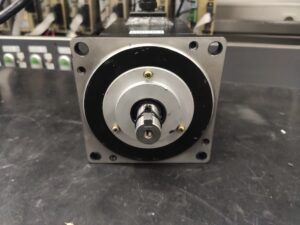
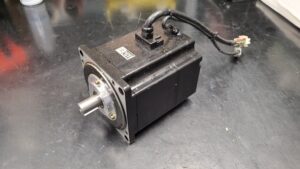
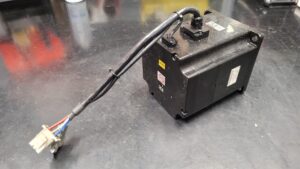
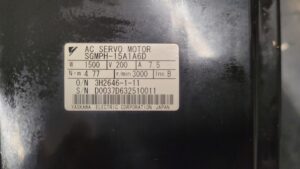
Repair of a Yaskawa AC Servo Motor SGMPH-15A1A6D with encoder fault and alarm Al.84
Initial situation and fault description.
The Yaskawa AC Servo Motor SGMPH-15A1A6D was delivered from a machine tool after the axis of the machine could no longer be enabled. When the servo drive was switched on, the alarm Al.84 appeared immediately on the connected servo amplifier.
The fault occurred reproducibly directly after activating the servo drive. As soon as the servo was enabled, the amplifier detected a problem in the position feedback system and refused to enable the motor. No motor rotation was possible.
Technically remarkable was that the alarm occurred even before any movement and not during operation or under load. This behavior typically indicates a feedback system problem because modern servo drives perform a plausibility check of the position feedback before enabling motion.
The motor was equipped with an incremental encoder type UTSAH-B16DC-E. In addition, a holding brake type Ogura Clutch Brake DC90V MCNB73Y03 was integrated.
Incoming inspection and first diagnosis
After arrival at the workshop a comprehensive incoming inspection was carried out.
The following aspects were checked:
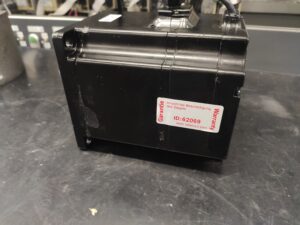
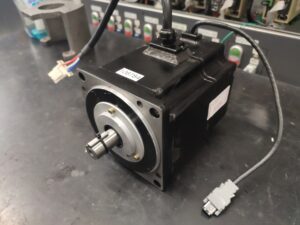
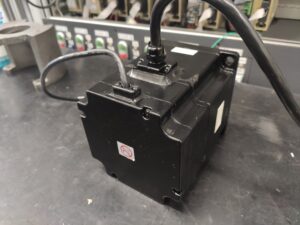
external condition of the motor
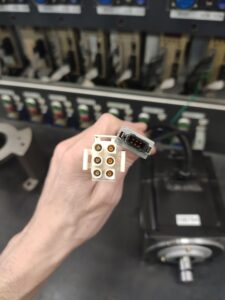
connectors and wiring
mechanical condition of the motor shaft
brake system and wiring
No external mechanical damage was detected. The motor was then connected to a compatible Yaskawa SIGMA II servo amplifier in order to reproduce the fault.
Immediately after enabling the servo, alarm Al.84 appeared again. The behavior was fully reproducible.
This type of fault often indicates a problem in the position feedback system because the servo amplifier checks the encoder signals when enabling the servo.
To further isolate the problem the encoder wiring and the feedback power supply were tested. Electrically no interruptions were detected.
Therefore the diagnosis focused on the encoder area of the motor.
Technical analysis
Servo motors of this series use high resolution incremental encoders for position feedback. The servo amplifier continuously monitors several feedback signals.
These include:
A and B position channels
reference signal
encoder supply voltage
signal quality and phase relation
Already during power up the servo amplifier checks the plausibility of these signals. If unstable or implausible signals are detected the system blocks the motor enable for safety reasons.
During the technical inspection contamination was found in the encoder area of the motor. This contamination affected the signal detection of the encoder.
As a result incorrect position signals were generated and interpreted by the servo amplifier as a feedback fault.
The cause effect chain could be reconstructed clearly:
contamination in the encoder area
disturbed signal detection
unstable position feedback
plausibility error in the servo amplifier
alarm Al.84 and blocked servo enable
Such problems often occur in production environments with coolant mist, oil or fine metal particles.
Repair measures and refurbishment
Because the encoder system is a central element of the position feedback and reliable signal quality is essential, the encoder was completely replaced.
The repair included the following steps:
removal of the encoder system
cleaning of the encoder area
replacement of the encoder
verification of the mechanical alignment
inspection of the motor brake
inspection of the wiring
As part of preventive refurbishment the motor was also completely overhauled.
The following measures were carried out:
complete cleaning of the motor
repainting of the motor housing
replacement of all seals
replacement of the ball bearings
These steps help to increase long term operational reliability and prevent future contamination or mechanical issues.
Final function test
After completion of the repair the servo motor was tested on a test bench.
The test setup consisted of:
Yaskawa SIGMA II servo amplifier
power supply approx. 200 V
measurement system for speed and feedback signals
The function test included several operating conditions:
power on and power off behavior
positioning at low speed
speed ramp across the operating range
return to standstill
thermal stability test
Special attention was given to low speed operation because encoder problems become visible quickly in this range.
During all test phases the motor operated stable and without any alarms.
Alarm Al.84 did not occur again and the position feedback remained stable.
Conclusion
The cause of alarm Al.84 was contamination in the encoder area of the servo motor.
This contamination caused faulty feedback signals and prevented the servo drive from enabling the motor.
By replacing the encoder and performing a complete mechanical overhaul of the motor the full functionality was restored.
The final test bench run confirmed stable and fault free operation in all tested operating conditions.
Information about the mentioned Servomotor and other components:
Yaskawa AC Servo Motors SGMPH-15A1A6D
More information about our Yaskawa repairs can be found here.
📞 Feel free to contact us if you have any questions regarding your Yaskawa drive tech
Technical Specifications
| Parameter | Value |
|---|
| Manufacturer | Yaskawa Electric Corporation |
| Device Type | AC Servo Motor |
| Model Designation | SGMPH-15A1A6D |
| Series | SGMPH |
| Rated Power | approx. 1.5 kW |
| Input Voltage | approx. 200 V |
| Output Voltage | controlled by servo amplifier |
| Rated Current | approx. 7.5 A |
| Control Method | servo control via servo amplifier |
| Feedback | incremental encoder |
| Cooling | self cooling |
| Protection Class | approx. IP65 housing |
| Ambient Temperature | approx. 0 to 40 °C |
| Mounting | flange mounting |
| Origin | Japan |
| Product Status | discontinued |
Operating Environment and Typical Applications
Servo motors of the SGMPH series are widely used in high precision industrial machines. Typical applications include:
CNC machine tools
automated production systems
handling and positioning systems
packaging machines
robot axes
These motors typically operate together with servo amplifiers from the Yaskawa SIGMA series.
Typical production years of this motor series range from approximately 1998 to 2010.
The motors are usually installed inside machines or machine compartments. A controlled environment with minimal contamination from oil mist, coolant or metal particles is recommended to ensure long term reliability.
Functional Description
The servo motor operates as part of a closed loop control system.
The servo amplifier converts the supply voltage into a controlled three phase output to drive the motor. At the same time it continuously evaluates the feedback signals from the encoder.
The position feedback is used for several control functions:
position control
speed control
monitoring of rotation direction
standstill detection
The servo amplifier constantly compares commanded position and actual position and adjusts the motor current accordingly.
Several protection mechanisms are integrated to protect the motor and the machine:
overcurrent protection
temperature monitoring
feedback signal monitoring
standstill monitoring
These functions ensure that any fault in the feedback system is detected immediately and the motor cannot move uncontrollably.
Alarm Messages and Troubleshooting (SGDH Sigma II)
| Alarm Code | Description | Possible Cause | Recommended Action |
|---|
| A.10 | Overcurrent | Motor short circuit, motor cable fault, mechanical blockage, excessive load | Check motor wiring, inspect mechanical load, test motor |
| A.30 | Regeneration error | Regenerative resistor overload or excessive deceleration | Check deceleration parameters and braking resistor |
| A.40 | DC bus overvoltage | Regenerative energy feedback or excessive supply voltage | Check power supply and braking parameters |
| A.41 | Undervoltage | Supply voltage too low or unstable power supply | Verify input voltage and power supply |
| A.51 | Overspeed | Actual motor speed exceeded allowable limit | Check parameters and mechanical load |
| A.52 | Excessive position error | Deviation between commanded and actual position | Inspect machine mechanics and control parameters |
| A.70 | Encoder communication error | Encoder cable disconnection or signal disturbance | Check encoder cable and connectors |
| A.71 | Encoder checksum error | Data transmission error from encoder | Inspect encoder cable or replace encoder |
| A.72 | Encoder battery alarm | Absolute encoder battery voltage low | Replace or check battery |
| A.73 | Encoder initialization error | Encoder failed to initialize during startup | Check encoder connection |
| A.74 | Encoder signal fault | Encoder signal unstable or invalid | Inspect encoder and contamination |
| A.84 | Encoder signal abnormal | Encoder returns invalid position signals | Check or replace encoder |
Assembly Overview
| Assembly | Functional Name | Function | Inspection or Repair Notes |
|---|
| Rotor | permanent magnet rotor | generates torque | check mechanical condition |
| Stator | winding system | electromagnetic excitation | perform insulation test |
| Encoder | position feedback system | provides position feedback | verify signal quality |
| Holding Brake | electromagnetic brake | holds position when stopped | check brake function |
| Motor Bearings | rolling bearings | support motor shaft | check for noise and wear |
| Connection Terminal | power connection interface | motor power supply | inspect connectors and contacts |