08.03.2026 by Viktor Siebert
Preventive overhaul of a Yaskawa AC servo motor SGMPH-08A1A4S after alarm A.84 and coolant ingress
Initial situation and fault symptoms
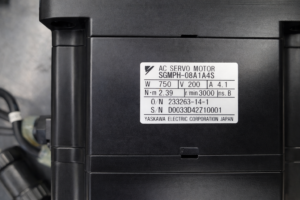
In a machine tool, a servo alarm A.84 occurred repeatedly. The affected component was an AC servo motor of type Yaskawa SGMPH-08A1A4S with an incremental encoder UTSAH-B16DC-E.
The error initially appeared sporadically during operation. The alarm occurred particularly often after longer machine running times or after several acceleration cycles of the axis.
The operator additionally reported occasional irregular movements of the axis as well as sporadic reset attempts of the servopack.
The behavior was technically unusual because the servo drive sometimes ran normally again after a reset. Such symptoms are typically caused by problems in the feedback system or electrical faults in the motor.
Alarm A.84 in the Sigma II series belongs to encoder feedback errors. The servopack detects implausible or disturbed position data coming from the motor feedback.
This protective function prevents uncontrolled movement of the machine and stops the drive.
Manual CACR_SR..BB Bulletin wit…
Incoming inspection and first diagnosis
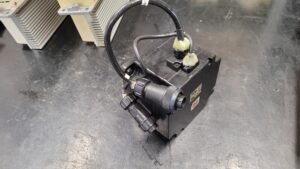
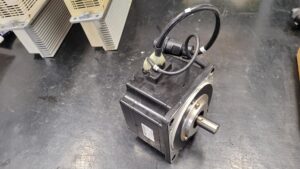
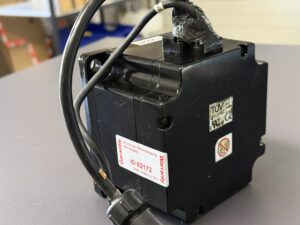
After the motor arrived at the workshop, an external visual inspection was carried out first.
The following was immediately noticeable:
moisture traces in the area of the motor connectors
slight corrosion marks on the encoder housing
contamination in the cable entry area
Already during the first insulation measurement, noticeably poor values of the motor winding were detected.
The measured values were significantly below the usual minimum values for a servo motor of this power class.
This strongly indicated the presence of penetrating coolant or moisture.
Additionally, the feedback system was electrically tested. An unstable encoder signal was detected.
The alarm could be reproduced on the test bench.
It therefore became clear that in addition to the mechanical contamination there was also a defect in the feedback system.
Technical analysis
During further disassembly the assumption was confirmed.
Clear traces of penetrated coolant were visible inside the motor.
Typical entry points are:
damaged shaft seal
aged seals
leaking cable entries
The presence of coolant causes several critical effects:
deterioration of insulation values
corrosion of electrical components
disturbances in the encoder signal
Incremental encoders in particular react very sensitively to moisture.
Even small amounts can cause signal errors that are detected by the servopack as position faults.
Alarm A.84 is therefore a typical symptom of:
disturbed encoder signals
damaged feedback system
electrical disturbances in the motor feedback.
In this case the encoder was internally damaged and had to be replaced completely.
It was also remarkable that the servopack did not suffer any power damage despite the poor insulation values.
In many cases such a condition leads to severe damage in the power stage of the drive.
Repair measures and overhaul
Since several wear and damage patterns occurred at the same time, a complete preventive overhaul was carried out.
The repair included the following measures:
complete cleaning and drying of the motor
replacement of the complete encoder system
replacement of bearings and seals
renewal of the cable entry
inspection of the electrical insulation
inspection of the mechanical components
The new encoder was then programmed with the appropriate parameters for the servopack.
Special attention was given to restoring the electrical insulation and sealing the motor against future coolant ingress.
This preventive overhaul is especially important for older servo motors, as seals and bearings lose reliability over the years.
Final functional test
After the repair the motor was tested on a servo drive test bench.
The test included several operating conditions:
power on behavior
reference run
low speed
medium speed
maximum speed
Additionally, the following parameters were monitored:
feedback signal
current consumption
temperature development
vibration behavior
Several acceleration and braking cycles were also simulated.
The motor subsequently operated stably and without any error messages.
Alarm A.84 did not occur again during the entire test period.
Conclusion
The servo motor showed typical damage caused by penetrating coolant.
The combination of:
poor insulation values
damaged encoder
and aging seals
led to the repeated servo alarm.
Through the complete preventive overhaul and replacement of all wear relevant components, the motor could be stabilized permanently.
In this case the encoder failure was particularly critical because it directly affects the feedback system of the servo drive.
Regular maintenance of the motor sealing can prevent such damage at an early stage.
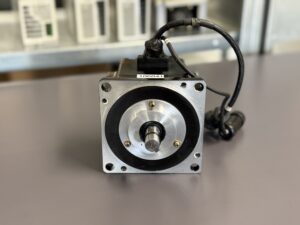
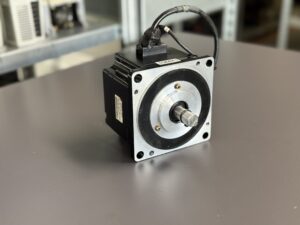
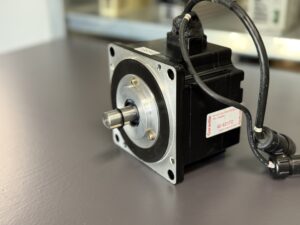
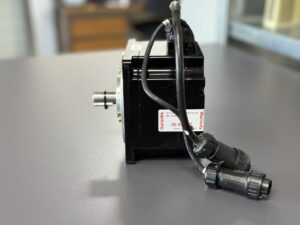
Information about the mentioned Servomotor and other components:
Yaskawa AC Servo Motors SGMPH-08A1A4S
More information about our Yaskawa repairs can be found here.
📞 Feel free to contact us if you have any questions regarding your Yaskawa drive
Technical Specifications
| Parameter | Value |
|---|
| Manufacturer | Yaskawa Electric |
| Device type | AC Servo Motor |
| Model designation | SGMPH-08A1A4S |
| Series | SGMPH |
| Power | 750 W |
| Input voltage | approx. 200 V |
| Output voltage | depending on servopack |
| Rated current | approx. 4.1 A |
| Control type | Servo drive with position control |
| Feedback | Incremental encoder UTSAH-B16DC-E |
| Cooling | Self cooled |
| Protection class | approx. IP65 motor side |
| Ambient temperature | 0 to 40 °C |
| Mounting | Flange mounting |
| Origin | Japan |
| Product status | Discontinued / Legacy |
Operating environment and applications
This servo motor is typically used in CNC machines.
Typical applications include:
machine tools
milling machines
machining centers
automation systems
Typical production years of this series are roughly between 1995 and 2010.
The motor operates in combination with servopacks of the Sigma series.
For reliable operation the following factors are particularly important:
stable power supply
clean encoder signals
sufficient cooling
protection against coolant.
Functional description
A servo drive consists of several functional units:
power stage in the servopack
control electronics
feedback system in the motor
The servopack generates a controlled motor current supply from the mains voltage.
The encoder provides position and speed information back to the controller.
Based on this data the motor current is continuously adjusted.
This results in:
precise positioning
high dynamics
stable speed control.
The feedback system is safety critical.
Encoder faults are detected immediately and lead to shutdown of the drive.
Alarms and troubleshooting
| Alarm code | Description | Cause | Action |
|---|
| A.84 | Encoder feedback error | Encoder signal fault | Check or replace encoder |
| A.81 | Encoder communication error | Cable defect | Check cable |
| A.83 | Encoder data error | Damaged encoder | Replace encoder |
| A.90 | Overload | Mechanical overload | Check load |
| A.91 | Overcurrent | Motor blockage | Check mechanics |
| A.92 | Overvoltage | Power supply issue | Check supply |
| A.93 | Undervoltage | Unstable supply | Check power |
| A.94 | Overtemperature | Insufficient cooling | Check cooling |
| A.95 | Motor fault | Winding damage | Check motor |
| A.96 | Position deviation | Feedback problem | Check encoder |
Assembly overview
| Assembly | Functional designation | Function | Notes |
|---|
| Motor stator | Electromagnetic winding | Generates torque | Insulation test important |
| Rotor | Permanent magnet rotor | Rotation movement | Mechanical inspection |
| Bearing system | Motor bearings | Supports rotor | Wear component |
| Feedback system | Incremental encoder | Position measurement | Sensitive to moisture |
| Connection area | Motor connector | Power and signal connection | Check contacts |
| Sealing system | Shaft seal | Protection against fluids | Inspect regularly |