28.01.2026 by Viktor Siebert
Repair of a Yaskawa AC Servo Motor SGMGH-20A5A2B after insulation and brake failure
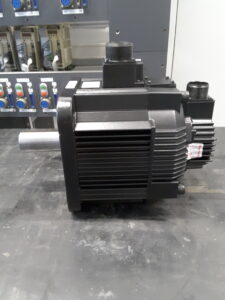
The Yaskawa AC Servo Motor SGMGH-20A5A2B arrived at our facility in a condition that made even experienced technicians pause for a moment. At first glance it was obvious that this motor had been operating for a long time under conditions it was never designed for. At the customer site, the associated servo drive SGDH-20AE-OY repeatedly reported overload alarms. In addition, the axis dropped after the machine was switched off because the motor brake had completely lost its holding force. To prevent the axis from hitting the machining table, the operator placed mechanical supports underneath the axis whenever the machine was shut down. There is hardly a clearer warning sign of a safety critical condition.
Initial situation and fault pattern at the customer
The fault description was clear and at the same time alarming. Recurrent overload alarms at the drive, unstable axis behavior in standstill, and a brake that was mechanically still present but no longer functional. In addition, an insulation fault was present and already noticeable in the machine. Under such conditions, many motors continue to run only for a short time until a complete failure occurs or, in the worst case, consequential damage to the drive or mechanics follows. Looking back, it was remarkable that this motor was still operational at all.
Disassembly and damage assessment
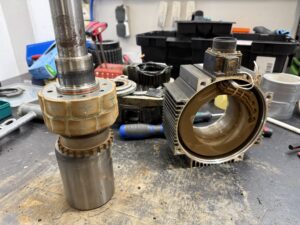
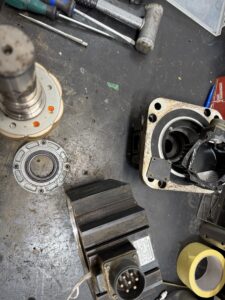
After delivery, the motor was completely disassembled. As soon as it was opened, the suspicion was confirmed. The interior was heavily contaminated with emulsion and dirt. Cooling fins, winding area, encoder section, and brake chamber were damp and heavily soiled. Such conditions usually develop over years due to defective seals, aggressive coolants, and missing maintenance intervals. The insulation resistance was well below the permissible limit values. In many cases, this already marks the economic end of a motor, since moisture can permanently alter insulation materials.
Cleaning, drying, and insulation testing
The motor was thoroughly cleaned, washed, and then carefully dried over several days. This process is time consuming but absolutely critical. It must be clearly stated that drying alone does not always restore insulation resistance to a stable and standard compliant level. In this case, however, we were fortunate. After the multi day drying process, the insulation resistance stabilized again within the specified range. Only after several measurements under defined conditions was the decision made to continue with the refurbishment.
Brake, encoder, and mechanical overhaul
The installed holding brake was beyond repair. Due to moisture ingress and wear, it had completely lost its function and was consistently replaced. A new Ogura Clutch RNB 4.4K-16(C), DC 90V brake was installed, matching the original specifications. The encoder UTSAH-B17BE, on the other hand, could be overhauled. Through cleaning, refurbishment, and precise adjustment, it was possible to continue using it, which resulted in significant cost savings for the customer. In addition, all relevant seals, bearings, and mechanical interfaces were inspected and replaced where necessary.
Reassembly and testing
After the complete overhaul, the motor was professionally reassembled and tested on our test bench. The test procedure included insulation measurements, no load and load tests, verification of brake holding force, and monitoring of encoder feedback under dynamic conditions. Only after all measured values were stable and the motor showed smooth running behavior under load was the repair approved. The focus was deliberately not on a minimal repair, but on a complete and sustainable overhaul.
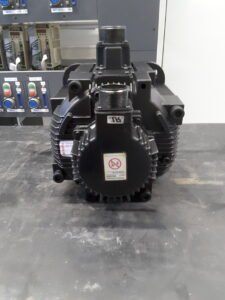
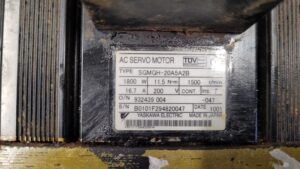
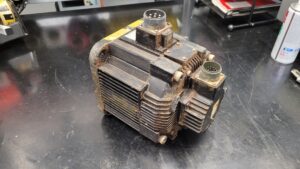
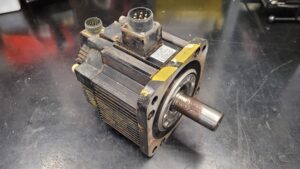
Information about the mentioned Servopack and Servomotor:
More information about our Yaskawa repairs can be found here.
📞 Feel free to contact us if you have any questions regarding your Yaskawa drive technology. Our experienced team is always ready to assist you.
Technical specifications
| Parameter | Value |
|---|
| Manufacturer | Yaskawa Electric |
| Model | SGMGH-20A5A2B |
| Motor type | AC Servo Motor |
| Rated power | 1.8 kW |
| Rated torque | 11.5 Nm |
| Rated speed | 1500 rpm |
| Rated voltage | 200 V |
| Rated current | approx. 16.7 A |
| Insulation class | F |
| Duty type | Continuous operation |
| Brake | Ogura RNB 4.4K-16(C), DC 90 V |
| Encoder | UTSAH-B17BE |
| Origin | Made in Japan |
Typical application environment
This motor type is commonly used in CNC machine tools, especially in axis applications with medium torque requirements. Typical environments include machines operating with coolant, high humidity, and continuous multi shift operation. In exactly these environments, intact sealing is critical for service life.
Functional description
The motor operates as a brushless AC servo motor with high resolution encoder feedback. In combination with Sigma II series servo amplifiers, it enables precise position and torque control. The integrated holding brake is designed exclusively for safe axis holding at standstill and is not intended for dynamic braking processes.
Alarm messages of the SGDH Sigma II series in connection with motor related faults
| Alarm code | Description | Typical cause | Action |
|---|
| A.10 | Overload | Mechanical binding, brake blocking | Check mechanics and motor |
| A.30 | Overcurrent | Insulation problems, winding damage | Inspect motor |
| A.40 | Encoder error | Moisture inside encoder | Check or replace encoder |
| A.51 | Overload warning | Continuous high load | Check load profile |
| A.71 | Motor overtemperature | Contamination, impaired cooling | Cleaning |
| A.72 | Brake error | Brake does not release or hold | Inspect brake |
| A.80 | Feedback error | Unstable encoder signal | Check encoder and cable |
| A.81 | Encoder initialization error | Internal encoder damage | Repair encoder |
| A.82 | Position deviation | Mechanical issues | Inspect axis |
| A.83 | Control deviation | Combined motor and load fault | System analysis |
Main assemblies
| Assembly | Designation | Function | Notes |
|---|
| Stator | SGMGH series | Torque generation | Insulation condition critical |
| Rotor | Permanent magnet | Motion generation | Avoid moisture |
| Brake | Ogura RNB 4.4K-16(C) | Holding function | Wear part |
| Encoder | UTSAH-B17BE | Position feedback | Sensitive to moisture |
| Seals | Motor housing | Protection against media | Inspect regularly |
Conclusion
This repair case clearly demonstrates how long a servo motor can remain in operation despite severe internal damage, and how high the risk for machine and operator becomes in such situations. A consistent overhaul with focus on insulation condition, brake, encoder, and seals is the only sensible approach in these cases. The successful refurbishment of this motor not only saved costs but also sustainably restored the operational safety of the machine.