12.05.2026 by Viktor Siebert
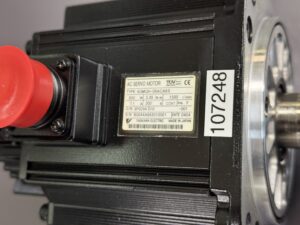
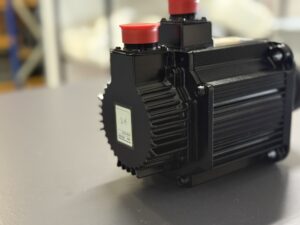
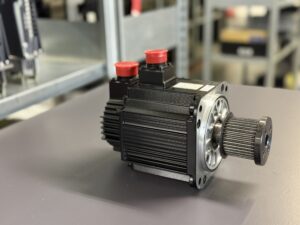
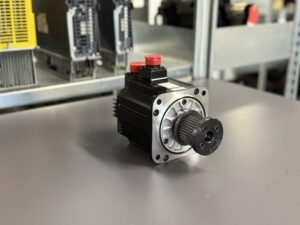
Repair of Yaskawa AC Servo Motor SGMGH-09ACA6S with Encoder UTSIH-B17CK and Servo Drive SGDH-10AE Insulation Failure Causing Alarm A.10
This case involves a Yaskawa SGMGH-09ACA6S operating together with a Yaskawa SGDH-10AE. The machine repeatedly reported alarm A.10, while the servo drive showed continuous thermal overload behavior.
The fault was not immediately reproducible. It appeared mainly under load conditions or after extended operation. In practice, this kind of intermittent behavior makes diagnosis significantly more difficult.
A key observation came from maintenance on site. After replacing the motor as a test, the machine ran without any faults. This clearly pointed to the motor as the root cause rather than the servo drive itself.
During incoming inspection, no obvious external damage was visible. Connectors and housing appeared intact. However, closer inspection revealed a damaged shaft seal. After disassembly, the internal condition confirmed the issue. Coolant emulsion, oil, and fine metal particles had entered the motor and contaminated internal components.
From a technical perspective, the critical factor is insulation degradation. Servo motors operate with precise current control. The servo drive continuously regulates motor current based on encoder feedback.
When contamination reduces insulation resistance to ground, leakage currents occur. These currents are interpreted by the servo drive as increased load demand. As a result, the power stage is forced to deliver higher current continuously.
This leads to thermal stress and overload of the power electronics. In this case, the reduced insulation resistance caused a permanent increase in current demand, ultimately triggering alarm A.10.
Alarm A.10 is often misinterpreted as a defect in the servo drive. In reality, it is frequently caused by external issues such as motor insulation failure. The protective functions of the servo system react to overcurrent, overload, or abnormal feedback conditions .
A key reason why the fault was difficult to detect is that the motor was still partially functional. The insulation was degraded but not completely broken down. This resulted in load-dependent and temperature-dependent failures, which are typical for contamination-related damage.
Technical Analysis
A servo system consists of three main components:
Power stage in the servo drive
Control electronics
Feedback system via encoder
The servo drive generates a PWM signal and controls the motor current. The encoder provides position and speed feedback. The control loop continuously compares target and actual values.
If leakage currents occur due to contamination, the current control loop becomes unstable. The drive compensates continuously, which increases current and thermal load.
Additionally, contamination affects bearings and increases mechanical resistance, further amplifying the problem.
Repair Measures and Overhaul
The motor was completely disassembled and rebuilt.
Performed work included:
Complete cleaning and removal of contamination
Drying of stator and insulation testing
Replacement of all bearings
Replacement of shaft seals
Overhaul of encoder UTSIH-B17CK
Verification of winding insulation
After repair, insulation was tested using high-voltage methods.
Preventive Measures
This type of damage is preventable.
Recommended actions:
Regular inspection of shaft seals
Monitoring for coolant ingress
Periodic insulation testing
Avoid direct exposure to coolant
Use of protective covers in critical environments
Coolant contamination is one of the most common causes of servo motor failure in machine tools.
Final Function Test
The motor was tested on a controlled test bench.
Test conditions:
Operation at rated voltage approx. 400 V
Speed testing up to 1500 rpm
Load cycle operation
Thermal monitoring
Results:
Stable operation across full speed range
No abnormal current behavior
Consistent encoder feedback
Thermally stable performance
Practical Diagnostic Value
Typical symptoms of this failure:
Servo drive overheating
Intermittent overload or overcurrent alarms
Machine runs normally after motor replacement
Gradual decrease in insulation resistance
Early detection indicators:
Insulation resistance below 10 MΩ
Increased no-load current
Signs of moisture or contamination
Differentiation from similar faults:
Drive defects usually appear immediately
Encoder faults cause position errors
Mechanical issues cause constant overload
Conclusion
This case clearly shows that electrical faults often originate from mechanical or environmental causes. A damaged shaft seal allowed coolant contamination, leading to insulation failure and overload of the servo drive.
The repair is sustainable, as all critical components were replaced. In practice, this type of failure is common and frequently misdiagnosed.
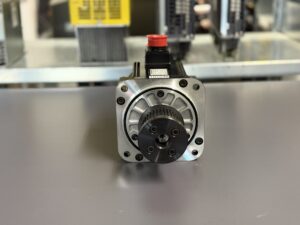
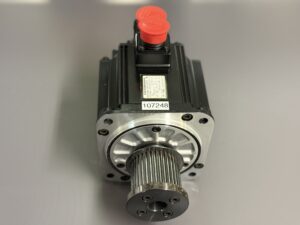
Information about the mentioned Servopack and Servomotor:
More information about our Yaskawa repairs can be found here.
📞 Feel free to contact us if you have any questions regarding your Yaskawa drive technology. Our expe
Technical Specifications Yaskawa SGMGH-09ACA6S
| Parameter | Value |
|---|
| Type | SGMGH-09ACA6S |
| Power | approx. 0.9 kW |
| Torque | approx. 8.6 Nm |
| Voltage | 400 V |
| Speed | 1500 rpm |
| Current | approx. 7.6 A |
| Insulation Class | F |
| Protection | IP65 (limited at shaft) |
Operating Environment and Applications
Typical applications:
Machine tools
CNC axes
Automated production systems
Typical stresses:
Coolant exposure
Temperature variations
Vibration
Critical risk areas:
Shaft seals
Cable entries
Encoder interface
Functional Description
The servo motor converts electrical energy into controlled mechanical motion. The servo drive generates PWM signals and regulates current.
The encoder provides feedback, forming a closed-loop control system.
Integrated protection functions include:
Overcurrent protection
Overload protection
Temperature monitoring
Voltage monitoring
These functions react immediately to abnormal conditions.
Typical Failure Causes and Prevention
| Cause | Effect | Symptom | Preventive Action |
|---|
| Damaged seal | Moisture ingress | Insulation failure | Replace seals |
| Coolant contamination | Corrosion | Intermittent faults | Improve sealing |
| Bearing wear | Increased friction | Overload | Replace bearings |
| Encoder contamination | Signal errors | Position faults | Clean encoder |
| Cable damage | Signal loss | Instability | Inspect cables |
Alarm Messages and Troubleshooting Yaskawa SGDH
| Code | Description | Cause | Solution |
|---|
| A.00 | Ready | Normal operation | none |
| A.02 | Parameter error | incorrect settings | check parameters |
| A.04 | Overcurrent | short circuit / insulation | check motor |
| A.05 | Overload | mechanical load | reduce load |
| A.07 | Overvoltage | regeneration issue | check resistor |
| A.08 | Undervoltage | supply issue | check voltage |
| A.09 | Regeneration error | brake circuit fault | inspect circuit |
| A.10 | Power stage overload | motor insulation fault | test motor |
| A.11 | Overspeed | control or encoder fault | check encoder |
| A.12 | Encoder error | signal loss | inspect encoder |
| A.13 | CPU error | electronics fault | replace drive |
| A.14 | Overheat | cooling problem | check fan |
| A.15 | Phase loss | supply issue | check wiring |
| A.16 | A/D error | measurement fault | replace drive |
Component Overview
| Component | Function |
|---|
| Stator | Generates magnetic field |
| Rotor | Produces rotation |
| Bearings | Mechanical support |
| Encoder | Position feedback |
| Seal | Protection against contamination |
| Terminals | Power connection |
Visual References
Typical images:
Motor with damaged shaft seal
Internal contamination by coolant
Corroded bearings
Contaminated encoder
Suggested video content:
Motor running before and after repair
Encoder signal analysis
Thermal behavior under load