26.08.2026 by Viktor Siebert
Why Servo Drives and Servo Motors Age: Typical Wear Mechanisms in Mitsubishi, Yaskawa, HAAS and Other CNC Systems
Many older CNC machines continue to operate reliably even after 15, 20 or even 30 years. Mechanically, these machines are often still in good condition. Nevertheless, as they age, faults in servo drives, spindle drives, frequency inverters, power supplies and servo motors become increasingly common.
In our workshop, we see surprisingly similar fault patterns regardless of the manufacturer. Whether Mitsubishi, Yaskawa, FANUC, Okuma or other drive systems: the circuit designs differ, but the fundamental ageing mechanisms of electronic and mechanical components are often very similar.
A drive may start normally in the morning and fail only after 30 minutes of machining. Another may operate for days before suddenly generating an overcurrent, voltage or feedback error. Yet another may initially operate normally again after a restart.
This behaviour is precisely what makes diagnosing older industrial electronics so difficult.
The fault is not necessarily caused by a single component that has completely failed. Often, a component is already operating outside, or very close to, the limits of its original operating range. Temperature, load and operating time ultimately determine whether the unit continues to function or triggers an alarm.
Electronics Age Even When They Look Perfectly Fine
Electronic assemblies do not have an unlimited service life.
Temperature cycles, operating hours, electrical load, dust, oil mist, vibration and thousands of machine cycles affect the components over many years. A component does not necessarily have to look burnt or visibly damaged.
Its electrical characteristics can gradually change.
This is exactly why troubleshooting older servo drives is often considerably more complex than diagnosing a clear short circuit. The unit may initially operate normally on the test bench and only become unstable under load or after reaching operating temperature.
Manufacturer documentation shows how important temperature and ageing were already considered when these systems were designed. In the Yaskawa CACR-SR SERVOPACK manual, for example, regular inspections for dust, oil, cooling fans and thermally damaged components are specified. Yaskawa even provides replacement intervals for certain wear components: cooling fans after two to three years, smoothing capacitors after seven to eight years and aluminium electrolytic capacitors on PC boards after approximately five years, depending on inspection results and operating conditions. The manual assumes optimum operating conditions including an average ambient temperature of 30 °C and a maximum operating time of 20 hours per day.
These specifications clearly demonstrate that component ageing is not merely a theoretical issue. It was already taken into account by the manufacturer as part of maintenance and servicing.
Electrolytic Capacitors: One of the Classic Ageing Components
Electrolytic capacitors are among the components that require particular attention in older industrial drives.
They can be found in power supplies, DC links, control power supplies and on various electronic boards. Over many years, their electrical characteristics change. Higher temperatures accelerate this process.
The problem is that an aged capacitor may look completely normal from the outside.
It does not necessarily have to be swollen or leaking.
Possible consequences include unstable supply voltages, increased ripple, startup problems, sporadic resets or faults that occur only when the load increases.
For this reason, visual inspection alone is often insufficient when dealing with a 20-year-old drive.
An interesting detail can already be found in Yaskawa’s documentation: smoothing capacitors are explicitly listed as components that should be inspected and, depending on their condition and age, replaced.
Optocouplers and Signal Transmission: When a Clear Signal Gradually Becomes Marginal
Optocouplers and other signal transmission components can also change their original characteristics over very long operating periods.
They are used in industrial drives for functions such as galvanic isolation and signal transmission. Over many years of operation and countless switching cycles, their transmission characteristics can deteriorate.
This does not necessarily result in complete failure.
And that is precisely what makes these faults interesting.
A signal may still be sufficient under certain conditions, but no longer reliable under others. Temperature and supply voltage can have an additional influence.
In practice, this can result in a drive that operates normally after startup, develops sporadic faults later and eventually fails permanently.
Heat Is One of the Greatest Enemies of Power Electronics
Thermal stress inside a servo drive is particularly critical.
IGBTs, transistor modules, rectifiers, regenerative circuits and other power components generate heat during operation. This heat must be dissipated through heat sinks and airflow.
If heat dissipation is no longer functioning properly, thermal stress increases.
The Mitsubishi MDS-D/DH documentation, for example, describes a Power Module Overheat alarm. Mitsubishi specifically lists the cooling fan, contaminated cooling fins and ambient temperature as inspection points. Clogged cooling fins should be cleaned and a defective fan should be replaced.
Overtemperature is also an important diagnostic condition in Okuma MIV systems. The manual includes faults such as “Inverter overheat” and “Motor overheat”.
This illustrates something we repeatedly see during repairs:
The service life of a drive is determined not only by its electrical load. It also depends on whether the heat generated during operation can be reliably dissipated over many years.
A Failed Cooling Fan Is Often Not the Actual Damage, but the Beginning of It
Cooling fans in older CNC systems are frequently underestimated.
A fan operates for thousands of hours over many years. Bearings wear, dirt accumulates and fan speed may gradually decrease. Eventually, the fan may stop completely.
The drive may initially continue operating.
This is where the dangerous phase often begins.
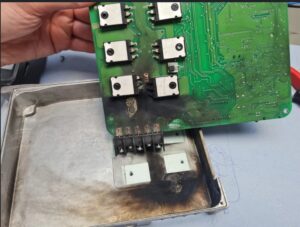
The power electronics continue generating heat, but that heat is no longer adequately removed. As a result, temperatures rise around power semiconductors, capacitors, circuit boards and neighbouring components.
Mitsubishi lists both a Fan Stop Warning and a Fan Stop Alarm for the MDS-D/DH series. For Power Module Overheat, the manual explicitly mentions contaminated fans and clogged cooling fins as possible causes.
Yaskawa even lists the cooling fan as a component requiring periodic replacement.
For this reason, when inspecting an older drive, we do not consider a defective fan in isolation.
The important question is:
How long has the unit already been operating with insufficient cooling, and what thermal stress have the remaining components experienced during this period?
Contamination Changes the Thermal Conditions Inside the Entire Unit
Dust, oil mist and fine particles gradually accumulate on heat sinks, fans and circuit boards.
This does more than simply make the unit dirty.
It changes its thermal characteristics.
A clogged heat sink cannot dissipate heat as effectively. A contaminated fan moves less air. Deposits inside the unit interfere with the intended airflow.
The Mitsubishi manual specifically lists cutting oil, chips and clogged cooling fins as inspection points when troubleshooting overheating problems.
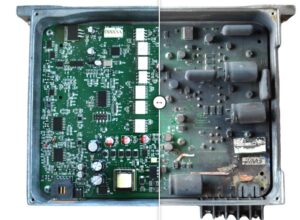
For this reason, thorough cleaning of older drive systems is not merely cosmetic. It is part of the technical repair process.
Typical Fault Pattern: The Unit Works When Cold, but the Alarm Appears When Warm
One of the most interesting fault patterns in older drives is temperature-dependent failure.
The machine is switched on in the morning.
Everything works.
After 20, 30 or 60 minutes of machining, an alarm suddenly occurs. After the unit has cooled down, it may work again.
To the machine operator, the fault initially appears random.
Technically, however, this behaviour is an important clue.
Electrical characteristics change with temperature. If components are already aged, the temperature increase during operation can cause a previously functional circuit to move outside its permissible operating range.
This is why load and long-term testing are particularly important for these units.
A drive that operates for ten minutes on a test bench cannot necessarily be considered fault-free when the customer’s problem occurs only after the unit has reached operating temperature.
Mitsubishi Case Example: Overcurrent Only Under Load
A typical case from our workshop involved a Mitsubishi MDS-DM-V3-404040 AC Servo Drive Unit.
The customer reported an F1 32 alarm. What made the case particularly interesting was not only the alarm itself, but the point at which it occurred.
After startup, the drive initially operated normally. Only after approximately half an hour of machining under heavier load did the fault appear. After that, the alarm occurred increasingly often.
Cases like this demonstrate why the statement “the unit is running” is not sufficient for diagnosis.
In the Mitsubishi MDS-D/DH manual, Alarm 32 is described as “Power module error (overcurrent)”. Troubleshooting includes checking motor wiring, motor insulation, unit configuration, feedback connections and environmental conditions such as temperature, electrical noise and grounding.
A sporadic overcurrent fault under thermal load therefore requires a systematic approach. Not only the power stage itself, but also the power supply, feedback system, motor and thermal conditions must be included in the analysis.
Yaskawa Case Example: Older SERVOPACKs and the Importance of Preventive Overhaul
Older Yaskawa SERVOPACKs provide a very good example of why preventive servicing can make sense.
Yaskawa itself distinguishes in its maintenance documentation between components subject to mechanical wear and components whose characteristics deteriorate with age.
For the CACR-SR series, the manual specifies, for example:
Cooling fan: replacement after approximately two to three years.
Smoothing capacitor: approximately seven to eight years, depending on inspection.
Aluminium electrolytic capacitors on PC boards: approximately five years, or replacement of the board depending on inspection.
Relays and protective components should also be evaluated during inspection.
Of course, this does not mean that every capacitor will fail after exactly five or eight years. Many units operate considerably longer.
However, it does show that a 20 or 25-year-old drive may already be far beyond the maintenance intervals originally considered for some of its components.
This is why, during a repair, it can make sense not to replace only the single component responsible for the current alarm.
Mitsubishi, Yaskawa, FANUC and Okuma: Different Systems, Similar Physical Stresses
Every manufacturer develops its own hardware, protective functions, alarm codes and diagnostic concepts.
The underlying physics, however, remains the same.
Power semiconductors generate heat.
Capacitors age.
Cooling fans wear out.
Connectors are exposed to vibration and thermal cycles.
Circuit boards experience thermal stress over many years.
Motor bearings operate for thousands of hours.
Seals gradually lose their original properties.
This is why we encounter similar groups of faults across very different manufacturers: overcurrent, overheating, undervoltage, overvoltage, feedback errors, encoder faults, fan problems and sporadic failures after extended operation.
The specific diagnosis must, of course, always be based on the individual system and the corresponding manufacturer’s documentation.
Servo Motors Age Differently from Servo Drives
Servo motors are additionally affected by mechanical ageing.
Bearings are particularly important.
As operating hours increase, lubrication and running characteristics change. Vibration and noise can increase. In extreme cases, the mechanical load can become so severe that it also affects the connected drive system.
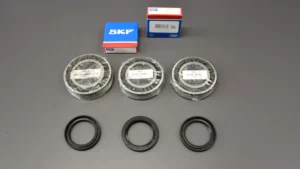
In its documentation for the servo motors described, Yaskawa specifies regular inspection for unusual vibration and noise. A replacement interval of 20,000 operating hours is given for bearings. Shaft seals are listed with an interval of 5,000 hours, depending on application and condition.
This demonstrates that even an electrically functional motor may already require mechanical maintenance.
Coolant and Emulsion: A Particularly Critical Enemy of Servo Motors
Machine tools introduce another problem: coolant and emulsion.
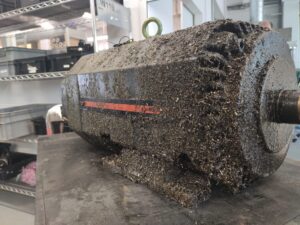
Seals age. If they become hard or damaged, fluid can enter the motor.
The consequences can be serious.
Insulation can deteriorate, bearings can be damaged, connectors can corrode and encoders or feedback systems can also be affected.
The Mitsubishi troubleshooting documentation specifically recommends checking whether oil has come into contact with the motor or power cable when investigating ground faults. For overcurrent problems, motor insulation is also checked, and the motor environment is examined for conditions including ambient temperature and cutting fluid.
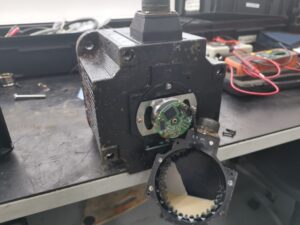
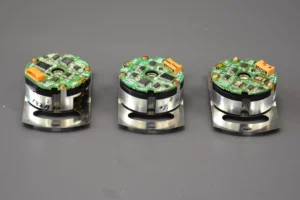
For example, we had a Mitsubishi HF104S-A48 servo motor with an OSA18-100 encoder in our workshop. When the motor was opened, a considerable amount of emulsion was found inside. The seals were no longer reliable, the bearings were worn and the encoder area was heavily contaminated.
Cases like this demonstrate why an encoder alarm does not automatically mean that only the encoder itself is defective.
The root cause may lie much deeper in the mechanical condition of the motor.
Why an Alarm Code Alone Rarely Provides the Complete Diagnosis
An alarm is initially the system’s response to a detected condition.
It is not automatically a complete description of the root cause.
This can be seen clearly in manufacturer documentation.
For Mitsubishi Alarm 32 “Power module overcurrent”, for example, troubleshooting does not focus solely on an internal drive fault. Motor cables, motor insulation, feedback connections, unit configuration and environmental conditions are also part of the diagnostic process.
Okuma MIV systems similarly include faults relating to inverter conditions, motor overcurrent, overheating, encoder communication, encoder power supply and motor overload.
For this reason, an older CNC system should not be diagnosed according to the simple principle:
Alarm X means component Y is defective.
The better question is:
Under which operating conditions does the alarm occur, and which part of the system can actually cause this condition?
Why Sporadic Faults Should Be Taken Seriously
A sporadic fault is not necessarily less serious than a permanent fault.
In many cases, the opposite is true.
If a unit fails only occasionally, a component may currently be transitioning between functional and defective.
Typical descriptions we receive from customers include:
“After restarting, it works again.”
“The fault only occurs after longer machining cycles.”
“The machine works perfectly in the morning.”
“The alarm occurs under high load.”
“Recently, the fault has been occurring more frequently.”
Such information is extremely valuable for diagnosis.
If a fault initially occurs once a week, then daily, and eventually becomes permanent, this is a typical pattern of progressive ageing.
Repair or Simply Replace the Defective Component?
With a relatively new unit, replacing only the clearly defective component may be sufficient.
With a 20 or 30-year-old drive, the question should be different.
What condition is the rest of the unit in?
If one aged capacitor is replaced while several other capacitors of the same age remain in operation, the fan is already becoming difficult to turn and the heat sink is heavily contaminated, the current fault may have been repaired, but the fundamental risk of failure remains.
This is why we distinguish between simple fault repair and preventive overhaul.
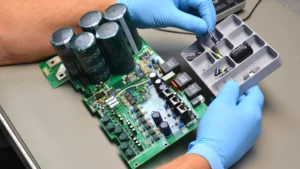
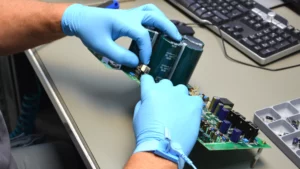
During a sensible overhaul, known ageing points are inspected and, depending on their condition, serviced or replaced preventively. The unit should then be tested under realistic operating conditions.
What Operators of Older CNC Machines Can Do
It is not necessary to replace every old servo drive as a precaution. A functioning system should not be modified without reason.
However, with older machines, it is worth paying close attention to typical wear points.
These include cooling fans and airflow paths, heat sinks, contamination inside the electrical cabinet, unusual temperature development, abnormal motor bearing noise, the condition of motor and encoder cables, connectors and any signs of oil or emulsion around the motor.
The fault history is equally important.
If sporadic alarms become increasingly frequent, they should be documented. Important information includes the exact time of occurrence, machine condition, load, speed, temperature and whether the fault occurs immediately after startup or only after prolonged production.
This information can be decisive during subsequent diagnosis.
The Most Important Factor Is Often Not Age Alone, but the Combination of Age, Heat and Load
A 20-year-old servo drive is not automatically defective.
At the same time, age should not be ignored.
The decisive factor is the combination of operating hours, thermal stress, environmental conditions, contamination, electrical load and the condition of individual wear components.
A clean unit that has operated under moderate conditions may remain reliable for many years. The same model operating continuously at high load, with a contaminated heat sink and an ageing cooling fan, may experience significantly greater component stress.
The same principle applies to servo motors. Bearings, seals and feedback systems are subject to mechanical and environmental influences that gradually accumulate over thousands of operating hours.
For operators of older CNC machines, this leads to an important conclusion:
Not every sporadic alarm means that the entire drive system must be replaced. But recurring faults should not simply be reset and ignored.
Understanding how and when a fault occurs is often the first step toward identifying the actual cause.
Conclusion
Mitsubishi, Yaskawa, FANUC, Okuma and other industrial drive systems may differ considerably in design, but their components are exposed to the same fundamental ageing mechanisms.
Electrolytic capacitors deteriorate over time. Cooling fans wear out. Heat affects power electronics. Dust and oil reduce cooling efficiency. Bearings accumulate operating hours. Seals age and can eventually allow coolant to enter a servo motor.
This explains why many older CNC systems develop similar symptoms despite using completely different drive technologies.
The most important point is therefore not simply to ask which alarm is displayed.
The more useful questions are:
When does the fault occur?
Does it depend on temperature?
Does it occur only under load?
Is it becoming more frequent?
Does it disappear after cooling or restarting?
What is the condition of the cooling system, motor, encoder and associated wiring?
When these questions are considered together, a seemingly random sporadic alarm often becomes a technically understandable fault pattern.
And in many cases, an ageing servo drive or servo motor does not have to be immediately replaced. A systematic diagnosis, professional repair and appropriate preventive overhaul can keep older CNC systems reliably in production for many more years.