11.03.2026 by Viktor Siebert
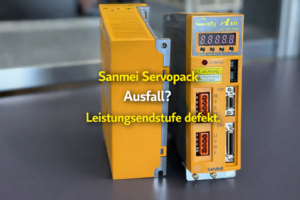
Repair of a Sanmei QT-002AXE-ST Servo Drive with Thermal Power Stage Failure
Initial situation and fault symptoms.
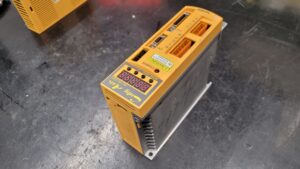
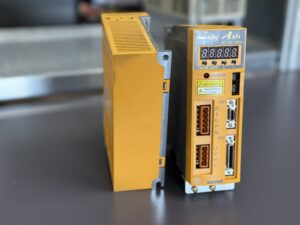
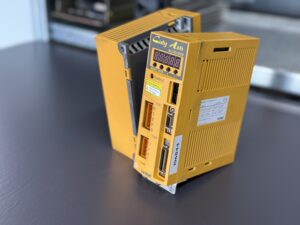
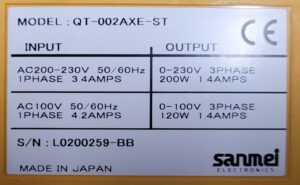
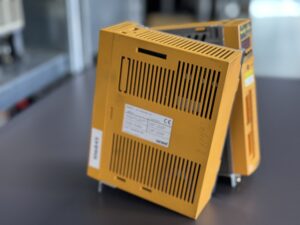
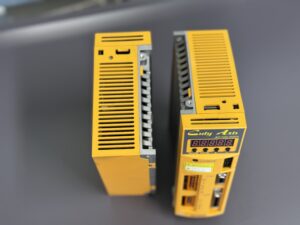
The servo drive Sanmei QT-002AXE-ST was received in the workshop from a CNC Swiss-type lathe machine. These drives are frequently used in Star machines and control feed axes or auxiliary functions.
The operator reported a recurring issue during production. The machine initially ran normally but suddenly stopped during operation. In many cases the machine could be restarted immediately, but sometimes a longer cooling period was required.
Typical symptoms observed in the machine:
Unexpected servo stop during machining
Machine standstill without mechanical damage
Occasional servo alarms or drive shutdown
Machine restart possible after a short waiting period
This behaviour typically appeared under normal machining load and not necessarily during maximum axis load. Because of this the fault was initially difficult for the operator to reproduce.
The failure is particularly noticeable because it does not occur immediately. Machines often run for several minutes or even hours before the drive shuts down again.
Incoming inspection and first diagnosis
Before starting any work the following safety procedures must always be followed:
Disconnect the machine from the power supply
Secure the system against reconnection
Wait for the discharge time of capacitors
Verify absence of voltage
Measurements on live components may only be performed by qualified electrical personnel.
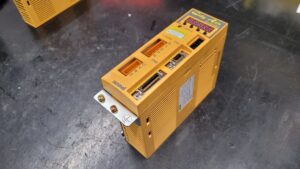
After the device arrived at the workshop an incoming visual inspection was performed.
The following areas were inspected:
Power electronics condition
Heatsinks and cooling airflow paths
Electrolytic capacitors
Power terminals and connectors
PCB thermal stress indicators
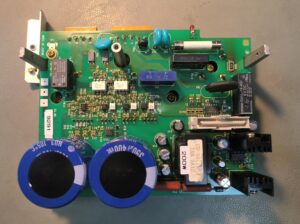
Already during the visual inspection several components in the power stage area showed signs of thermal stress. In particular the driver stage and power supply section showed clear aging patterns.
Initial electrical tests confirmed unstable power stage behaviour.
Technical analysis
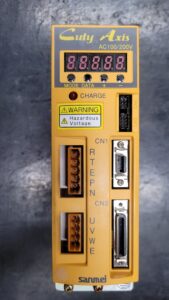
The Sanmei QT-002AXE-ST belongs to the CutyAxis2 servo drive series and communicates with external control systems through serial interfaces such as RS-232 or RS-422/485.
Within the CNC system the servo drive performs several critical functions:
Execution of motion commands from the CNC
Motor current regulation
Monitoring of power electronics
Communication with HMI or PLC
The power stage generates motor current using PWM switching technology. This causes significant thermal stress on several components.
Critical components include:
IGBT or power switching stage
Gate driver circuits
DC-link capacitors
Current sensing amplifiers
Over time multiple components age simultaneously.
Typical aging mechanisms include:
Loss of capacitance in electrolytic capacitors
Thermal degradation of gate driver circuits
Resistance drift in power resistors
Contact oxidation on connectors
During inspection of the unit more than 20 known weak points were identified.
These mainly affect:
Power stage components
Driver circuits
Auxiliary power supply
Temperature monitoring circuits
This results in the following failure mechanism:
Cause → Effect → Symptom
Aging power electronics → increased power dissipation → thermal shutdown during operation
Repair measures and refurbishment
After identifying the fault a full repair procedure was performed.
The repair process consisted of several steps.
Cleaning
All assemblies were thoroughly cleaned.
Removal of dust and oil residues
Cleaning of heatsinks and airflow channels
Inspection of thermal contact surfaces
Clean cooling surfaces are essential for stable thermal behaviour of the drive.
Replacement of critical components
Known weak components were replaced preventively.
Typical replaced parts include:
DC-link electrolytic capacitors
Gate driver ICs
Thermally stressed resistors
Temperature sensing components
Auxiliary power supply components
These components are replaced systematically, not individually, because aging usually affects several parts at the same time.
Preventive stabilization
Additional measures included:
Resoldering thermally stressed solder joints
Verification of gate drive signals
Inspection of current measurement circuits
Improvement of thermal contact surfaces
These steps significantly improve long term reliability of the servo drive.
Final functional test
After the repair the drive was tested on a dedicated servo drive test bench.
Test procedures included:
Drive initialization
Communication test
Speed control test
Dynamic load testing
Thermal endurance testing
The drive is operated for several hours under realistic load conditions.
Protection tests
Additional protection tests were performed:
Overcurrent monitoring
Thermal shutdown verification
DC-link voltage monitoring
Result
After the repair the servo drive operated stably during the entire test procedure.
No unexpected shutdowns occurred
Power consumption remained stable
Temperature remained within normal limits
The original failure was therefore completely eliminated.
Conclusion
The typical failure of the Sanmei QT-002AXE-ST is caused by thermal aging in the power stage.
In most cases several components degrade simultaneously. Replacing only a single defective component is therefore rarely sufficient.
A systematic refurbishment of all known weak components significantly improves long-term reliability.
Preventive replacement of aging components extends the service life of these servo drives and helps avoid unexpected machine downtime.
Learn more about our Repairportfolio and services here:
About Company
Regarding the mentioned unit:
Sanmei QT-002AXE-ST Servo Drive
📞 Questions or a defective unit?
Feel free to contact us directly we provide fast, competent, and solution-oriented support.
Technical Specifications
| Parameter | Value |
|---|
| Manufacturer | Sanmei Electronics |
| Device Type | Servo Drive |
| Model | QT-002AXE-ST |
| Series | CutyAxis2 |
| Power rating | approx. 200 to 400 W |
| Input voltage | AC 200 to 230 V |
| Output voltage | approx. 0 to 200 V PWM |
| Rated current | approx. 2 to 4 A |
| Control type | Digital servo control |
| Feedback | Incremental encoder |
| Cooling | Passive heatsink |
| Protection class | Control cabinet installation |
| Mounting | Control cabinet |
| Ambient temperature | approx. 0 to 40 °C |
| Country of origin | Japan |
| Product status | Obsolete but repairable |
Operating Environment and Applications
Typical machines:
CNC Swiss-type lathes
CNC milling machines
Automated production systems
Typical applications:
Axis feed drives
Tool changer mechanisms
Auxiliary positioning axes
Control cabinet requirements:
Stable power supply
Adequate cooling airflow
EMC-compliant wiring
Thermal load is typically highest during continuous machining cycles with frequent acceleration.
Functional Description
The servo drive operates as a closed loop control system.
Internal structure includes:
Power rectifier
DC link capacitor stage
PWM power stage
Control electronics
The control unit calculates the required motor current based on speed or position commands from the CNC.
Encoder feedback signals are used for closed loop control.
The drive monitors several protection functions:
Overcurrent protection
Overtemperature monitoring
DC link voltage monitoring
Alarm Messages and Troubleshooting
The CutyAxis servo system does not use a single numeric alarm code list.
Instead the drive provides alarm status bits through the ALM memory area, which can be read by the controller or HMI.
| Alarm Register | Description | Possible Cause | Corrective Action |
|---|
| ALM0 | Servo alarm status | internal drive fault | restart drive and check power stage |
| ALM1 | Servo ON failure | control logic fault | verify enable signals |
| ALM2 | Position error | encoder or motion error | check encoder signals |
| ALM3 | Parameter error | incorrect configuration | verify parameter settings |
| ALM4 | Reference position error | homing not completed | perform reference return |
| ALM5 | Communication error | RS232 or RS485 failure | check communication cable |
| ALM6 | EEPROM error | memory failure | reload parameters |
| ALM7 | CPU error | control processor failure | reset controller |
| ALM8 | Emergency stop | external stop input | verify safety circuit |
Error messages can additionally be generated by the connected control system or HMI depending on configuration.
Component Overview
| Assembly | Function | Inspection Notes |
|---|
| Power stage | Motor current generation | check IGBT switching stage |
| Control board | Servo control logic | inspect CPU and signal processing |
| Power supply | Internal voltage generation | frequent failure point |
| Cooling system | Heat dissipation | inspect heatsink surfaces |
| Signal processing | Encoder feedback evaluation | sensitive to noise |