20.01.2026 by Viktor Siebert
Repair and portfolio integration of a Rubycon PD27A power supply, Mazak Edition
It regularly happens that customers ask us whether we can add new devices or series to our repair portfolio. In most cases, these inquiries do not arise by chance but directly from practice: a certain power supply fails more frequently, replacement units are difficult to obtain, or machine downtimes increase. This was exactly the case with the Rubycon PD27A.
The Rubycon PD27A is an industrial switched-mode power supply that we know mainly from CNC machine tools. It is particularly often installed in Mazak machines in the area of CNC controls. Over the past years, the number of inquiries regarding this specific power supply has increased significantly. At first, we were only asked occasionally about repairs, later about exchange units, and finally about general availability.
For us, this is the typical trigger to systematically integrate a new series into our portfolio. We do not react spontaneously or improvised but follow a fixed internal process that has proven itself over many years.
The first step is always the technical evaluation of the device. For the PD27A, we initially focused intensively on the nameplate, the electrical characteristics, and the installation environment. The wide input voltage range of 200 to 480 V AC is particularly important, as these power supplies are used in different countries and machine variants. Equally relevant is the stable 24 V output with 8 A, which plays a central role in CNC controls.
At the same time, we analyze the typical operating conditions. With the Rubycon PD27A, it quickly became clear that this is a continuous-duty device that often operates for many years without interruption. Combined with the environment inside machine tools, meaning heat, dust, oil mist, and vibration, this results in a clear picture of possible aging and failure mechanisms.
Once these fundamentals are clarified, the practical part follows: setting up our own test bench. For the PD27A, we developed a dedicated test setup that realistically represents both the wide input voltage range and the typical load conditions. We do not only simulate nominal operation but also thermal stress, power-on behavior, and load changes. Only when a unit passes these tests stably is it considered technically approved by us.
A central component of our work is checklists. For every new series, we create several internal inspection and process lists. For the Rubycon PD27A, this includes incoming inspection, visual inspection for thermal traces, measurement of output voltage under load, testing of protective functions, and a documented final inspection. These checklists ensure that every device is treated identically, regardless of which technician is working on it.
In parallel with the technical approval, the organizational integration into our system takes place. This means, specifically, that we create the PD27A in our shop and internal ERP system as a repairable device. From that point on, we can not only offer repairs but also exchange solutions and tested units for sale. This is particularly important for customers, as it allows them to choose between several options depending on time pressure and budget.
Another aspect is the preventive perspective. Especially with power supplies like the PD27A, the aging of electrolytic capacitors plays a major role. Although Rubycon, as a capacitor manufacturer, brings extensive expertise in this area, these components are still subject to physical limits. Therefore, our findings flow directly into recommendations for customers, for example regarding preventive overhauls after certain operating times or thermal loads.
Today, the Rubycon PD27A is fully integrated into our portfolio. We can carry out repairs, provide exchange units, and offer tested power supplies. For our customers, this means planning reliability and short response times; for us, it is another building block in a structured, steadily growing repair and service portfolio.
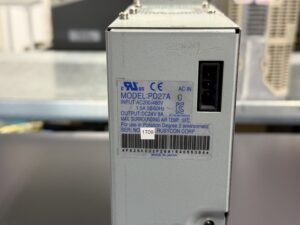
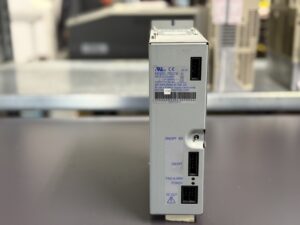
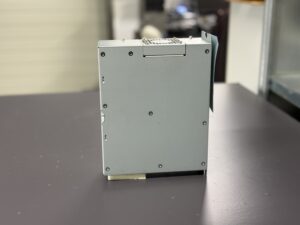
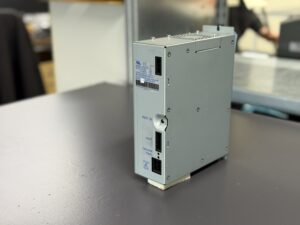
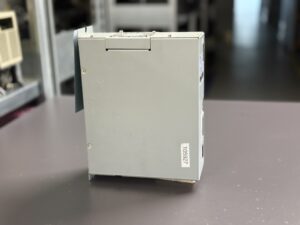
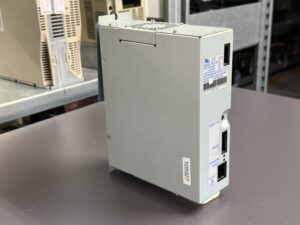
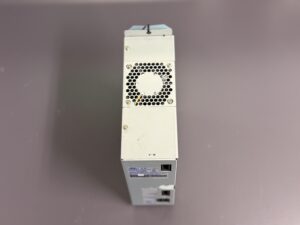
To mentioned Mitsubishi Drive: Rubycon-Mazak Power Supply PD27A
More details about our Mitsubishi repair services can be found here:
Mitsubishi drive Repair by Industrypart
📞 Feel free to contact us with any questions about your Mitsubishi drive technology.
Our expert team is happy to help!
Rubycon PD27A
Technical data
| Feature | Specification |
|---|
| Manufacturer | Rubycon Corporation |
| Model | PD27A |
| Input voltage | 200 – 480 V AC |
| Input frequency | 50 / 60 Hz |
| Rated input current | approx. 1.5 A |
| Output voltage | 24 V DC |
| Output current | 8 A |
| Output power | approx. 192 W |
| Cooling | Forced air cooling recommended |
| Power factor | Nearly 1 due to integrated PFC |
| Weight | approx. 2.27 kg |
| Ambient temperature | up to 55 °C |
| Application class | Industrial switched-mode power supply |
Operating environment and typical applications
The Rubycon PD27A is predominantly used in industrial CNC machines. It is particularly widespread in Mazak machine tools, where it provides the 24 V supply for controls, peripherals, and internal electronics. Typical operating conditions include control cabinet installation, continuous operation, and increased thermal stress.
Functional description
The power supply converts a wide AC input voltage into a stable 24 V DC output voltage. The integrated power factor correction ensures high efficiency and grid-friendly current consumption. Internal protective mechanisms monitor overcurrent, temperature, and voltage deviations to protect connected systems.
Service and repair approach
In the event of repair, we systematically inspect the PD27A for electrical and thermal abnormalities. Depending on the condition, a targeted repair or a preventive overhaul is carried out. Finally, each unit is tested under load and released with documentation. Alternatively, we offer tested exchange units or refurbished power supplies from our stock.
Note for customers
Since many users search specifically for the term “Mazak PD27A”, we recommend mentioning this designation in spare part inquiries. This facilitates clear identification and significantly speeds up processing.
Conclusion
The integration of the Rubycon PD27A into our repair portfolio exemplifies how we systematically, technically soundly, and practically integrate new series. Through our own test benches, clear checklists, and documented processes, we ensure that customers receive not just a repair, but a reliable and sustainable solution.