27.05.2025 by Viktor Siebert
Repair of a Mitsubishi MR-J2S-40CP Servo Amplifier with Temperature Dependent Failure
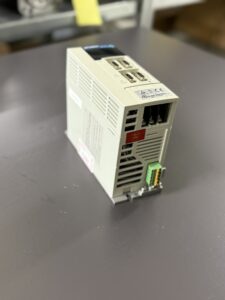
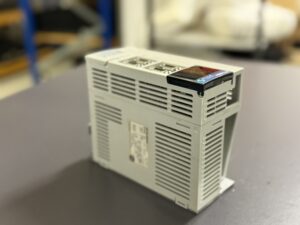
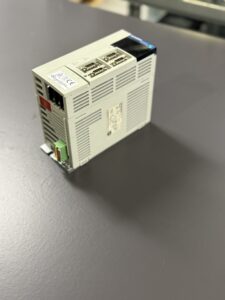
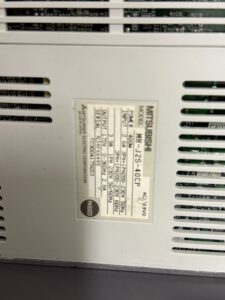
A few weeks ago, we received a Mitsubishi MR-J2S-40CP from one of our long term customers for inspection. The fault description was unusual: the machine occasionally stopped during operation, but without any clear alarm indication. Sometimes the machine ran for several hours without issues, and then suddenly stopped without warning.
These types of faults are among the most difficult cases in industrial electronics. While classic failures usually trigger an alarm immediately, intermittent faults often only occur under very specific operating conditions.
After arrival, the servo amplifier first underwent a visual inspection. No obvious damage could be found. There were no thermal discolorations, no damaged components and no swollen capacitors.
The servo amplifier was then connected to our test bench. Initially, the MR-J2S-40CP behaved completely normally. All voltages were within specification, current consumption was stable and encoder communication showed no abnormalities.
Even under load conditions, no fault could be reproduced during the first test cycles.
Cases like this require extensive experience with the specific product family. Our technicians have worked with the MR-J2S series for many years and know that certain age related failures only become visible after prolonged thermal stress.
For that reason, the test procedure was extended. The servo amplifier remained on the test bench for a longer period under realistic operating conditions. Temperatures were monitored continuously while different load profiles were simulated.
After approximately ten minutes of continuous operation, the exact behavior described by the customer finally occurred. The output stage briefly stopped delivering power without triggering a conventional protection function or alarm message.
At that point, the actual fault finding process could begin.
Using thermal imaging, signal analysis and targeted load testing, the fault was narrowed down further. Eventually, the cause was identified in the power section of the drive.
A temperature dependent cold solder joint caused intermittent contact interruptions once a certain operating temperature was reached. While the unit was cold, everything functioned normally. Only after heating up under load did microscopic interruptions occur, leading to sporadic power loss.
These faults are particularly difficult to detect because they are usually invisible during visual inspection and often do not appear during short functional tests.
After locating the defect, all critical solder joints were carefully inspected and professionally reworked. The complete unit was then thoroughly cleaned. All relevant assemblies were checked electrically and functionally.
As part of our preventive refurbishment process, typical aging related weak points were additionally inspected and the overall operational reliability of the drive was evaluated.
Following the repair, the unit underwent several hours of continuous load testing on our test bench. During the entire test period, no further fault occurred. All temperatures, voltages and currents remained stable.
After successful completion of testing, the MR-J2S-40CP was returned to the customer.
Several weeks later, we received confirmation that the machine had been operating without any further interruptions. Based on this positive experience, the customer immediately announced additional units of the same series for preventive refurbishment.
This case demonstrates that apparently random machine stoppages can often be caused by temperature dependent aging effects that can only be identified through systematic diagnostics and sufficiently long testing periods.
Preventive Measures for the Customer
- Clean the control cabinet regularly
- Keep cooling surfaces free from dust
- Inspect connectors annually
- Check capacitors after 10 to 15 years of operation
- Inspect cooling fans of surrounding assemblies regularly
- Monitor thermal development
- Perform preventive inspections during machine overhauls
- Carry out long duration testing for intermittent faults
Conclusion
The Mitsubishi MR-J2S-40CP clearly demonstrates that not every fault immediately generates an alarm message. Temperature dependent contact issues in particular can remain undetected for a long time and may only occur under real operating conditions. Through systematic diagnostics, extended load testing and preventive refurbishment, the unit was successfully returned to reliable operation. Experience shows that older servo drives benefit significantly from regular condition assessments, helping to extend their service life considerably.
More Info & Contact
To mentioned Mitsubishi Drive: Mitsubishi AC Servo Drive MR-J2S-40CP
More details about our Mitsubishi repair services can be found here:
Mitsubishi drive Repair by Industrypart
We regularly repair similar models, including:
MR-J2S-40
MR-J2S-40A
MR-J2S-40A4
MR-J2S-40A-QW219
MR-J2S-40B4
MR-J2S-40CP-S084
MR-J2S-40CP-S212
MR-J2S-40D-S016
MR-J2S-40B-EE085
Technical Specifications
| Parameter | Value |
|---|
| Model | Mitsubishi MR-J2S-40CP |
| Device Type | AC Servo Amplifier |
| Rated Power | 400 W |
| Input Voltage | Single phase or three phase 200 to 230 VAC |
| Frequency | 50/60 Hz |
| Output Voltage | Up to approx. 170 VAC |
| Rated Input Current | Approx. 2.8 A |
| Control Method | Sinusoidal PWM control |
| Feedback | Absolute or incremental encoder |
| Cooling | Convection cooling |
| Protection Class | IP00 |
| Weight | Approx. 1.1 kg |
| Manufacturer | Mitsubishi Electric |
| Series | MELSERVO MR-J2S |
Operating Environment & Compatible Equipment
The MR-J2S-40CP is typically used in:
- CNC machine tools
- Pick and place machines
- Packaging machines
- Handling systems
- Transfer lines
- Robotics applications
Typical compatible motors:
- HC-KFS43
- HC-MFS43
- HC-RFS43
Operating conditions:
| Parameter | Value |
|---|
| Ambient Temperature | 0 to 55 °C |
| Humidity | Max. 90 %, non condensing |
| Installation | Control cabinet |
| Altitude | Up to 1000 m |
| Vibration | Low vibration environment recommended |
Functional Description
The Mitsubishi MR-J2S-40CP is part of the proven MELSERVO series and is responsible for precise torque, speed and position control of a connected servo motor.
The unit continuously processes command values from the machine control and compares them with the feedback signals from the encoder. Based on this information, the internal control loop calculates the optimal motor current and voltage output.
Key functions include:
- Speed control
- Position control
- Torque control
- Encoder monitoring
- Overcurrent protection
- Overvoltage protection
- Overload monitoring
- Overtemperature protection
- Communication monitoring
Many of these drives have been operating continuously in machine tools for more than twenty years. As a result, age related failures are becoming increasingly common and are not always immediately indicated by an alarm message.
Alarms & Troubleshooting
| Alarm Code | Description | Cause | Solution |
|---|
| AL.10 | Undervoltage | Input voltage too low | Check power supply |
| AL.16 | Encoder error | Encoder or cable defective | Check encoder and wiring |
| AL.24 | Main circuit fault | Short circuit or ground fault | Inspect wiring |
| AL.30 | Regeneration fault | Dynamic brake resistor defective | Check braking circuit |
| AL.31 | Overspeed | Motor running too fast | Check parameters and encoder |
| AL.50 | Overload 1 | Continuous overload | Reduce load |
| AL.51 | Overload 2 | Excessive current demand | Check mechanics and load |
| AL.52 | Position deviation | Mechanical play or encoder issue | Inspect mechanics |
| AL.61 | Homing error | Parameter setting issue | Verify homing parameters |
| AL.8A | Communication fault | Data communication interrupted | Check cables and controller |
Components
| Assembly | Function | Notes |
|---|
| Power Stage | Motor control | Subject to thermal stress |
| Power Supply Section | Electronics supply | Capacitor aging possible |
| Control Board | Control algorithms | Sensitive to voltage fluctuations |
| Encoder Interface | Feedback processing | Contact issues possible |
| Relay Assemblies | Switching functions | Wear after long operating periods |
| DC Bus Capacitors | Energy storage | Preventive replacement recommended |
| Heat Sink | Heat dissipation | Clean regularly |