21.05.2026 by Viktor Siebert
Production Downtime Caused by Mitsubishi MR-J2S-350B and HC-SFS352 Servo Motor Due to Encoder Failure and Overload Damage
A customer from the machine tool industry reported repeated production failures on an axis equipped with a Mitsubishi AC servo system consisting of a MR-J2S-350B servo amplifier and an HC-SFS352 servo motor. After approximately 20 minutes of operation, the machine repeatedly shut down with overload and thermal faults. Initially, the issue appeared sporadically before becoming a fully reproducible production stop.
The machine was part of an automated manufacturing cell. The unplanned downtime caused repeated interruptions in production, significant maintenance pressure and economic losses.
During incoming inspection, both the motor and the servo drive already showed clear signs of severe thermal stress. One particularly noticeable symptom was that the fault did not occur only under high load conditions but also under moderate operating conditions.
The analysis was carried out on an original Mitsubishi test bench using an identical reference system.
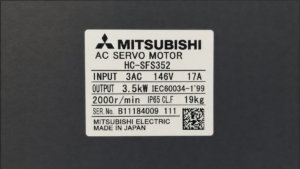
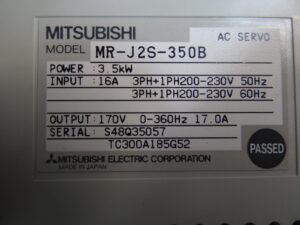
The nameplates confirmed the following components:
Motor:
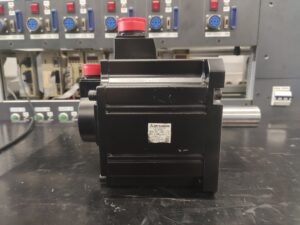
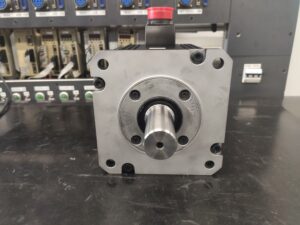
Mitsubishi HC-SFS352
3.5 kW
2000 r/min
146 V
17 A
IP65
19 kg
Servo Drive:
Mitsubishi MR-J2S-350B
3.5 kW
3PH + 1PH 200 to 230 V
16 A input
17 A output
0 to 360 Hz output frequency
The technical specifications were taken directly from the supplied device nameplates.
Initial Diagnosis in the Test Area
After the visual inspection, the following abnormalities were identified:
- severe thermal stress in the power section of the MR-J2S-350B
- excessive heating even during idle operation
- unstable speed regulation
- irregular current behavior under load
- sporadic encoder communication faults
- repeated overcurrent and overload situations
During load testing, the servo amplifier increasingly showed unstable current regulation. At the same time, the motor did not run smoothly and the speed fluctuations were no longer proportional to the applied load.
Since the customer supplied an additional functioning reference drive, the fault could be isolated very clearly.
Even when connected to a good reference motor, the customer’s drive eventually developed thermal issues and overload conditions after prolonged operation.
This confirmed that not only the motor but also the power stage inside the MR-J2S-350B had already suffered damage.
Actual Root Cause
The technical analysis revealed a combined failure chain involving both encoder feedback and the power stage.
The following root causes were clearly identified:
- defective Mitsubishi encoder OSA18-130
- unstable position and speed feedback signals
- unstable current regulation inside the servo drive
- continuous correction cycles by the amplifier
- permanent thermal overload of the power modules
- increased current consumption despite normal load
- thermal pre-damage of the power stage
- beginning failure of the IGBT stage
- unstable current sensing during continuous operation
The encoder feedback signals were no longer stable. As a result, the drive continuously attempted correction movements.
This permanent regulation error caused:
- increased power dissipation
- rising motor temperature
- increased DC bus stress
- overcurrent situations
- thermal overload inside the drive
The Mitsubishi MELSERVO alarm tables describe several matching fault conditions such as:
| Alarm | Description |
|---|
| 32 | Overcurrent |
| 45 | Power stage overheating |
| 50 | Overload 1 |
| 51 | Overload 2 |
| 52 | Excessive deviation |
| 46 | Servo motor overheating |
These alarm definitions originate directly from the uploaded Mitsubishi documentation.
Especially relevant were alarms 50 and 51:
- continuous current overload
- unstable servo system
- encoder failure
- mechanical overload
The documentation explicitly states that encoder faults can lead to unstable control loops and overload conditions.
Repair Measures
The HC-SFS352 servo motor was fully disassembled and completely rebuilt.
The following work was performed on the motor:
- complete disassembly
- full cleaning of all assemblies
- insulation testing of the windings
- bearing inspection
- inspection of the magnetic assembly
- verification of resolver and encoder signals
- repair of the OSA18-130 encoder
- recalibration of encoder reference
- thermal load testing
- vibration testing
- extended runtime testing
The following work was performed on the Mitsubishi MR-J2S-350B:
- removal and inspection of the power stage
- inspection of the IGBT modules
- replacement of thermally stressed components
- testing of DC bus capacitors
- inspection of gate drivers
- verification of current sensing circuits
- reworking of thermally stressed solder joints
- cleaning of heatsinks
- thermal load testing
- long-term full load testing
Particular attention was given to the power stage because the defective encoder forced the drive to operate continuously in unstable regulation conditions.
The thermal overload had already caused visible damage inside the power electronics section.
Final Testing and Return Shipment
After completion of all repairs, the motor and servo drive were tested together on the test bench.
The final testing included:
- long-term load testing
- temperature monitoring
- speed stability testing
- encoder communication verification
- current monitoring
- acceleration cycle testing
- overload simulation
- thermal endurance testing
After several hours of continuous testing, the system operated completely stable without any further overload or thermal alarms.
The repaired units were shipped back immediately after successful testing so the customer could resume production as quickly as possible.
Customer Feedback
“The axis is running stable again. Before the repair the drive became extremely hot after a short time. After the overhaul the complete system is operating normally again without overload shutdowns.”
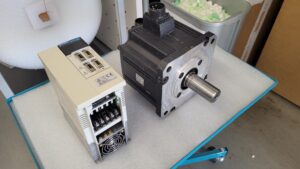
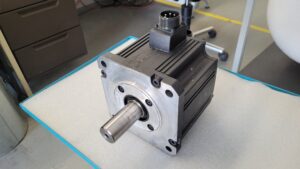
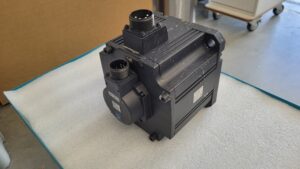
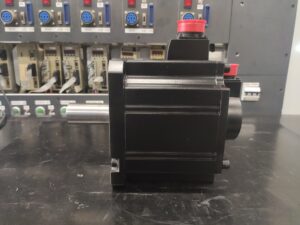
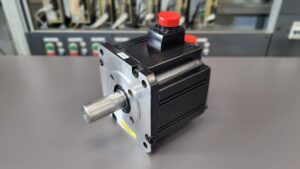
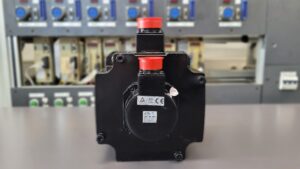
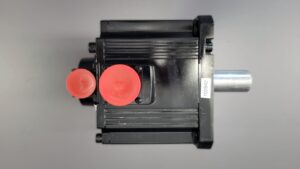
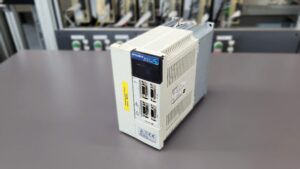
To mentioned Mitsubishi Motor: Mitsubishi AC Servo Motor Mitsubishi HC-SFS352
More details about our Mitsubishi repair services can be found here:
Mitsubishi motor Repair by Industrypart
📞 Feel free to contact us with any questions about your Mitsubishi drive technology.
Our expert team is happy to help!
Technical Specifications
| Parameter | Mitsubishi MR-J2S-350B |
|---|
| Device Type | AC Servo Drive |
| Manufacturer | Mitsubishi Electric |
| Power | 3.5 kW |
| Input Voltage | 200 to 230 V |
| Input Current | 16 A |
| Output Voltage | 170 V |
| Output Current | 17 A |
| Output Frequency | 0 to 360 Hz |
| Power Supply | 3PH + 1PH |
| Frequency | 50/60 Hz |
| Parameter | Mitsubishi HC-SFS352 |
|---|
| Device Type | AC Servo Motor |
| Manufacturer | Mitsubishi Electric |
| Power | 3.5 kW |
| Voltage | 146 V |
| Current | 17 A |
| Speed | 2000 r/min |
| Protection Class | IP65 |
| Weight | 19 kg |
| Cooling Type | Enclosed |
| Mounting Type | Flange Mount |
The specifications originate from the supplied nameplates and uploaded Mitsubishi documentation.
Operating Conditions
| Parameter | Value |
|---|
| Ambient Temperature | 0 to 40 °C |
| Storage Temperature | -20 to +60 °C |
| Humidity | 20 to 80 % |
| Protection Class | IP65 |
| Mounting | Flange |
| Cooling | Self-cooled |
| Vibration Class | 15 µm or lower |
These values are based on the uploaded Mitsubishi and Yaskawa servo documentation.
Integration With Other Equipment
The system was typically used together with:
- Mitsubishi CNC controls
- machine tools
- machining centers
- feed axes
- automation systems
- positioning systems
Supported components according to documentation:
- serial encoders
- position detectors
- regenerative brake resistors
- external emergency stop systems
- fieldbus and NC communication
- servo feedback systems
Functional Description
The Mitsubishi MR-J2S-350B operates as a regulated AC servo amplifier for precise speed and position control of industrial servo axes.
The system processes:
- encoder feedback
- current regulation
- speed regulation
- position regulation
- protective functions
- thermal monitoring
- overcurrent protection
- regenerative energy management
The HC-SFS352 servo motor provides the mechanical output power for highly dynamic CNC and automation axes.
The control system is based on continuous encoder feedback.
If this feedback becomes unstable or fails, the following occurs:
- unstable current regulation
- overload conditions
- thermal overload
- overcurrent conditions
- unstable speed behavior
This exact fault condition was present in this repair case.
Alarm and Fault Codes
| Alarm | Fault Name | Meaning | Reset | Action |
|---|
| 10 | Undervoltage | Voltage drop | Power Reset | Check supply |
| 24 | Power circuit fault | Power section defective | Reset | Inspect power stage |
| 30 | Regenerative overload | Brake resistor overloaded | Reset | Check braking circuit |
| 31 | Overspeed | Speed exceeded limit | Reset | Check encoder |
| 32 | Overcurrent | Excessive motor current | Reset | Check IGBT and motor |
| 33 | Overvoltage | DC bus too high | Reset | Check supply voltage |
| 45 | Power stage overheating | Power module overheated | Reset | Check cooling |
| 46 | Servo motor overheating | Motor thermally overloaded | Reset | Reduce load |
| 50 | Overload 1 | Continuous overload | Reset | Inspect mechanics |
| 51 | Overload 2 | High current load | Reset | Check encoder and control |
| 52 | Excessive deviation | Position error | Reset | Check encoder |
| E1 | Overload warning | Pre-overload warning | Auto | Check load |
The alarm definitions originate directly from the uploaded Mitsubishi documentation.
Conclusion
This repair case clearly demonstrates how critical faulty encoder feedback can become in modern servo systems.
The original root cause was the defective OSA18-130 encoder inside the HC-SFS352 servo motor. Due to unstable feedback signals, the Mitsubishi MR-J2S-350B operated continuously under unstable regulation conditions.
Without early diagnosis, the damage would most likely have resulted in complete failure of both motor and drive.
By fully rebuilding both components, the system could be returned to stable long-term operation.