10.08.2025 by Viktor Siebert
Mitsubishi MR-J200A-D33 AC Servo Drive urgent repair and another fake device from Asia
Once again, we were faced with a challenging repair case. A customer who operates several wire EDM machines sent us a Mitsubishi MR-J200A-D33 AC Servo Drive for repair. The device had failed, and the customer was under pressure to complete an urgent order.
Initial Inspection and Surprise
Upon arrival, we carried out an initial visual and functional inspection. To our surprise, the servo drive had been completely modified internally. It was not the original MR-J200A-D33 model, but rather a standard MR-J200A without the special D33 extension.
The Story Behind the Failure
When we asked the customer for more details, he explained that he had recently purchased the device from a parts supplier in Asia. The price was tempting, and the device was said to be fully functional. In his rush, he trusted the offer without having the unit tested beforehand.
Manipulation and Defects
Our analysis revealed that the nameplate had been manipulated to present the device as a D33 version. Inside, we found numerous issues: used electrolytic capacitors, ISO amplifiers replaced with second-hand components, and used optocouplers. Additionally, the communication board was incompatible with the customer’s machine control, making operation impossible.
Customer Contact and Solution
We immediately contacted the customer and asked him to send us his original faulty MR-J200A-D33 unit. Only then could we perform a proper repair. The customer reacted promptly and sent us the original unit via express courier. The very next day, the servo drive was back in operation, and the customer was able to continue production.
Our Preventive Overhaul Process
In our workshop, we always perform a preventive overhaul during such repairs. All critical components, such as power semiconductors, driver modules, capacitors, optocouplers, and control boards, are thoroughly tested and replaced if necessary. Even if a part is still within specification, we replace it as a precaution to ensure long-term operational safety.
Testing Procedures and Quality Assurance
After repair, each unit undergoes a multi-stage testing process. First, a no-load test is carried out to verify basic functionality. This is followed by a full-load test in a realistic operating environment, during which we monitor all relevant parameters such as temperature behavior, current draw, and signal quality. Only when all tests are passed without issues is the unit released and returned to the customer. The servo drive can be tested with the Mitsubishi AC Servo Motor HA-SE152W2.
Conclusion
This case once again shows that seemingly cheap offers from unreliable sources often turn out to be far more costly in the end. Original devices and professional repairs not only provide safety but also ensure the device will operate reliably. Through preventive overhauls and thorough testing, we make sure our customers can continue production in the long term without unexpected breakdowns.
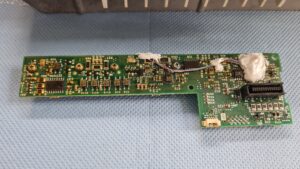
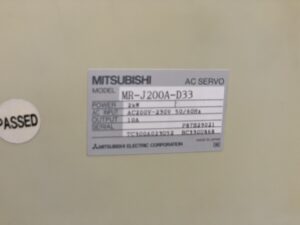
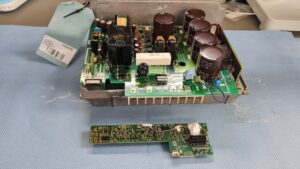
To mentioned Mitsubishi Drive: Mitsubishi MR-J200A-D33 AC Servo Drive Unit
More details about our Mitsubishi repair services can be found here:
Mitsubishi drive Repair by Industrypart
We regularly repair similar models, including:
MR-J20A-D33
MR-J40A-D33
MR-J200A-D33
Mentioned Servo Motor: Mitsubishi AC Servo Motor HA-SE152W2.
Device Data
| Parameter | Value |
|---|
| Model | MR-J200A-D33 |
| Power | 2 kW |
| AC Input | AC 200–230 V, 50/60 Hz |
| Output Current | 10 A |
| Manufacturer | Mitsubishi Electric Corporation |
| Origin | Japan |
Operating Environment
The Mitsubishi MR-J200A-D33 is typically used in CNC machines, especially wire EDM machines.
It operates in combination with compatible Mitsubishi servo motors (e.g., HA-SE and HA-ME series) and is controlled via the machine’s CNC or PLC system.
The unit is designed for industrial environments with ambient temperatures between 0 and 55 °C and a maximum relative humidity of 90% (non-condensing).
Functional Description
The MR-J200A-D33 is an AC servo amplifier that provides torque, speed, and position control for connected servo motors.
It processes control commands from a CNC or PLC system and precisely regulates motor current and speed.
The D33 version is a special variant with a customized communication interface for specific machine manufacturers.
Alarm Codes and Troubleshooting
| Alarm Code | Description | Possible Cause | Recommended Solution |
|---|
| AL.10 | Undervoltage | AC input voltage too low | Check power supply |
| AL.11 | Overvoltage | Excessive regenerative voltage | Inspect brake resistor |
| AL.12 | Overcurrent | Short circuit or overload | Check motor and cables |
| AL.13 | Overheat | Overheating of the unit | Check cooling and fans |
| AL.14 | Encoder Error | Encoder faulty or cable disconnected | Inspect encoder and wiring |
| AL.15 | Overload | Mechanical load too high | Reduce load |
| AL.16 | Communication Error | Control connection interrupted | Inspect cables and interfaces |
| AL.17 | Regeneration Error | Faulty brake resistor | Replace resistor |
| AL.18 | EEPROM Error | Internal memory error | Reinitialize or repair unit |
| AL.19 | Phase Loss | Wiring error or broken cable | Check phase connections |
Components
| Name | Board Designation | Quantity |
|---|
| Control Board | J-C19A | 1 |
| Display Board | J-F01B | 1 |
| Power Board | J-P06A | 1 |
| Power Module | Power Module | 1 |