01.08.2025 by Viktor Siebert
Repair Report: Mitsubishi MDS-DH-V2-8080 When Overheating Leads to Total Failure
A well-known supplier from the automotive industry contacted us regarding a complete failure of their Mitsubishi MDS-DH-V2-8080 servo drive unit. The device showed no signs of life, no READY signal, no LED activity, no response whatsoever. However, machine downtime was not an option. To ensure continuous production, we immediately provided the customer with a loan unit.
Fault Analysis and Repair
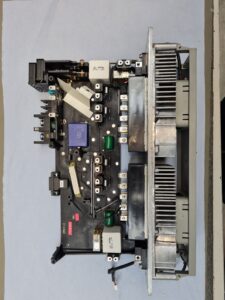
Upon disassembly, extensive damage became apparent:
- The transistor module had suffered thermal destruction.
- The control circuitry for the power output stage was also damaged.
- The fan located behind the transistor module, directly mounted to the heatsink, was barely spinning. The root cause: fan failure → overheating → power degradation → short circuit.
- The control board showed a short circuit at the BGA processor, most likely caused by feedback from the power module failure.
We took the following steps:
- Completely isolated, cleaned, and tested both the control and power sections.
- Replaced all components with thermal or electrical damage.
- Repaired the control board using rework technology.
- Installed a new IGBT module and replaced the corresponding driver circuitry.
- Replaced the fan, including lubrication and thermal paste renewal.
Testing and Quality Assurance
After successful repair, the unit underwent:
- Insulation testing according to EN50178
- Load testing with motor connection at our test bench
- Long-term testing under full load (over 12 hours)
- Continuous temperature and current monitoring
Only after passing all tests was the unit approved for return to the customer.
Result and Follow-Up Order
The refurbished unit has now been running stably at the customer’s facility for over three weeks. Impressed by the outcome, the customer entrusted us with the repair of several servo motors, which also showed signs of aging (bearing play, mispositioning, encoder errors).
Conclusion
A failed fan can lead to serious secondary damage, in the case of the MDS-DH-V2-8080, it caused a complex cascade of failures. Thanks to our experience and the availability of original spare parts, we were able to respond quickly, keep the customer operational, and restore the unit to long-term reliability.
Need assistance with a Mitsubishi drive or motor?
Get in touch, we’re happy to help by phone or email, even before a repair is scheduled.
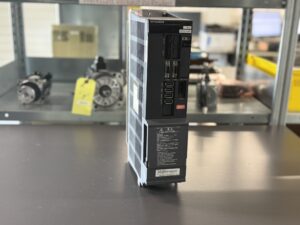
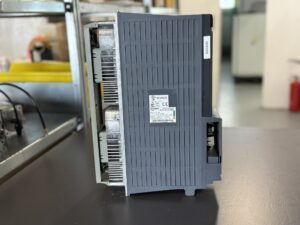
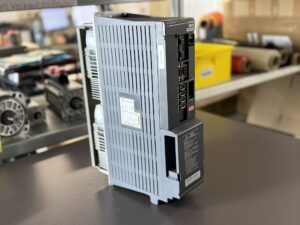
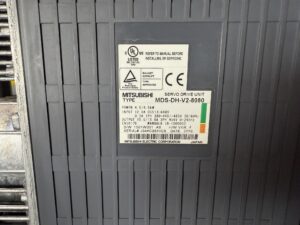
To mentioned Mitsubishi Drive: Mitsubishi MDS-DH-V2-8080 Servo Drive Unit
More details about our Mitsubishi repair services can be found here:
Mitsubishi drive Repair by Industrypart
📞 Feel free to contact us with any questions about your Mitsubishi drive technology.
Our expert team is happy to help!
Technical Summary of the Unit
Typical Operating Environment
This drive unit is commonly used in CNC machines from Japanese manufacturers, especially for high-performance axes with medium current requirements. It typically operates in combination with Mitsubishi HF, HA, or HC servo motors and is mainly found in milling, turning, or general machining centers.
Functional Description
The MDS-DH-V2-8080 is a 2-axis servo drive module designed for 400 V systems. It provides precise control of a servo motor’s position, speed, and torque. Communication with the CNC control is typically established via optical fiber or serial data interface.
Device Specifications
| Parameter | Value |
|---|
| Model | MDS-DH-V2-8080 |
| Input Voltage (DC) | 513–648 V DC |
| Auxiliary Supply Voltage | 3AC 380–440/480 V, 50/60 Hz, 0.1 A |
| Output Voltage | 3AC 456 V, 0–240 Hz |
| Input Current | 12 A |
| Output Current | 15.0 / 15.0 A (per axis – dual-axis module) |
| Rated Power | 4.5 / 4.5 kW (per axis – total 9.0 kW) |
| Weight | approx. 7.4 kg |
Alarm and Troubleshooting Overview
| Alarm No. | Alarm Name | Error Description | Possible Cause | Recommended Action |
|---|
| 10 | Insufficient Voltage | DC bus voltage too low at power-on | Low input voltage, faulty contactor, loose terminals | Check input voltage, replace contactor, verify wiring |
| 11 | Axis Selection Error | Incorrect axis rotary switch setting | Duplicate axis address, incorrect configuration | Set rotary switch correctly, verify control system configuration |
| 16 | Magnetic Pole Detection Error | Magnetic pole position could not be detected | SP118/SV028 not set, faulty pole initialization | Re-run magnetic pole detection, correct parameters, check EMC environment |
| 17 | A/D Converter Error | Error in current feedback via A/D converter | Internal electronics fault, environmental interference | Check repeatability, replace drive if persistent, verify shielding/grounding |
| 21 | No Signal 2 (Sub Side Detector) | No feedback from position detector (e.g. ABZ encoder) | Broken cable, incorrect parameter settings | Check encoder cable and plug, set SV025/SV020/SV019 correctly |
| 24 | Grounding Error | Ground fault – power cable touches chassis | Damaged cable insulation, oil ingress | Measure insulation (>1 MΩ), replace motor or cable, clean motor terminals |
| 30 | Over Regeneration | Regenerative energy exceeds braking resistor limit | Underrated resistor, wrong or loose wiring, overload during deceleration | Verify P/D wiring, check SV036/SP032, use correct or external braking resistor |
| 32 | Power Module Overcurrent | Short circuit or current spike in power module | Motor fault, shorted cable, wrong axis configuration in 2-axis unit | Test cable/motor insulation, verify wiring, check drive configuration, replace unit if necessary |
| 42 | Feedback Error 1 | Position feedback error (Z-phase or signal dropout) | Encoder error, misalignment, loose connection | Inspect encoder mounting and cable, set parameters correctly |
| 50 | Overload 1 | Drive or motor thermal overload | High mechanical load, poor cooling, motor undersized | Reduce load, verify SV021/SV022, check fan and air circulation |