09.10.2025 by Viktor Siebert
Repair Story: Mitsubishi MDS-B-V2-3510 Servo Drive Unit with Overcurrent Error 32
This Mitsubishi MDS-B-V2-3510 was originally sent to us for preventive refurbishment. At that time, there was no complete machine shutdown. The customer only reported occasional irregular behavior and wanted the nearly thirty-year-old servo drive to be inspected as a precaution.
During the incoming inspection, our technician immediately noticed unusual behavior. The drive would not power up at all. All input voltages were present, yet the electronics remained completely inactive.
Only after the unit was carefully warmed up did the control electronics suddenly begin to operate normally. Temperature-dependent faults like this are commonly observed in older servo amplifiers. The cause is usually aging electronic components whose electrical characteristics have changed over decades of operation.
After successful startup, the drive was connected to our Mitsubishi test bench together with a matching servo motor. During the first motion tests, the servo drive initially appeared to operate normally.
However, as soon as rapid traverse movements were executed, another problem became apparent.
The motor began to stutter briefly and lost its smooth motion. A few seconds later, the drive shut down with Alarm 32 Overcurrent.
This combination of temperature-dependent startup behavior and overcurrent faults immediately suggested multiple age-related failures within the servo drive.
After discussing the situation with the customer, an interesting overall picture emerged.
The customer confirmed that the machine had hardly been switched off during the previous months. The operators had noticed that the faults occurred more frequently whenever the machine was started from a cold condition.
In addition, the machining speed had been reduced. Heavy workpieces were avoided whenever possible, and several programs had been modified to reduce axis loading.
Although the machine was still running, it was no longer operating at its original performance level.
After completely disassembling the unit, the root causes could be clearly identified.
The following age-related conditions were found:
- Aged electrolytic capacitors in multiple power supply sections
- Increased ESR values of the DC link capacitors
- Thermally stressed areas on the power board
- Aged cooling fan assembly
- Critical solder joints with developing microcracks
- Reduced voltage stability in the control electronics section
As part of the refurbishment, the servo drive was completely cleaned and then preventively rebuilt.
All critical aging components were replaced. The current measurement circuitry was recalibrated. The power supply section was restored, and the complete power stage underwent extensive testing.
Following the repair, multiple functional tests were performed on our Mitsubishi test bench.
Various operating conditions were simulated, including:
- Cold startup
- Warm operation
- Rapid traverse movements
- Continuous operation
- Load changes
- Repeated acceleration and deceleration cycles
After completion of all tests, the drive operated reliably and consistently without any faults.
Particularly important was the successful completion of multiple cold-start tests. The original temperature-dependent startup issue was completely eliminated.
Alarm 32 also did not reoccur, even under heavy load conditions.
After the unit was returned, it was reinstalled in the customer’s machine.
The customer was able to restore the original machining speeds and once again operate the machine at full performance.
For the customer, this not only prevented a future failure but also restored the machine’s original productivity.
Preventive Measures for the Customer
- Clean the electrical cabinet regularly
- Inspect cooling fans every 1 to 2 years and replace if necessary
- Evaluate capacitors preventively after 10 to 15 years of operation
- Check heat sinks for contamination
- Inspect connectors regularly
- Monitor cabinet temperatures
- Investigate unusual motor noises at an early stage
- Perform regular machine shutdowns
Conclusion
This repair case clearly demonstrates how aging processes can develop gradually over many years. The Mitsubishi MDS-B-V2-3510 exhibited not only an overcurrent fault but also temperature-dependent startup behavior that would have been difficult to identify at first glance.
Through systematic diagnostics, preventive replacement of critical assemblies, and extensive testing, the servo drive was fully restored.
Today, the unit is once again operating reliably in production and allows the customer to use the machine at full speed and load capacity. Particularly for older Mitsubishi systems, timely refurbishment is often the most economical way to significantly extend the service life of the entire machine.
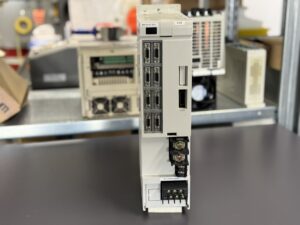
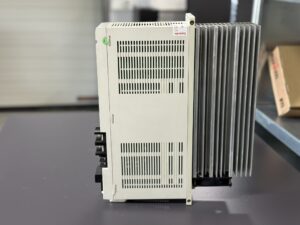
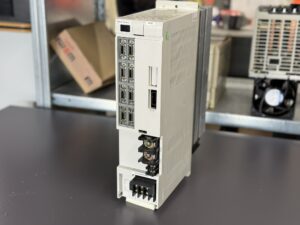
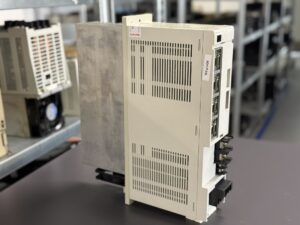
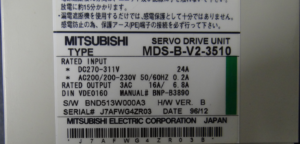
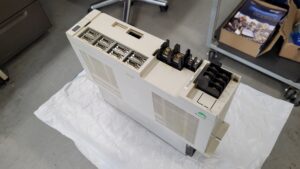
To mentioned Mitsubishi Drive: Mitsubishi MDS-B-V2-3510 Servo Drive
More details about our Mitsubishi repair services can be found here:
Mitsubishi drive Repair by Industrypart
📞 Feel free to contact us with any questions about your Mitsubishi drive technology.
Our expert team is happy to help!
Technical Specifications
| Parameter | Value |
|---|
| Manufacturer | Mitsubishi Electric |
| Model | MDS-B-V2-3510 |
| Device Type | Servo Drive Unit |
| DC Input Voltage | 270 to 311 VDC |
| AC Input Voltage | 200 to 230 VAC |
| Frequency | 50/60 Hz |
| Input Current | 24 A DC |
| Output | Three-phase servo output |
| Output Current Axis 1 | 16 A |
| Output Current Axis 2 | 6.8 A |
| Cooling | Fan cooled |
| Construction | Plug-in module |
| Production Date | 12/1996 |
| Manual Reference | BNP-B3890 |
| Weight | approx. 8.5 kg |
| Dimensions | approx. 90 × 300 × 250 mm |
Operating Environment & Compatible Equipment
The Mitsubishi MDS-B-V2-3510 Servo Drive Unit was designed for CNC machine tools and is typically used in machining centers, lathes, milling machines, and special-purpose machinery.
Typical machine manufacturers:
- Mitsubishi
- Mazak
- Mori Seiki
- DMG
- Okuma
- Takisawa
- Kitamura
Compatible motors:
- Mitsubishi HA Series
- Mitsubishi HF Series
- Mitsubishi AC servo motors of the MDS-B generation
These drives are commonly used for feed axes requiring high positioning accuracy, dynamic response, and repeatability.
Functional Description
The MDS-B-V2-3510 performs complete control of the connected servo motors. The CNC control transmits position, speed, and torque commands. The servo drive processes this information and regulates motor currents according to the encoder feedback signals.
The internal control structure consists of:
- Current control loop
- Speed control loop
- Position control loop
In addition, the drive continuously monitors:
- DC bus voltage
- Motor currents
- Power modules
- Temperature
- Communication with the CNC controller
- Encoder feedback signals
If any abnormal condition is detected, the drive immediately shuts down to protect the machine and drive system.
Alarm Messages & Troubleshooting
| Alarm | Description | Cause | Solution |
|---|
| 12 ME | Memory Error | Memory section fault | Check control board |
| 18 WAT | Initial Communication Error | Startup communication fault | Check encoder and wiring |
| 1B SCPU | Sub CPU Error | Processor control fault | Check control board |
| 1C SLED | LED Error | Encoder detector fault | Check encoder |
| 20 NS1 | No Signal Detection | Encoder signal missing | Check wiring |
| 26 NAE | Axis Parameter Error | Parameter configuration fault | Verify parameters |
| 31 OS | Overspeed | Excessive speed detected | Check control tuning and mechanics |
| 32 OC | Overcurrent | Overcurrent in power stage | Check power section and motor |
| 3B PMOH | Power Module Overheat | Power module overheating | Check cooling system |
| 46 OH1 | Motor Overheat | Motor temperature too high | Inspect motor and cooling |
| 82 NSP | Power Supply Error | Power supply fault | Check power supply section |
Components
| Assembly | Designation | Function | Notes |
|---|
| Control Board | Mitsubishi Servo Control Board | Control and communication | Inspect for aging |
| Power Module | IGBT/IPM Module | Motor power control | Common wear component |
| DC Link Capacitors | Electrolytic Capacitors | Voltage stabilization | Preventive replacement recommended |
| Fan | Cooling Fan Unit | Cooling | Replace regularly |
| Current Sensors | Current Detection Circuit | Current monitoring | Critical for Error 32 |
| Encoder Interface | Feedback Interface | Position feedback processing | Check connectors |
| Power Supply Section | Internal Power Supply | Electronics power supply | Susceptible to aging |