30.08.2026 by Viktor Siebert
Production Downtime Caused by Coolant Ingress: Mitsubishi HC202BS AC Servo Motor with Defective OSE104S2 Encoder Completely Overhauled
With older CNC machines, a failed servo motor is often not simply an electrical defect. Especially in motors that have operated for many years in close proximity to the machining area, coolant, oil, contamination, and aging seals can gradually cause damage that is initially barely visible from the outside.
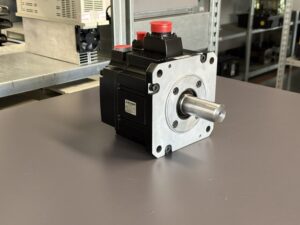
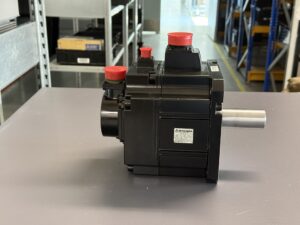
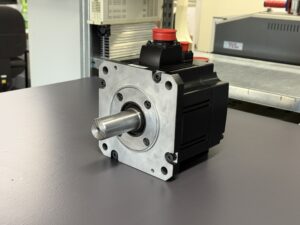
This was exactly the type of damage we found on a Mitsubishi HC202BS AC Servo Motor that arrived at our workshop for repair.
The motor is equipped with a Mitsubishi UA-5-00 brake and an OSE104S2 encoder. During the initial inspection, there were already strong indications that the actual problem was on the feedback side. The encoder had failed.
After opening the motor, however, it became clear that this was not an isolated encoder defect. Coolant had penetrated areas of the motor over an extended period. Particularly critical was the fact that the fluid had reached the inside of the encoder and eventually destroyed it.
At the same time, the motor itself showed poor insulation. Contamination and coolant residue were found inside the motor.
This resulted in a typical chain of damage in an older CNC servo motor:
Aging seals → coolant ingress → contamination and moisture inside the motor → deterioration of insulation → coolant ingress into the encoder → failure of position feedback.
For this reason, the repair was not limited to replacing the encoder. The motor was mechanically overhauled completely and subsequently tested on an original Mitsubishi MDS-B-SVJ2-20 Servo Drive.
Initial Diagnosis
The motor nameplate provided clear identification:
| Characteristic | Specification |
|---|
| Manufacturer | Mitsubishi Electric |
| Device class | AC Servo Motor |
| Model | HC202BS |
| Input | 3 AC |
| Voltage | 138 V |
| Current | 11 A |
| Output power | 2 kW |
| Rated speed | 2000 r/min |
| Standard | IEC 34-1 |
| Nameplate year | 1994 |
| Brake | Mitsubishi UA-5-00 |
| Encoder | Mitsubishi OSE104S2 |
| Test drive after repair | Mitsubishi MDS-B-SVJ2-20 |
During the subsequent inspection, three areas were the primary focus:
- Condition of the OSE104S2 encoder
- Insulation condition of the motor winding
- Mechanical and structural condition of the motor, including the seals
The encoder proved to be defective. After opening it, the cause became clear: coolant had entered the encoder housing.
The encoder failure therefore could not be regarded as a random electronic defect, but rather as the consequence of a sealing problem that had existed for an extended period.
In addition, the motor insulation test showed a poor condition. Contamination and coolant residue inside the motor confirmed that the fluid had not only reached the encoder area.
This is a crucial point in a professional repair. If only the encoder had been replaced, the actual cause of the damage would have remained inside the motor.
Actual Cause of Failure
The failure analysis revealed a clear chain of damage:
- The motor seals had aged and become porous after many years of operation.
- This allowed coolant to penetrate areas that are intended to remain dry.
- Coolant and contamination entered the motor interior.
- The insulation condition of the motor deteriorated.
- Fluid reached the OSE104S2 encoder.
- The encoder was damaged by the penetrating coolant and eventually failed completely.
- Replacing only the encoder would not have eliminated the underlying cause.
The final point is particularly important.
Installing a new encoder on a motor that remained contaminated and inadequately sealed would not have constituted a sustainable repair. The entire motor therefore had to be considered as a system.
Mitsubishi servo documentation also demonstrates how critical feedback is to the servo system. Mitsubishi CNC Drives separately monitor motor-side detector faults, communication faults, and incorrect feedback data. The available Mitsubishi MDS-D/DH manual lists, among other faults, initialization errors, Detector Data Error, and Main Side Detector Communication Error. The manual also explicitly mentions the OSE104 as an incremental detector type. However, these alarm specifications originate from the MDS-D/DH generation and are therefore not presented here as direct alarm codes for the older MDS-B-SVJ2-20.
Why Coolant Is So Problematic for a Servo Motor
Coolant is intended to cool and lubricate the tool and workpiece during machining. Inside a servo motor or encoder, however, it has no place.
Gradual ingress is particularly problematic.
An aged seal does not necessarily fail completely from one day to the next. Initially, only very small quantities may penetrate. Over time, moisture, oil components, and contamination accumulate inside the motor.
This can progressively deteriorate the electrical insulation condition.
The situation is even more critical with the encoder. The feedback system provides the servo system with information about the actual motor movement. If this information is incorrect or completely absent, the control system can no longer operate correctly.
For this reason, Mitsubishi troubleshooting procedures systematically distinguish between the encoder, detector cable, and drive unit when diagnosing detector problems. In the event of a Detector Communication Error, for example, the connector connections, detector cable, shielding, and finally the encoder or drive are checked.
In our repair case, this distinction was clear: the OSE104S2 itself had been damaged by coolant ingress.
Repair Measures
Due to the extent of the damage, the repair was not limited to the encoder.
The Mitsubishi HC202BS was completely refurbished.
The main work steps included:
- Complete disassembly of the servo motor
- Inspection of the motor interior for coolant and contamination
- Intensive cleaning of the affected areas
- Inspection of the electrical insulation condition
- Complete mechanical overhaul of the motor
- Reworking or replacement of wear components relevant to sealing
- Replacement of the defective Mitsubishi OSE104S2 encoder
- Inspection of the Mitsubishi UA-5-00 brake
- Reassembly of the motor
- Final electrical and mechanical inspection
- Functional test using an original Mitsubishi Servo Drive
Cleaning was particularly important.
Coolant residue and the contamination bound to it must not simply remain inside the motor after an overhaul. The electrical condition must be reassessed after cleaning and refurbishment.
Only then does it make sense to install the replacement encoder and proceed with the final functional test.
Final Test on Mitsubishi MDS-B-SVJ2-20
A decisive part of a servo motor repair is testing the motor together with suitable servo electronics.
For this reason, the HC202BS was tested after the overhaul on an original Mitsubishi MDS-B-SVJ2-20 Servo Drive.
The objective is not merely to determine whether the shaft rotates.
The feedback system must operate reliably in the interaction between the motor, encoder, and Servo Drive. The drive must correctly detect and regulate the motor movement.
This system test is particularly important after an encoder failure.
A motor may initially appear electrically and mechanically normal and still have problems with position or speed feedback. Only testing on the Servo Drive demonstrates whether the motor and feedback system are once again functioning correctly together.
After replacement of the OSE104S2, the complete mechanical overhaul, and restoration of the motor to a proper condition, the HC202BS was successfully tested on the Mitsubishi MDS-B-SVJ2-20.
Customer Feedback
No documented verbatim customer feedback is available for this repair case. We therefore deliberately refrain from using a fabricated customer quotation.
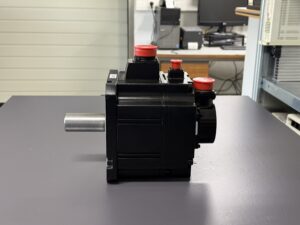
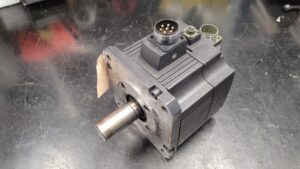
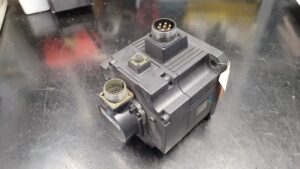
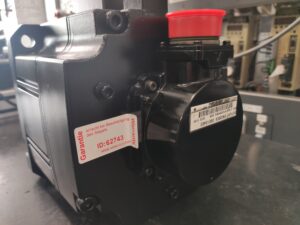
To mentioned Mitsubishi Motor:
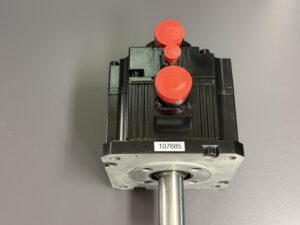
Mitsubishi HC202BS AC Servo Motor
Mitsubishi MDS-B-SVJ2-20 AC Servo Drive Unit
Encoder Mitsubishi OSE104S2
More details about our Mitsubishi repair services can be found here:
Mitsubishi motor Repair by Industrypart
📞 Feel free to contact us with any questions about your Mitsubishi drive technology.
Our expert team is happy to help!
Technical Data: Mitsubishi HC202BS
The following table contains only information that can be clearly derived from the available nameplate and documented repair data.
| Technical characteristic | Value |
|---|
| Manufacturer | Mitsubishi Electric |
| Model | HC202BS |
| Alternative spelling | HC 202 BS / HC-202BS |
| Device type | AC Servo Motor |
| Input | 3 AC |
| Motor voltage | 138 V |
| Motor current | 11 A |
| Output power | 2 kW |
| Rated speed | 2000 r/min |
| Brake | Mitsubishi UA-5-00 |
| Encoder | Mitsubishi OSE104S2 |
| Nameplate standard | IEC 34-1 |
| Nameplate year | 1994 |
| Serial number | M62556002 |
| Test drive | Mitsubishi MDS-B-SVJ2-20 |
| Frequency | Cannot be clearly determined from the available documentation |
| Weight | Not documented |
| Protection class | Not documented |
| Software version | Not specified for the motor |
| Axes | Not specified as a motor characteristic |
This repair case clearly demonstrates why theoretical protection conditions and the actual operating conditions inside a machine tool must be considered separately.
Even if a motor operates without problems for many years, elastomeric seals age. A seal that originally provided sufficient protection may no longer offer the same level of protection after decades of operation.
Interaction with Other Devices
The following system configuration is documented for the motor repaired in this case:
- Mitsubishi HC202BS AC Servo Motor
- Mitsubishi OSE104S2 Encoder
- Mitsubishi UA-5-00 Brake
- Mitsubishi MDS-B-SVJ2-20 Servo Drive used for testing
Other motor, drive, or CNC combinations are deliberately not described as compatible because no definitive approval for such combinations is available in the provided documentation.
The OSE104 belongs to a Mitsubishi encoder family that is also mentioned in later Mitsubishi CNC documentation. The available MDS-D/DH manual, for example, explicitly identifies the OSE104 and OSE105 as incremental detectors.
Functional Description
Together with the Servo Drive and encoder, the Mitsubishi HC202BS forms a closed-loop servo control system.
The Servo Drive generates the electrical motor control signals based on commands received from the CNC control. The encoder detects the actual movement of the motor and feeds this information back to the system.
In simplified form, the control loop consists of:
CNC Control → Servo Drive → HC202BS Servo Motor → Mechanical Axis → OSE104S2 Feedback → Servo Drive
The encoder is therefore not merely an auxiliary component.
Without reliable feedback, the Servo Drive cannot reliably determine whether the requested movement has actually been executed.
For detector-related problems, Mitsubishi troubleshooting documentation therefore includes inspections of connectors, detector cables, shielding, and the detector itself. In cases involving incorrect feedback data, mechanical mounting and excessive vibration are also considered.
The Mitsubishi UA-5-00 brake adds a holding function to the motor. It is not part of the actual servo control process itself, but rather provides an additional mechanical function.
Alarm and Error Codes in the Mitsubishi CNC Servo System
Important note: No exact MDS-B alarm table for the HC202BS or the MDS-B-SVJ2-20 used in this case was found in the provided files. The following table therefore contains only genuine Mitsubishi alarm codes from the provided MDS-D/DH Instruction Manual. They illustrate typical fault groups involving motors, encoders, and Servo Drives, but must not be interpreted as a 1:1 alarm table for the MDS-B-SVJ2-20.
| Alarm | Error name | Meaning | Reset | Action according to manual |
|---|
| 18 | Main side detector: Initial communication error | Initial communication with motor-side detector failed | PR | Check parameters, connectors, cable, detector, and drive |
| 22 | Detector data error | Incorrect feedback data from position detector | AR | Check detector mounting, vibration, cable, and detector |
| 24 | Grounding | Motor power cable is in contact with FG | PR | Check insulation of motor and power cable |
| 2B | Main side detector: Error 1 | Motor-side detector reports an error | Depends on detector | Perform detector-specific diagnostics |
| 2C | Main side detector: Error 2 | Motor-side detector reports an error | Depends on detector | Perform detector-specific diagnostics |
| 2D | Main side detector: Error 3 | Motor-side detector reports an error | Depends on detector | Perform detector-specific diagnostics |
| 2E | Main side detector: Error 4 | Motor-side detector reports an error | Depends on detector | Perform detector-specific diagnostics |
| 2F | Main side detector: Communication error | Communication with motor-side detector interrupted | PR | Check connectors, cable, shielding, detector, and drive |
| 31 | Overspeed | Motor speed exceeds allowable value | PR | Check parameters, feedback, and drive |
| 32 | Power module error, overcurrent | Overcurrent detected in power module | PR | Check motor cable, motor insulation, detector cable, and drive |
| 3A | Overcurrent | Excessive motor current detected | PR | Check motor, cable, insulation, and operating conditions |
| 46 | Motor overheat / Thermal error | Thermal protection of motor or detector activated | NR | Check load, wiring, motor, and detector |
| 50 | Overload 1 | Motor or drive overload level ≥ 100% | NR | Check load and mechanical conditions |
| 51 | Overload 2 | Very high current command present for a defined period | NR | Check motor cable, feedback, and load |
The Mitsubishi documentation explicitly includes insulation testing of the motor and motor power cable as part of troubleshooting for grounding and overcurrent faults. Contact with oil is also specifically mentioned as an inspection point in the event of a grounding fault.
This is precisely what makes the HC202BS repair case technically relevant: the poor insulation condition and the coolant ingress were not two unrelated observations. They were consequences of the same aging and sealing failure process.
Technical Block
| Assembly | Designation | Function | Finding / Repair |
|---|
| Servo motor | Mitsubishi HC202BS | Generates mechanical axis movement | Completely mechanically overhauled |
| Motor winding | Component of HC202BS | Electromagnetic torque generation | Poor insulation condition due to contamination and coolant residue |
| Encoder | Mitsubishi OSE104S2 | Position and speed feedback | Defective due to coolant ingress, replaced |
| Brake | Mitsubishi UA-5-00 | Mechanical holding function | Inspected during overhaul |
| Seals | Motor sealing components | Protect the motor interior against contamination and fluids | Aged and porous, identified as the cause of coolant ingress |
| Motor interior | HC202BS | Protected internal area containing electrical and mechanical components | Contaminated with dirt and coolant residue, thoroughly cleaned |
| Feedback system | OSE104S2 / Servo Drive | Provides actual motor movement data to the servo control system | Restored by encoder replacement and system testing |
| Test Servo Drive | Mitsubishi MDS-B-SVJ2-20 | Control and functional testing of the repaired motor | Used for final functional test |
| Final condition | Mitsubishi HC202BS | Complete servo motor assembly | Mechanically overhauled, encoder replaced and successfully tested on original Mitsubishi Servo Drive |