06.05.2026 by Viktor Siebert
Mitsubishi HC103S-SZ Servo Motor with OSA104S2 Encoder. Communication Failure and Alarm 5A on MDS-B-SVJ2-20
Initial Situation and Fault Description.
The Mitsubishi AC servo motor HC103S-SZ was received together with the servo drive MDS-B-SVJ2-20. According to the customer, the fault initially occurred sporadically. At first about once per month, then increasingly frequent until the alarm appeared immediately after axis movement.
The servo drive repeatedly reported alarm 5A. According to Mitsubishi documentation, this alarm indicates collision detection where excessive torque is detected . At the same time, the encoder could intermittently not be addressed.
It was noticeable that the fault was not immediately permanent but developed over time. This behavior typically indicates gradual degradation of electrical or mechanical components, often combined with environmental influence.
Incoming Inspection and Initial Diagnosis
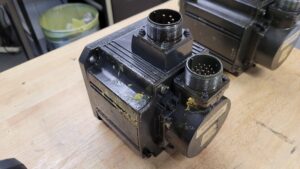
During incoming inspection, a visual check was performed first. Clear traces of emulsion and contamination were visible on the motor. Residues were especially present around the shaft sealing area and the encoder housing.
The insulation measurement showed reduced values. These were significantly below what is required for stable operation. At the same time, the encoder connection was checked. No obvious contact issues were found, but moisture influence could not be ruled out.
At this stage, it was already suspected that the combination of moisture ingress and insulation degradation was the root cause of the communication issue.
Technical Analysis
The OSA104S2 encoder is responsible for position feedback to the servo drive. This feedback is essential for control accuracy. Even small signal disturbances lead to incorrect torque calculation.
The cause effect chain could be reconstructed as follows:
Contamination and emulsion enter the motor
→ Moisture affects insulation and signal transmission
→ Encoder signal becomes unstable or fails intermittently
→ Servo drive receives incorrect position data
→ Torque control reacts incorrectly
→ Alarm 5A is triggered
The gradual progression is explained by the fact that contamination initially affects only small areas and spreads over time. At the same time, insulation typically deteriorates progressively under moisture exposure.
Repair Measures and Refurbishment
The motor was completely disassembled.
All assemblies were thoroughly cleaned, especially the stator area and the encoder section. Oil and emulsion residues were completely removed.
Insulation recovery was carried out through controlled drying and treatment.
The following functional units were reworked or replaced:
- Bearing system replaced
- Sealing system renewed to prevent future moisture ingress
- Encoder completely overhauled and recalibrated
- Electrical connections inspected and restored
Additional preventive measures were implemented:
- Improved sealing concept
- Inspection of cable entries
- Protection against future emulsion ingress
Final Functional Test
Testing was performed on a dedicated test bench with a suitable servo drive.
Test conditions:
- Multiple power on and off cycles
- Stable operation at low speed
- Clean feedback at medium speed
- High speed operation up to approx. 3000 rpm without issues
- Stable encoder signals across the full speed range
- Thermal monitoring under continuous operation
The system ran for an extended period without faults. No recurrence of alarm 5A.
Conclusion
The fault was not caused by a single defective component, but by a combination of environmental influence and gradual insulation degradation.
By overhauling the encoder, cleaning the motor, and improving sealing, a sustainable repair was achieved.
Especially in environments with emulsion or moisture, such damage often develops unnoticed over time and only becomes visible through faults at a later stage.
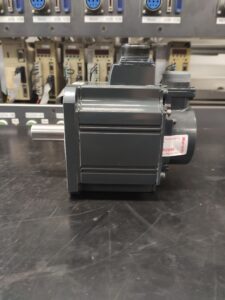
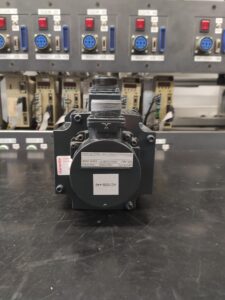
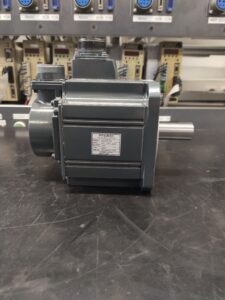
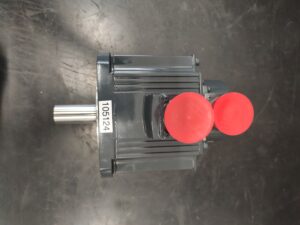
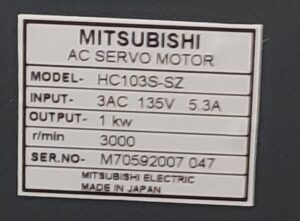
To mentioned Mitsubishi Motor:
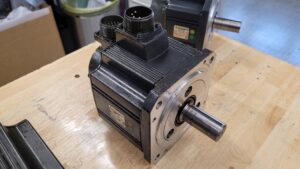
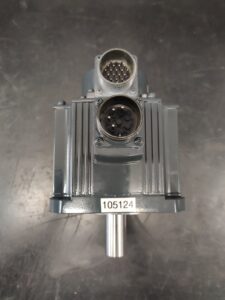
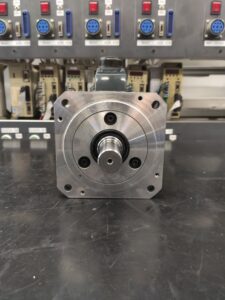
Mitsubishi HC103S-SZ / HC103S-A42 AC Servo Motor
Mitsubishi MDS-B-SVJ2-20 AC Servo Drive Unit
Encoder Mitsubishi OSA104S2
More details about our Mitsubishi repair services can be found here:
Mitsubishi motor Repair by Industrypart
📞 Feel free to contact us with any questions about your Mitsubishi drive technology.
Our expert team is happy to help!
Technical Specifications
Servo Motor
| Parameter | Value |
|---|
| Manufacturer | Mitsubishi |
| Device Type | AC Servo Motor |
| Model | HC103S-SZ |
| Series | HC Series |
| Power | approx. 1 kW |
| Input Voltage | 3AC 135 V |
| Output Voltage | approx. 135 V |
| Rated Current | approx. 5.3 A |
| Control Type | Servo |
| Feedback | Encoder OSA104S2 |
| Cooling | Self-cooled |
| Protection Class | approx. IP54 |
| Ambient Temperature | 0 to 40 °C |
| Mounting | Flange |
| Origin | Japan |
| Product Status | Discontinued / Service available |
Servo Drive
| Parameter | Value |
|---|
| Manufacturer | Mitsubishi |
| Device Type | Servo Drive |
| Model | MDS-B-SVJ2-20 |
| Series | MDS-B |
| Power | approx. 2 kW |
| Input Voltage | 3AC 200 V |
| Output Voltage | Variable |
| Rated Current | approx. 10 to 20 A |
| Control Type | CNC Servo |
| Feedback | Motor encoder |
| Cooling | Fan cooled |
| Protection Class | Cabinet installation |
| Ambient Temperature | 0 to 55 °C |
| Mounting | Control cabinet |
| Origin | Japan |
| Product Status | Spare parts available |
Application Environment and Use Cases
Typical machines include machine tools, machining centers, and automated production systems.
Typical applications are axis drives, feed drives, and positioning tasks.
These systems often operate in industrial environments with oil mist, chips, or emulsion.
High demands are placed on thermal stability, signal integrity, and electrical cleanliness.
Functional Description
The servo motor is controlled by the drive and receives regulated voltage for positioning.
The encoder provides position feedback to the drive. This feedback is essential for torque and position control.
Enable is done via the servo ON signal.
Protection functions monitor current, temperature, and signal quality.
Faulty feedback signals lead to shutdown to protect machine and operator.
Alarm Messages and Troubleshooting
| Alarm Code | Description | Possible Cause | Recommended Action |
|---|
| 10 | Undervoltage | Low supply voltage | Check power supply |
| 13 | Software error | Internal control issue | Check drive |
| 17 | A D error | Signal error | Check electronics |
| 18 | Encoder init error | No communication | Check cable or encoder |
| 2F | Encoder communication error | Signal interruption | Check wiring |
| 30 | Regeneration error | Excess energy | Check resistor |
| 31 | Overspeed | Speed too high | Check parameters |
| 32 | Overcurrent | Short circuit or load | Check motor |
| 46 | Motor overheat | Overload | Check cooling |
| 5A | Collision detection | Excessive torque | Check mechanics |
Source: Mitsubishi alarm table
Assembly Overview
| Assembly | Functional Name | Function | Inspection Notes |
|---|
| Stator | Winding unit | Torque generation | Check insulation |
| Rotor | Magnet carrier | Motion | Check mechanically |
| Bearings | Bearing system | Smooth rotation | Check wear |
| Encoder | Feedback system | Position signal | Check signal |
| Connector system | Electrical interface | Signal transmission | Check contacts |
| Sealing | Sealing system | Protection against ingress | Replace regularly |