20.07.2025 by Viktor Siebert
Small Cause, Big Impact: How a Faulty Fan Triggered a Communication Error at Fanuc A06B-6114-H303
Small Cause, Big Impact: How a Faulty Fan Triggered a Communication Error
A servo amplifier of type A06B-6114-H303 was brought to our workshop for express diagnostics by a well-known pharmaceutical manufacturer. The associated machine is reserved for prototyping and not in continuous operation, which made the failure all the more surprising. The customer had always been satisfied with the machine builder, but after around ten years of use, regular maintenance was no longer economically viable. As so often happens, the fault occurred at the most inconvenient time.
An inquiry to the machine manufacturer would have resulted in a waiting time of at least one week. A replacement unit would have cost around €5,000. Since our company was located just 20 km away, the customer opted for an express repair and delivered the unit personally.
On the same day, our team performed an initial inspection. The amplifier continuously displayed error code “P” on the unit display. At the same time, the test setup showed the CNC error message “604 X/Y/Z AXIS: AMP. COMMUNICATION ERROR”, indicating a communication failure between amplifier and control.
First, the control board, which includes the communication interface, was replaced with a reference module from our test stock. The error remained. Upon closer inspection, our technician noticed that one of the internal fans was not rotating. After replacing the fan, the unit immediately started up without issue when operated with our test board.
That initial relief faded quickly: when the customer’s original board was reinstalled, the communication error reappeared. A more in-depth analysis revealed that the defective fan had caused a short circuit, which overloaded the fan controller and surrounding circuitry. Several components on the board were damaged as a result.
Our technician proposed replacing the defective board with our tested spare unit. To get the customer back into production quickly, our sales department offered a suitable replacement board. Meanwhile, the entire amplifier was comprehensively overhauled. In addition to the board swap, the output stage was regenerated, and electrolytic capacitors, current measuring modules, and driver ICs were replaced preventively.
The complete repair was carried out in just 24 hours, and the customer was able to resume prototype production without delay.
This case clearly illustrates that a seemingly minor defect, like a stuck fan, can lead to extensive damage. Fans should be inspected regularly and replaced after their recommended operating hours to avoid heat damage or short circuits that can harm sensitive electronics.
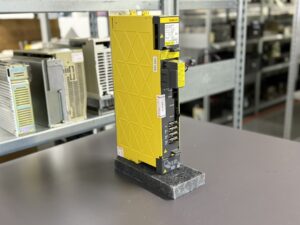
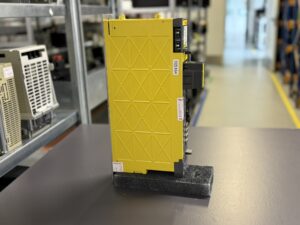
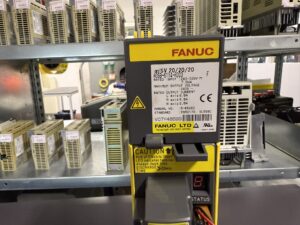
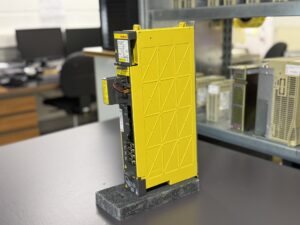
To mentioned Fanuc Drive: Fanuc A06B-6114-H303 Servo Amplifier
More details about our Fanuc repair services can be found here:
Fanuc drive Repair by Industrypart
📞 Feel free to contact us with any questions about your Fanuc drive technology.
Our expert team is happy to help!
Technical Specifications
| Parameter | Value |
|---|
| Model Number | A06B-6114-H303 |
| Type | aiSV 20/20/20 (3-axis servo amplifier) |
| Input Voltage | 283–339 V AC |
| Frequency | 50/60 Hz |
| Power Consumption | 5.5 kW |
| Max. Output Voltage | 240 V AC |
| Output Current | L/M/N axis: 6.5 A each |
| Weight | Approx. 6.5–8.5 kg (depending on configuration) |
| Protection Class | IP20 (typical for open-frame modules) |
| Manual Reference | B-65285EN |
Components (based on internal records)
| Type | Model Number | Qty |
|---|
| Control Board | A20B-2100-0742 | 1 |
| Power Board | A16B-2203-0698 | 1 |
| Power Section | — (not specified further) | 1 |
Alarm Codes & Troubleshooting (LED Display according to Manual B-65285EN/03, Section 3.2)
| Alarm | LED | Cause | Ref. |
|---|
| 1 | 1 | Internal cooling fan failure, fan cable or SVM defect | 3.2.1 |
| 2 | 2 | 24 V control power too low (from PSM), CXA2A/B cable defect | 3.2.2 |
| 5 | 5 | DC link undervoltage, poor short-bar connection | 3.2.3 |
| 6 | 6 | Overtemperature – harsh conditions or poor ventilation | 3.2.4 |
| F | F | Cooling fan of the heatsink stopped | 3.2.5 |
| P | P | Communication error (FSSB), defective cable or SVM | 3.2.6 |
| 8 | 8 | DC link current fault (e.g. phase short or ground fault) | 3.2.7 |
| 8./9./A. | 8./9./A. | IPM alarm (L/M/N axis) – usually phase short or hardware fault | 3.2.8 |
| b/c/d | b/c/d | DC link current error, motor ID mismatch, insulation failure | 3.2.10 |
| “U” | U | FSSB communication error via COP10B | 3.2.12 |
| “L” | L | FSSB communication error via COP10A | 3.2.13 |